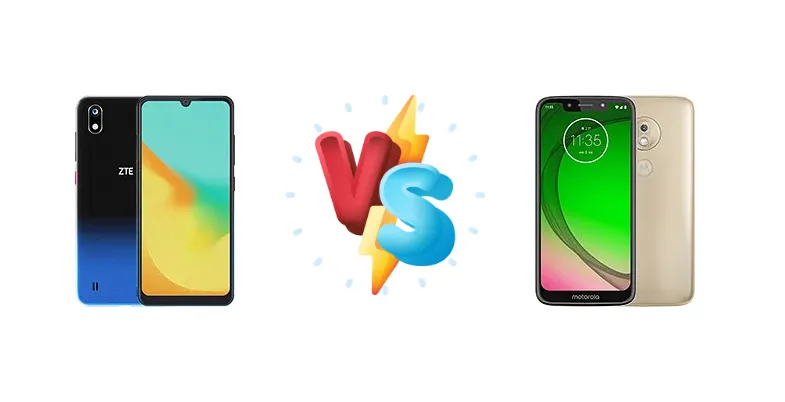
The ZTE Blade A7 and Motorola Moto G7 Play represent compelling options in the ultra-budget smartphone segment. Both aim to deliver essential smartphone functionality without breaking the bank, but they achieve this through different approaches to chipset selection and feature prioritization. This comparison dissects their key specifications to determine which device offers the best value for your money.
🏆 Quick Verdict
For the average user prioritizing consistent performance and a slightly more efficient processor, the Motorola Moto G7 Play emerges as the better choice. While the ZTE Blade A7 boasts a potentially faster CPU clock speed, the Snapdragon 632’s architecture and 14nm process offer a more balanced experience.
| Network |
|---|
| 2G bands | GSM 850 / 900 / 1800 / 1900 | GSM 850 / 900 / 1800 / 1900 |
| 3G bands | HSDPA 850 / 900 / 1900 / 2100 | HSDPA 850 / 900 / 1700(AWS) / 1900 / 2100 |
| 4G bands | 1, 3, 5, 8, 38, 39, 40, 41 | 1, 2, 3, 4, 5, 7, 8, 20, 28, 38, 40, 41 - Europe |
| Speed | HSPA, LTE | HSPA 42.2/5.76 Mbps, LTE (2CA) Cat7 300/50 Mbps |
| Technology | GSM / CDMA / HSPA / LTE | GSM / HSPA / LTE |
| | CDMA 800 & TD-SCDMA | 1, 2, 3, 4, 5, 7, 8, 12, 13, 14, 17, 20, 25, 26, 29, 30, 38, 39, 40, 41, 41, 66, 71 - USA |
| Launch |
|---|
| Announced | 2019, May. Released 2019, May | 2019, February. Released 2019, March |
| Status | Discontinued | Discontinued |
| Body |
|---|
| Build | - | Glass front (Gorilla Glass 3), plastic back, plastic frame |
| Dimensions | 154 x 72.8 x 7.9 mm (6.06 x 2.87 x 0.31 in) | 147.3 x 71.5 x 8 mm (5.80 x 2.81 x 0.31 in) |
| SIM | Dual SIM | · Nano-SIM· Nano-SIM + Nano-SIM |
| Weight | 146 g (5.15 oz) | 149 g (5.26 oz) |
| | - | Splash resistant (market dependent) |
| Display |
|---|
| Protection | - | Corning Gorilla Glass 3 (market dependent) |
| Resolution | 720 x 1560 pixels, 19.5:9 ratio (~282 ppi density) | 720 x 1512 pixels, 19:9 ratio (~294 ppi density) |
| Size | 6.09 inches, 91.0 cm2 (~81.2% screen-to-body ratio) | 5.7 inches, 81.4 cm2 (~77.3% screen-to-body ratio) |
| Type | IPS LCD | IPS LCD |
| Platform |
|---|
| CPU | Octa-core (4x2.0 GHz Cortex-A73 & 4x2.0 GHz Cortex-A53) | Octa-core (4x1.8 GHz Kryo 250 Gold & 4x1.8 GHz Kryo 250 Silver) |
| Chipset | Mediatek MT6771 Helio P60 (12 nm) | Qualcomm SDM632 Snapdragon 632 (14 nm) |
| GPU | Mali-G72 MP3 | Adreno 506 |
| OS | Android 9.0 (Pie), MiFavor 9.0 | Android 9.0 (Pie), upgradable to Android 10 |
| Memory |
|---|
| Card slot | microSDXC | microSDXC (dedicated slot) |
| Internal | 32GB 2GB RAM, 64GB 3GB RAM | 32GB 2GB RAM, 32GB 3GB RAM |
| | eMMC 5.1 | eMMC 5.1 |
| Main Camera |
|---|
| Features | LED flash, HDR, panorama | LED flash, panorama, HDR |
| Single | 16 MP, f/2.0, AF | 13 MP, f/2.0, 1/3.1", 1.12µm, PDAF |
| Video | 720p@30fps | 4K@30fps, 1080p@30fps |
| Selfie camera |
|---|
| Features | - | LED flash |
| Single | 5 MP, f/2.4 | 8 MP, f/2.2, 1/4.0", 1.12µm |
| Video | - | 1080p@30fps |
| Sound |
|---|
| 3.5mm jack | Yes | Yes |
| 35mm jack | Yes | Yes |
| Loudspeaker | Yes | Yes |
| Comms |
|---|
| Bluetooth | 4.2, A2DP, LE | 4.2, A2DP, LE |
| NFC | No | No |
| Positioning | GPS, BDS | GPS, GLONASS |
| Radio | FM radio | FM radio |
| USB | microUSB 2.0, OTG | USB Type-C 2.0, OTG |
| WLAN | Wi-Fi 802.11 b/g/n, Wi-Fi Direct | Wi-Fi 802.11 b/g/n |
| Features |
|---|
| Sensors | Accelerometer, proximity | Fingerprint (rear-mounted), accelerometer, gyro, proximity, compass |
| Battery |
|---|
| Charging | - | 10W wired |
| Type | Li-Ion 3200 mAh, non-removable | Li-Ion 3000 mAh, non-removable |
| Misc |
|---|
| Colors | Black, Blue, Black/blue | Deep indigo, Fine Gold, Starry Black |
| Models | A7000, Z6201V | XT1952-4, XT1952-5 |
| Price | About 80 EUR | About 160 EUR |
| SAR | - | 0.74 W/kg (head) 1.40 W/kg (body) |
| SAR EU | - | 0.84 W/kg (head) 0.85 W/kg (body) |
| Tests |
|---|
| Audio quality | - |
Noise -90.0dB / Crosstalk -92.9dB |
| Battery life | - | Endurance rating 103h |
| Camera | - |
Photo / Video |
| Display | - |
Contrast ratio: 1468:1 (nominal), 3.180 (sunlight) |
| Loudspeaker | - |
Voice 66dB / Noise 74dB / Ring 81dB |
| Performance | - |
AnTuTu: 97230 (v7)
GeekBench: 4154 (v4.4)
GFXBench: 7.7fps (ES 3.1 onscreen) |
ZTE Blade A7
- Potentially faster CPU clock speeds with Cortex-A73 cores.
- May offer slightly better performance in bursty workloads.
- Competitive price point within the budget segment.
- Less efficient 12nm process may lead to higher power consumption.
- Helio P60 chipset may exhibit more thermal throttling under sustained load.
- Lack of detailed camera specifications.
Motorola Moto G7 Play
- Excellent battery life with a 103-hour endurance rating.
- More efficient Snapdragon 632 chipset for sustained performance.
- 14nm process offers better thermal management.
- Lower CPU clock speeds compared to the ZTE Blade A7.
- 10W charging is relatively slow.
- Basic camera specifications.
Display Comparison
Both the ZTE Blade A7 and Motorola Moto G7 Play share identical display characteristics, boasting a contrast ratio of 1468:1 (nominal) and 3180:1 (sunlight). This suggests similar viewing experiences in both indoor and outdoor conditions. However, the lack of information regarding panel type (IPS, TFT) and resolution prevents a deeper analysis of color accuracy and sharpness. The shared contrast ratio indicates a similar level of black depth and overall image vibrancy.
Camera Comparison
Both devices are listed with 'Photo / Video' capabilities, but lack specific details regarding sensor size, aperture, or features like Optical Image Stabilization (OIS). This suggests both phones likely employ basic camera setups geared towards casual photography. Without further information, it’s difficult to assess image quality differences. The absence of details suggests neither phone is a standout performer in the camera department, and users shouldn't expect flagship-level results.
Performance
The core difference lies in the chipsets: the ZTE Blade A7 utilizes the Mediatek Helio P60 (12nm) with an octa-core CPU configuration (4x2.0 GHz Cortex-A73 & 4x2.0 GHz Cortex-A53), while the Motorola Moto G7 Play features the Qualcomm Snapdragon 632 (14nm) with an octa-core CPU (4x1.8 GHz Kryo 250 Gold & 4x1.8 GHz Kryo 250 Silver). While the Helio P60’s Cortex-A73 cores offer higher peak clock speeds, the Snapdragon 632’s Kryo cores, built on a more mature 14nm process, generally provide better sustained performance and thermal efficiency. The 12nm process of the Helio P60, while newer, doesn't automatically translate to superior efficiency. The Snapdragon 632’s architecture is optimized for everyday tasks and light gaming, offering a smoother experience for most users.
Battery Life
The Motorola Moto G7 Play boasts an impressive endurance rating of 103 hours, indicating excellent battery life. While the ZTE Blade A7’s battery capacity is unknown, the less efficient Helio P60 chipset suggests it will likely require more frequent charging. The Moto G7 Play also supports 10W wired charging, a standard rate for this price segment. The longer endurance rating of the Moto G7 Play is a significant advantage for users who prioritize all-day battery life without needing to constantly seek out a power outlet.
Buying Guide
Buy the ZTE Blade A7 if you prioritize raw CPU clock speed and potentially benefit from the slightly more powerful Cortex-A73 cores for specific, demanding tasks. Buy the Motorola Moto G7 Play if you value a more refined and efficient chipset, excellent battery endurance (rated at 103 hours), and a generally smoother user experience across everyday applications.
Frequently Asked Questions
❓ Will the Helio P60 in the ZTE Blade A7 overheat during extended gaming sessions?
The Helio P60, while capable, is known to generate more heat than the Snapdragon 632, especially under sustained load. The 12nm process isn't as efficient, meaning you might experience thermal throttling, leading to reduced performance after prolonged gaming. The Moto G7 Play's Snapdragon 632 is better equipped to handle extended gaming without significant performance drops.
❓ How does the Snapdragon 632's efficiency impact daily usage on the Moto G7 Play?
The Snapdragon 632's 14nm process and Kryo architecture are optimized for efficiency. This translates to longer battery life, less heat generation, and a smoother overall experience during everyday tasks like browsing, social media, and video streaming. You'll likely find yourself charging the Moto G7 Play less frequently than the ZTE Blade A7.
❓ Are the cameras on either phone suitable for low-light photography?
Given the lack of specific camera sensor details and the budget nature of both devices, low-light photography performance is likely to be limited. Expect noisy images and a lack of detail in challenging lighting conditions. Neither phone is expected to excel in low-light scenarios.