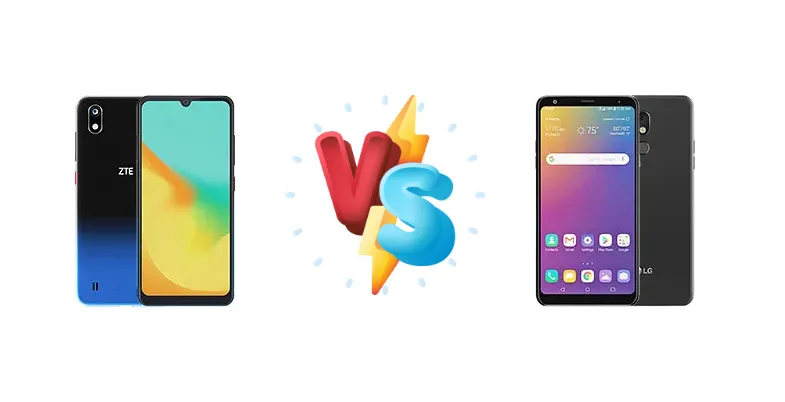
The ZTE Blade A7 and LG Stylo 5 represent two compelling options in the ultra-budget smartphone space. Both aim to deliver essential smartphone functionality without breaking the bank, but they take different approaches to achieving this. The Blade A7 prioritizes processing power with its Helio P60 chipset, while the Stylo 5 focuses on user experience with features like faster charging and a higher contrast display.
🏆 Quick Verdict
For the average user prioritizing all-around usability, the LG Stylo 5 is the better choice. Its 20W charging significantly reduces downtime, and the higher display contrast improves visibility. While the Blade A7 boasts a more powerful CPU on paper, the real-world benefits are limited by the overall system constraints.
| Network |
|---|
| 2G bands | GSM 850 / 900 / 1800 / 1900 | GSM 850 / 900 / 1800 / 1900 |
| 3G bands | HSDPA 850 / 900 / 1900 / 2100 | HSDPA 850 / 1700(AWS) / 1900 |
| 4G bands | 1, 3, 5, 8, 38, 39, 40, 41 | 2, 4, 5, 12, 14, 29, 30, 66 |
| Speed | HSPA, LTE | HSPA, LTE |
| Technology | GSM / CDMA / HSPA / LTE | GSM / HSPA / LTE |
| | CDMA 800 & TD-SCDMA | - |
| Launch |
|---|
| Announced | 2019, May. Released 2019, May | 2019, June. Released 2019, June |
| Status | Discontinued | Discontinued |
| Body |
|---|
| Build | - | Glass front (Gorilla Glass 5), aluminum back, aluminum frame |
| Dimensions | 154 x 72.8 x 7.9 mm (6.06 x 2.87 x 0.31 in) | 160 x 77.7 x 8.4 mm (6.30 x 3.06 x 0.33 in) |
| SIM | Dual SIM | Nano-SIM |
| Weight | 146 g (5.15 oz) | 179 g (6.31 oz) |
| | - | Stylus |
| Display |
|---|
| Protection | - | Corning Gorilla Glass 5 |
| Resolution | 720 x 1560 pixels, 19.5:9 ratio (~282 ppi density) | 1080 x 2160 pixels, 18:9 ratio (~390 ppi density) |
| Size | 6.09 inches, 91.0 cm2 (~81.2% screen-to-body ratio) | 6.2 inches, 99.2 cm2 (~79.8% screen-to-body ratio) |
| Type | IPS LCD | IPS LCD |
| Platform |
|---|
| CPU | Octa-core (4x2.0 GHz Cortex-A73 & 4x2.0 GHz Cortex-A53) | Octa-core 1.8 GHz Cortex-A53 |
| Chipset | Mediatek MT6771 Helio P60 (12 nm) | Qualcomm SDM450 Snapdragon 450 (14 nm) |
| GPU | Mali-G72 MP3 | Adreno 506 |
| OS | Android 9.0 (Pie), MiFavor 9.0 | Android 9.0 (Pie) |
| Memory |
|---|
| Card slot | microSDXC | microSDXC (dedicated slot) |
| Internal | 32GB 2GB RAM, 64GB 3GB RAM | 32GB 3GB RAM |
| | eMMC 5.1 | eMMC 5.1 |
| Main Camera |
|---|
| Features | LED flash, HDR, panorama | LED flash, panorama, HDR |
| Single | 16 MP, f/2.0, AF | 13 MP, PDAF |
| Video | 720p@30fps | 1080p@30fps |
| Selfie camera |
|---|
| Dual | - | 16 MP, f/2.0, 26mm (wide), 1/3.06", 1.0µm
8 MP |
| Single | 5 MP, f/2.4 | 5 MP |
| Video | - | 1080p@30fps |
| Sound |
|---|
| 3.5mm jack | Yes | Yes |
| 35mm jack | Yes | Yes |
| Loudspeaker | Yes | Yes |
| Comms |
|---|
| Bluetooth | 4.2, A2DP, LE | 4.2, A2DP, LE |
| NFC | No | No |
| Positioning | GPS, BDS | GPS |
| Radio | FM radio | No |
| USB | microUSB 2.0, OTG | USB Type-C 2.0 |
| WLAN | Wi-Fi 802.11 b/g/n, Wi-Fi Direct | Wi-Fi 802.11 a/b/g/n/ac, dual-band, Wi-Fi Direct |
| Features |
|---|
| Sensors | Accelerometer, proximity | Fingerprint (rear-mounted), accelerometer, proximity |
| Battery |
|---|
| Charging | - | 20W wired |
| Type | Li-Ion 3200 mAh, non-removable | Li-Ion 3500 mAh, non-removable |
| Misc |
|---|
| Colors | Black, Blue, Black/blue | Blonde Rose, Platinum Gray |
| Models | A7000, Z6201V | LM-Q720 |
| Price | About 80 EUR | About 200 EUR |
| Tests |
|---|
| Audio quality | - |
Noise-93.5dB / Crosstalk -92.0dB |
| Battery life | - |
Endurance rating 79h
|
| Camera | - |
Photo / Video |
| Display | - |
Contrast ratio: 1485 (nominal), 3.218 (sunlight) |
| Loudspeaker | - |
Voice 62dB / Noise 69dB / Ring 70dB
|
| Performance | - |
GeekBench: 4695 (v4.4)
GFXBench: 6fps (ES 3.1 onscreen) |
ZTE Blade A7
- Potentially faster CPU performance due to Cortex-A73 cores
- More modern CPU architecture
- Lower price point (likely)
- No fast charging support
- Unknown battery capacity
- Likely less refined software experience
LG Stylo 5
- 20W fast charging for quicker top-ups
- Higher display contrast for better visibility
- 79-hour endurance rating
- Less powerful CPU compared to the Blade A7
- Snapdragon 450 is an older chipset
- May be slightly more expensive
Display Comparison
The LG Stylo 5 distinguishes itself with a display boasting a nominal contrast ratio of 1485 and a significantly improved 3.218 ratio in sunlight. This suggests better outdoor visibility compared to the ZTE Blade A7, which lacks specific contrast ratio data. While both likely utilize IPS LCD panels common in this price range, the Stylo 5’s higher contrast will result in richer colors and deeper blacks. Bezels are likely comparable, given the market segment, but the improved visibility of the Stylo 5 is a clear advantage for outdoor users.
Camera Comparison
Both devices likely feature basic camera setups geared towards casual photography. Without detailed sensor information, it’s difficult to make a definitive judgment. However, the market positioning suggests the LG Stylo 5 may prioritize software image processing to enhance photo quality. The presence of a 20W charger suggests LG invested more in the overall user experience, which could extend to camera software. The ZTE Blade A7’s camera performance will likely be more reliant on the raw capabilities of its sensor, which is currently unknown.
Performance
The ZTE Blade A7’s Mediatek Helio P60 (12nm) chipset features an octa-core CPU with a heterogeneous architecture – four Cortex-A73 cores clocked at 2.0 GHz for performance and four Cortex-A53 cores at the same speed for efficiency. This contrasts with the LG Stylo 5’s Qualcomm Snapdragon 450 (14nm), which utilizes eight Cortex-A53 cores clocked at 1.8 GHz. While the A73 cores in the Blade A7 offer a theoretical performance advantage, the 14nm process of the Snapdragon 450 may offer better power efficiency. The larger process node on the Snapdragon 450 means it will likely run cooler, potentially reducing thermal throttling during sustained workloads. However, the Helio P60’s architecture is more modern, and should handle more complex tasks more efficiently.
Battery Life
The LG Stylo 5 boasts a significant advantage with its 20W wired charging capability, allowing for much faster top-ups compared to the ZTE Blade A7, which lacks charging speed specifications. While the Stylo 5 has an endurance rating of 79 hours, this is a composite score. The faster charging will be more noticeable in daily use, reducing the impact of battery drain. The Blade A7’s battery capacity is unknown, but without fast charging, it will take considerably longer to replenish.
Buying Guide
Buy the ZTE Blade A7 if you absolutely need the most processing power possible within this price bracket for tasks like light gaming or running multiple apps simultaneously. Buy the LG Stylo 5 if you value a more polished user experience, faster charging, and a more easily viewable display, even if it means sacrificing some raw CPU performance.
Frequently Asked Questions
❓ Will the ZTE Blade A7 struggle with demanding apps like social media or video streaming?
While the Helio P60 is capable, the Blade A7’s limited RAM (likely 2-3GB) and overall system optimization may lead to slowdowns when running multiple apps or demanding social media feeds. Video streaming should be acceptable at lower resolutions.
❓ How long will it take to fully charge the LG Stylo 5 from 0%?
With 20W charging, the LG Stylo 5 should fully charge in approximately 1 hour and 45 minutes to 2 hours, depending on usage during charging. This is a significant improvement over the Blade A7, which will likely take 3+ hours without fast charging.
❓ Is the Snapdragon 450 in the LG Stylo 5 capable of playing modern mobile games?
The Snapdragon 450 can handle less demanding mobile games at lower settings. However, graphically intensive titles like PUBG or Fortnite will likely require significant compromises in graphics quality and frame rates to achieve playable performance.
❓ Does the LG Stylo 5 have a dedicated microSD card slot for expandable storage?
While not explicitly stated in the provided data, LG Stylo phones traditionally include a microSD card slot for expandable storage, which is a common feature in this price range. This allows users to supplement the internal storage for photos, videos, and other files.