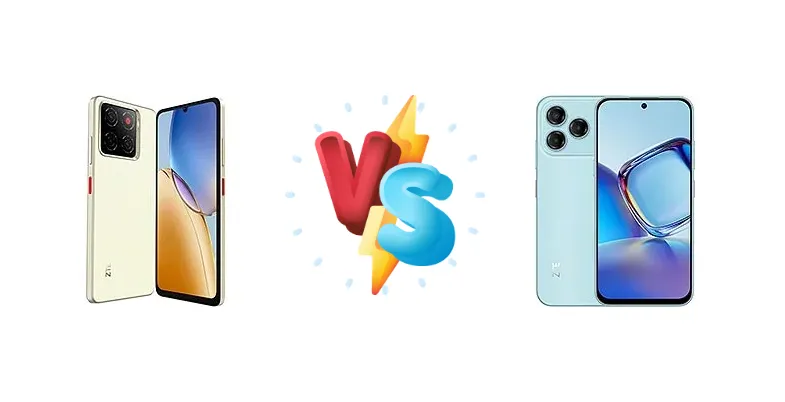
ZTE's Blade series consistently delivers value, but the A56 and V80 Design represent slightly different approaches to the budget smartphone market. The A56 prioritizes endurance, while the V80 Design focuses on quicker charging and a modest performance bump. This comparison dissects the key differences to determine which device best suits your needs.
🏆 Quick Verdict
For most users, the ZTE Blade V80 Design is the better choice. Its faster Unisoc T7280 chipset and significantly quicker 22.5W charging outweigh the A56’s longer battery endurance, offering a more responsive and convenient experience. The reverse charging capability is a bonus.
| Network |
|---|
| 2G bands | GSM 850 / 900 / 1800 / 1900 | GSM 850 / 900 / 1800 / 1900 |
| 3G bands | HSDPA 850 / 900 / 1900 / 2100 | HSDPA 850 / 900 / 1900 / 2100 |
| 4G bands | 1, 3, 5, 7, 8, 20, 28, 38, 40, 41 | 1, 3, 5, 7, 8, 20, 28, 38, 40, 41 |
| Speed | HSPA, LTE | HSPA, LTE |
| Technology | GSM / HSPA / LTE | GSM / HSPA / LTE |
| Launch |
|---|
| Announced | 2025, June 11 | 2025, November 10 |
| Status | Available. Released 2025, July | Available. Released 2025, November |
| Body |
|---|
| Build | - | Glass front, plastic frame |
| Dimensions | 167.6 x 77.4 x 8.3 mm (6.60 x 3.05 x 0.33 in) | 166 x 79 x 7.7 mm (6.54 x 3.11 x 0.30 in) |
| SIM | Nano-SIM + Nano-SIM | Nano-SIM + Nano-SIM |
| Weight | 193 g (6.81 oz) | 191 g (6.74 oz) |
| Display |
|---|
| Protection | Mohs level 4 | - |
| Resolution | 720 x 1600 pixels, 20:9 ratio (~260 ppi density) | 900 x 1940 pixels, 19.5:9 ratio (~317 ppi density) |
| Size | 6.75 inches, 110.0 cm2 (~84.8% screen-to-body ratio) | 6.75 inches, 112.2 cm2 (~85.6% screen-to-body ratio) |
| Type | IPS LCD, 90Hz | IPS LCD, 120Hz, 1000 nits (HBM) |
| Platform |
|---|
| CPU | Octa-core (2x1.6 GHz Cortex-A75 & 6x1.6 GHz Cortex-A55) | Octa-core (2x2.2 GHz Cortex-A75 & 6x2.0 GHz Cortex-A55) |
| Chipset | Unisoc T7200 (12 nm) | Unisoc T7280 (12 nm) |
| GPU | Mali-G57 MP1 | Mali-G57 MP1 |
| OS | Android 15 | Android 16 |
| Memory |
|---|
| Card slot | microSDXC (dedicated slot) | Unspecified |
| Internal | 64GB 4GB RAM, 128GB 4GB RAM | 256GB 8GB RAM |
| Main Camera |
|---|
| Dual | - | 50 MP, f/1.8, (wide), PDAF
Auxiliary lens |
| Features | LED flash | LED flash, HDR, panorama |
| Single | 13 MP, AF
Auxiliary lenses | - |
| Video | 1080p@30fps | 1080p@30fps |
| Selfie camera |
|---|
| Single | 8 MP | 16 MP |
| Video | Yes | 1080p@30fps |
| Sound |
|---|
| 35mm jack | Yes | Yes |
| Loudspeaker | Yes | Yes |
| Comms |
|---|
| Bluetooth | 5.2, A2DP, LE | 5.2, A2DP, LE |
| NFC | No | Yes (market/region dependent) |
| Positioning | GPS, GALILEO, GLONASS | GPS, GALILEO, GLONASS |
| Radio | FM radio | Unspecified |
| USB | USB Type-C 2.0, OTG | USB Type-C 2.0, OTG |
| WLAN | Wi-Fi 802.11 b/g/n | Wi-Fi 802.11 a/b/g/n/ac, dual-band |
| Features |
|---|
| Sensors | Fingerprint (side-mounted), accelerometer | Fingerprint (side-mounted), accelerometer, proximity, compass |
| Battery |
|---|
| Charging | 10W wired | 22.5W wired
10W reverse wired |
| Type | Li-Po 5000 mAh | 5000 mAh |
| Misc |
|---|
| Colors | Black, Yellow | Midnight Black, Pale Amber, Celadon Cyan, Peach Fuzz |
| Models | Z2473 | Z2575 |
| Price | € 69.00 / $ 87.12 / £ 66.75 | About 120 EUR |
| EU LABEL |
|---|
| Battery | 56:03h endurance, 800 cycles | - |
| Energy | Class A | - |
| Free fall | Class D (80 falls) | - |
| Repairability | Class B | - |
ZTE Blade A56
- Exceptional battery endurance (56:03h)
- Long-term battery health (800 cycles)
- More affordable price point (likely)
- Slower processor (Unisoc T7200)
- Slow 10W charging
- Lacks reverse charging
ZTE Blade V80 Design
- Faster processor (Unisoc T7280)
- Significantly faster 22.5W charging
- Convenient 10W reverse wired charging
- Potentially shorter battery life compared to A56
- May be slightly more expensive
Display Comparison
Both devices likely feature LCD panels, typical for this price bracket. Specifics like resolution and brightness are not provided, but the focus here is on internal performance. The absence of high refresh rate technology on either device suggests a focus on power efficiency rather than visual fluidity.
Camera Comparison
Without detailed camera specifications, a direct comparison is difficult. However, it’s safe to assume both phones utilize budget-friendly sensors. The focus should be on image processing capabilities, which are tied to the chipset. The V80 Design’s more powerful processor likely allows for faster image processing and potentially better low-light performance, though this remains speculative without sample images. We can expect both phones to struggle with complex scenes and dynamic range.
Performance
The ZTE Blade V80 Design boasts the Unisoc T7280 chipset, featuring two Cortex-A75 cores clocked at 2.2 GHz and six Cortex-A55 cores at 2.0 GHz. This is a step up from the A56’s Unisoc T7200, which has 2x1.6 GHz Cortex-A75 and 6x1.6 GHz Cortex-A55 cores. The higher clock speeds on the V80 Design translate to noticeably snappier performance in everyday tasks and a smoother experience with demanding applications. While both chipsets are built on a 12nm process, the architectural improvements in the T7280 provide a tangible benefit.
Battery Life
The ZTE Blade A56 claims 56:03h of endurance based on 800 charge cycles, suggesting a focus on long-term battery health and sustained usage. However, the V80 Design compensates for potentially slightly lower endurance with its 22.5W wired charging, a significant upgrade over the A56’s 10W charging. This means the V80 Design can replenish its battery much faster, minimizing downtime. The inclusion of 10W reverse wired charging on the V80 Design is a unique feature, allowing it to charge other devices, like earbuds or smartwatches, albeit slowly.
Buying Guide
Buy the ZTE Blade A56 if you absolutely prioritize maximizing screen-on time and are willing to trade off charging speed and processing power. This phone is ideal for users who primarily use their phone for basic tasks like calls, texts, and light social media. Buy the ZTE Blade V80 Design if you value faster performance for multitasking and gaming, and appreciate the convenience of rapid charging and the added functionality of reverse wireless charging. This is the better option for users who demand a more responsive experience.
Frequently Asked Questions
❓ How much faster is the charging on the ZTE Blade V80 Design compared to the A56?
The V80 Design’s 22.5W charging is more than double the speed of the A56’s 10W charging. This translates to a significantly reduced charging time, allowing you to quickly top up your battery when needed. Expect a full charge on the V80 Design to take considerably less time than on the A56.
❓ Will I notice a difference in performance when multitasking on the ZTE Blade V80 Design?
Yes, the Unisoc T7280 in the V80 Design offers a noticeable performance improvement over the T7200 in the A56, particularly when multitasking. The higher clock speeds of the A75 cores will result in smoother app switching and a more responsive user experience when running multiple applications simultaneously.
❓ Is the reverse charging feature on the V80 Design useful for everyday use?
While 10W reverse charging isn't incredibly fast, it's a convenient feature for topping up accessories like wireless earbuds, smartwatches, or even a friend's phone in a pinch. It provides a level of versatility not found on the A56.