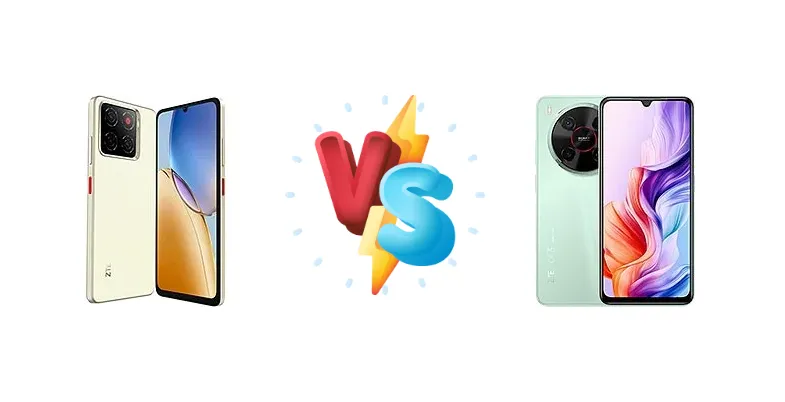
ZTE's Blade series consistently targets the value-conscious consumer, but even within that segment, choices must be made. The Blade A56 and V70 Max both utilize the Unisoc T7200 chipset, creating a surprisingly close contest. However, a key divergence emerges in their battery and charging strategies, making one a champion of longevity while the other prioritizes rapid replenishment.
🏆 Quick Verdict
For users prioritizing maximum uptime between charges, the ZTE Blade A56 is the clear winner, boasting 56:03 hours of endurance. However, if you frequently find yourself needing a quick power boost, the V70 Max’s 22.5W charging significantly reduces downtime, making it ideal for power users.
| Network |
|---|
| 2G bands | GSM 850 / 900 / 1800 / 1900 | GSM 850 / 900 / 1800 / 1900 |
| 3G bands | HSDPA 850 / 900 / 1900 / 2100 | HSDPA 850 / 900 / 1900 / 2100 - International |
| 4G bands | 1, 3, 5, 7, 8, 20, 28, 38, 40, 41 | 1, 3, 5, 7, 8, 20, 28, 38, 40, 41 - International |
| Speed | HSPA, LTE | HSPA, LTE |
| Technology | GSM / HSPA / LTE | GSM / HSPA / LTE |
| Launch |
|---|
| Announced | 2025, June 11 | 2025, February 02 |
| Status | Available. Released 2025, July | Available. Released 2025, February 15 |
| Body |
|---|
| Dimensions | 167.6 x 77.4 x 8.3 mm (6.60 x 3.05 x 0.33 in) | 171.8 x 78.4 x 8.3 mm (6.76 x 3.09 x 0.33 in) |
| SIM | Nano-SIM + Nano-SIM | Nano-SIM + Nano-SIM |
| Weight | 193 g (6.81 oz) | - |
| Display |
|---|
| Protection | Mohs level 4 | Mohs level 4 |
| Resolution | 720 x 1600 pixels, 20:9 ratio (~260 ppi density) | 720 x 1640 pixels (~260 ppi density) |
| Size | 6.75 inches, 110.0 cm2 (~84.8% screen-to-body ratio) | 6.9 inches, 113.1 cm2 (~83.9% screen-to-body ratio) |
| Type | IPS LCD, 90Hz | IPS LCD, 120Hz |
| Platform |
|---|
| CPU | Octa-core (2x1.6 GHz Cortex-A75 & 6x1.6 GHz Cortex-A55) | Octa-core (2x1.6 GHz Cortex-A75 & 6x1.6 GHz Cortex-A55) |
| Chipset | Unisoc T7200 (12 nm) | Unisoc T7200 (12 nm) |
| GPU | Mali-G57 MP1 | Mali-G57 MP1 |
| OS | Android 15 | Android 15 |
| Memory |
|---|
| Card slot | microSDXC (dedicated slot) | microSDXC (dedicated slot) |
| Internal | 64GB 4GB RAM, 128GB 4GB RAM | 128GB 4GB RAM, 128GB 6GB RAM, 128GB 8GB RAM, 256GB 4GB RAM |
| Main Camera |
|---|
| Dual | - | 50 MP, f/1.8, (wide), PDAF
Auxiliary lenses |
| Features | LED flash | LED flash, HDR, panorama |
| Single | 13 MP, AF
Auxiliary lenses | - |
| Video | 1080p@30fps | 1080p@30fps |
| Selfie camera |
|---|
| Single | 8 MP | 8 MP |
| Video | Yes | Yes |
| Sound |
|---|
| 35mm jack | Yes | Yes |
| Loudspeaker | Yes | Yes |
| Comms |
|---|
| Bluetooth | 5.2, A2DP, LE | 5.2, A2DP, LE |
| NFC | No | Yes (market/region dependent) |
| Positioning | GPS, GALILEO, GLONASS | GPS, GALILEO, GLONASS |
| Radio | FM radio | Unspecified |
| USB | USB Type-C 2.0, OTG | USB Type-C 2.0 |
| WLAN | Wi-Fi 802.11 b/g/n | Wi-Fi 802.11 a/b/g/n/ac, dual-band |
| Features |
|---|
| Sensors | Fingerprint (side-mounted), accelerometer | Fingerprint (side-mounted), accelerometer, proximity |
| Battery |
|---|
| Charging | 10W wired | 22.5W wired |
| Type | Li-Po 5000 mAh | 6000 mAh |
| Misc |
|---|
| Colors | Black, Yellow | Purple, Green, Pink |
| Models | Z2473 | Z2467 |
| Price | € 69.00 / $ 87.12 / £ 66.75 | € 79.00 |
| EU LABEL |
|---|
| Battery | 56:03h endurance, 800 cycles | 52:00h endurance, 800 cycles |
| Energy | Class A | Class B |
| Free fall | Class D (80 falls) | Class B (200 falls) |
| Repairability | Class B | Class B |
ZTE Blade A56
- Exceptional battery endurance (56:03h)
- Identical CPU performance to V70 Max
- Long-term battery health with 800 cycles
- Slow 10W charging
- Likely basic display technology
ZTE Blade V70 Max
- Faster 22.5W charging
- Identical CPU performance to A56
- Long-term battery health with 800 cycles
- Slightly lower battery endurance (52:00h)
- Likely basic display technology
Display Comparison
Both devices lack detailed display specifications in the provided data. Given their price point, we can anticipate LCD panels with 720p+ resolution. The absence of information regarding refresh rates or peak brightness suggests standard 60Hz panels with typical brightness levels for this segment. Bezels are likely to be noticeable, prioritizing cost-effectiveness over premium aesthetics.
Camera Comparison
The provided data doesn't detail camera specifications beyond the chipset. In this price bracket, camera performance is rarely a standout feature. We can expect a primary camera, likely around 13-50MP, and potentially auxiliary lenses for depth sensing or macro photography. Image processing will be software-driven, aiming for acceptable results in good lighting conditions. The absence of OIS suggests image stabilization will be limited, impacting low-light performance.
Performance
Both the ZTE Blade A56 and V70 Max are powered by the Unisoc T7200 (12nm) chipset, featuring an octa-core configuration with 2x1.6 GHz Cortex-A75 and 6x1.6 GHz Cortex-A55 cores. This indicates identical CPU performance. The 12nm fabrication process, while not leading-edge, offers a reasonable balance between power efficiency and performance. The lack of information on RAM configuration means performance will be heavily influenced by the amount of RAM installed, but the chipset itself is the limiting factor for demanding tasks. Thermal management will likely be passive, relying on the phone's chassis to dissipate heat.
Battery Life
The core difference lies in battery endurance and charging. The Blade A56 achieves an impressive 56:03 hours of endurance, suggesting excellent power efficiency. The V70 Max, while still respectable at 52:00 hours, falls slightly behind. However, the V70 Max compensates with 22.5W wired charging, a significant upgrade over the A56’s 10W charging. This translates to a substantially faster 0-100% charge time for the V70 Max, potentially shaving off an hour or more compared to the A56. Both devices are rated for 800 charge cycles, indicating similar long-term battery health.
Buying Guide
Buy the ZTE Blade A56 if you need a phone that can reliably last through a full day – and then some – on a single charge, and aren't concerned about the fastest possible charging speeds. This is the phone for travelers, commuters, or anyone who dislikes the constant search for an outlet. Buy the ZTE Blade V70 Max if you prefer the convenience of faster charging, even if it means slightly less overall battery endurance. This phone suits users who actively use their devices throughout the day and need to quickly top up their battery during short breaks.
Frequently Asked Questions
❓ How much faster is the charging on the ZTE Blade V70 Max compared to the A56 in real-world use?
While exact times depend on usage, the 22.5W charging on the V70 Max will likely reduce a full charge time by at least 60-90 minutes compared to the A56’s 10W charging. This is a substantial difference for users who frequently need to top up their battery.
❓ Will the Unisoc T7200 chipset struggle with demanding games like PUBG or Call of Duty?
The Unisoc T7200 is a budget-focused chipset. While it can handle less demanding games, you'll likely need to lower graphics settings and resolution to achieve playable frame rates in titles like PUBG or Call of Duty. Expect some stuttering and potential overheating during extended gaming sessions.
❓ Does the difference in battery endurance (56:03h vs 52:00h) translate to a noticeable difference in daily use?
Yes, the 4+ hour difference in endurance is significant. For average users, the A56 could easily last a full day and a half on a single charge, while the V70 Max might require a top-up before the end of the day with moderate to heavy use.