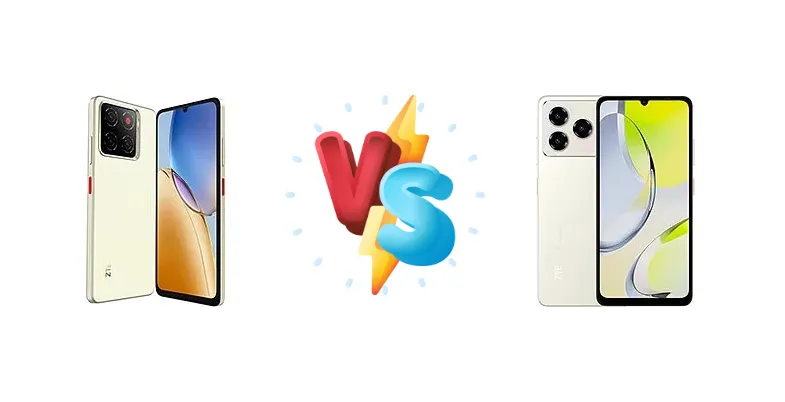
The ZTE Blade A56 and A76 4G represent ZTE’s commitment to the affordable smartphone market. While both aim to deliver essential features at a competitive price, they diverge in key areas like processing power and charging capabilities. This comparison dissects these differences to determine which device offers the best value for your money.
🏆 Quick Verdict
For most users, the ZTE Blade A76 4G emerges as the better choice. Its significantly faster 22.5W charging capability offsets the slightly shorter battery endurance, providing a more convenient user experience. While the A56 boasts a more modern CPU architecture, the real-world performance gains are likely minimal for typical tasks.
| Network |
|---|
| 2G bands | GSM 850 / 900 / 1800 / 1900 | GSM 850 / 900 / 1800 / 1900 |
| 3G bands | HSDPA 850 / 900 / 1900 / 2100 | HSDPA 850 / 900 / 1900 / 2100 |
| 4G bands | 1, 3, 5, 7, 8, 20, 28, 38, 40, 41 | LTE |
| Speed | HSPA, LTE | HSPA, LTE |
| Technology | GSM / HSPA / LTE | GSM / HSPA / LTE |
| Launch |
|---|
| Announced | 2025, June 11 | 2025, October |
| Status | Available. Released 2025, July | Available. Released 2025, October |
| Body |
|---|
| Dimensions | 167.6 x 77.4 x 8.3 mm (6.60 x 3.05 x 0.33 in) | - |
| SIM | Nano-SIM + Nano-SIM | Nano-SIM + Nano-SIM |
| Weight | 193 g (6.81 oz) | - |
| Display |
|---|
| Protection | Mohs level 4 | Mohs level 4 |
| Resolution | 720 x 1600 pixels, 20:9 ratio (~260 ppi density) | 720 x 1612 pixels, 20:9 ratio (~262 ppi density) |
| Size | 6.75 inches, 110.0 cm2 (~84.8% screen-to-body ratio) | 6.75 inches, 109.5 cm2 (~89.3% screen-to-body ratio) |
| Type | IPS LCD, 90Hz | IPS LCD, 90Hz |
| Platform |
|---|
| CPU | Octa-core (2x1.6 GHz Cortex-A75 & 6x1.6 GHz Cortex-A55) | Octa-core 1.8 GHz |
| Chipset | Unisoc T7200 (12 nm) | - |
| GPU | Mali-G57 MP1 | - |
| OS | Android 15 | Android 15 |
| Memory |
|---|
| Card slot | microSDXC (dedicated slot) | No |
| Internal | 64GB 4GB RAM, 128GB 4GB RAM | 64GB 4GB RAM, 128GB 4GB RAM |
| Main Camera |
|---|
| Dual | - | 50 MP, (wide), AF
Auxiliary lens |
| Features | LED flash | LED flash, HDR |
| Single | 13 MP, AF
Auxiliary lenses | - |
| Video | 1080p@30fps | 1080p@30fps |
| Selfie camera |
|---|
| Single | 8 MP | Yes |
| Video | Yes | 1080p@30fps |
| Sound |
|---|
| 35mm jack | Yes | Yes |
| Loudspeaker | Yes | Yes |
| Comms |
|---|
| Bluetooth | 5.2, A2DP, LE | Yes |
| NFC | No | Unspecified |
| Positioning | GPS, GALILEO, GLONASS | GPS |
| Radio | FM radio | Unspecified |
| USB | USB Type-C 2.0, OTG | USB Type-C 2.0 |
| WLAN | Wi-Fi 802.11 b/g/n | Wi-Fi 802.11 a/b/g/n/ac, dual-band |
| Features |
|---|
| Sensors | Fingerprint (side-mounted), accelerometer | Yes |
| Battery |
|---|
| Charging | 10W wired | 22.5W wired |
| Type | Li-Po 5000 mAh | 5000 mAh |
| Misc |
|---|
| Colors | Black, Yellow | Silver, Gold, Violet |
| Models | Z2473 | Z2474 |
| Price | € 69.00 / $ 87.12 / £ 66.75 | € 93.19 |
| EU LABEL |
|---|
| Battery | 56:03h endurance, 800 cycles | 54:20h endurance, 800 cycles |
| Energy | Class A | Class A |
| Free fall | Class D (80 falls) | Class C (90 falls) |
| Repairability | Class B | Class B |
ZTE Blade A56
- Slightly longer battery endurance (56:03h)
- More modern CPU architecture with Cortex-A75 cores
- Potentially better thermal efficiency due to 12nm process
- Significantly slower 10W charging
- Lack of detailed camera specifications
- Display details are unknown
ZTE Blade A76 4G
- Much faster 22.5W wired charging
- Higher CPU clock speed (1.8 GHz)
- Competitive battery endurance (54:20h)
- Likely utilizes less efficient CPU cores
- Lack of detailed camera specifications
- Display details are unknown
Display Comparison
Display specifications are not provided, so a direct comparison is impossible. However, given the price point, both devices likely utilize LCD panels with 720p or 1080p resolution. The absence of details like peak brightness or color gamut suggests neither phone will excel in outdoor visibility or color accuracy. Bezels are likely to be substantial on both models, reflecting their budget positioning.
Camera Comparison
Camera details are absent for both devices. Given their budget nature, it’s reasonable to expect basic camera setups with a primary sensor and potentially a depth or macro lens. Without knowing sensor sizes, apertures, or image processing capabilities, a meaningful comparison is impossible. The presence of a 2MP macro lens on either device would likely offer limited practical benefit due to its low resolution.
Performance
The ZTE Blade A56 utilizes the Unisoc T7200 chipset, featuring an octa-core CPU with a heterogeneous architecture – 2x1.6 GHz Cortex-A75 cores and 6x1.6 GHz Cortex-A55 cores. This configuration aims to balance performance and efficiency. The A76 4G, conversely, employs an octa-core CPU clocked at 1.8 GHz, but the specific chipset is not specified. While the A76’s clock speed is higher, the A56’s Cortex-A75 cores offer superior individual performance compared to the likely Cortex-A55 cores found in the A76. However, the practical difference in everyday tasks like browsing and app loading will likely be minimal. The 12nm process node of the Unisoc T7200 suggests reasonable thermal efficiency, but without knowing the A76’s chipset’s fabrication process, a definitive thermal comparison is impossible.
Battery Life
The ZTE Blade A56 boasts a battery endurance of 56:03 hours, while the A76 4G achieves 54:20 hours. This indicates a slight advantage for the A56 in longevity. However, the A76 4G compensates with significantly faster 22.5W wired charging, compared to the A56’s 10W charging. This difference translates to a much quicker top-up time, potentially mitigating the slightly shorter endurance. The 800 charge cycles rating for both devices suggests comparable battery lifespan expectations.
Buying Guide
Buy the ZTE Blade A56 if you prioritize a slightly newer CPU architecture and are willing to accept slower charging speeds. This phone suits users who primarily use their device for basic communication and light social media. Buy the ZTE Blade A76 4G if you value faster charging and a more responsive overall experience, even if it means sacrificing the latest CPU design. This is ideal for users who frequently find themselves needing to top up their battery quickly.
Frequently Asked Questions
❓ How long will it take to fully charge the ZTE Blade A76 4G from 0%?
With its 22.5W charging capability, the ZTE Blade A76 4G will charge significantly faster than the A56. While a precise time is unavailable without testing, it's reasonable to expect a full charge in approximately 1.5 to 2 hours, compared to the A56’s considerably longer charging time with its 10W charger.
❓ Will the Unisoc T7200 in the ZTE Blade A56 handle demanding games like PUBG Mobile?
The Unisoc T7200 is capable of running PUBG Mobile, but likely at lower graphics settings to maintain a stable frame rate. The A76’s higher clock speed might offer a slight advantage, but both phones are budget devices and shouldn’t be expected to deliver a high-end gaming experience. Expect compromises in visual fidelity.
❓ Is the difference in battery endurance between the A56 and A76 4G noticeable in everyday use?
The difference of just over an hour in battery endurance (56:03h vs 54:20h) is unlikely to be dramatically noticeable in typical daily use. Factors like screen brightness, app usage, and network connectivity will have a greater impact on battery life than this small difference in rated endurance. The A76’s faster charging is a more significant benefit.