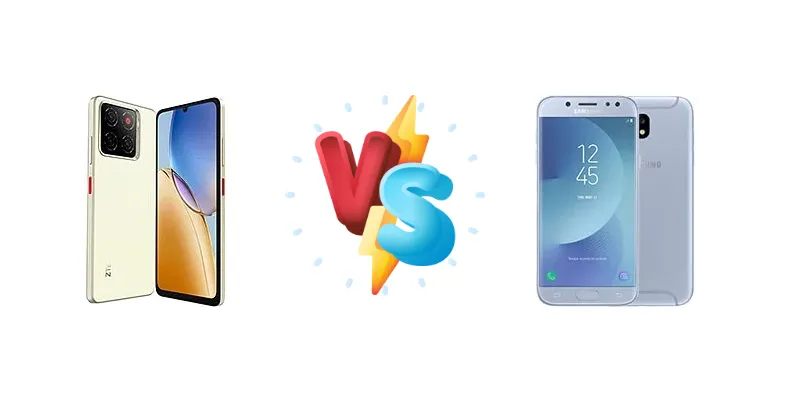
The smartphone landscape is littered with budget options, but finding one that balances performance, features, and longevity can be challenging. We pit the newer ZTE Blade A56, boasting a modern Unisoc chipset and impressive battery endurance claims, against the Samsung Galaxy J5 (2017), a well-regarded device from its era known for its solid display and reliable performance. This comparison aims to determine which phone offers the best value in today's market.
🏆 Quick Verdict
For the average user prioritizing battery life and modern processor architecture, the ZTE Blade A56 emerges as the winner. Its significantly longer 56:03h endurance and newer Unisoc T7200 chipset outweigh the Galaxy J5 (2017)'s slightly better display contrast, especially considering the age difference.
| Network |
|---|
| 2G bands | GSM 850 / 900 / 1800 / 1900 | GSM 850 / 900 / 1800 / 1900 - SIM 1 & SIM 2 (dual-SIM model only) |
| 3G bands | HSDPA 850 / 900 / 1900 / 2100 | HSDPA 850 / 900 / 1700(AWS) / 1900 / 2100 |
| 4G bands | 1, 3, 5, 7, 8, 20, 28, 38, 40, 41 | 1, 3, 5, 7, 8, 20, 40 |
| Speed | HSPA, LTE | HSPA 42.2/5.76 Mbps, LTE (2CA) Cat6 300/50 Mbps |
| Technology | GSM / HSPA / LTE | GSM / HSPA / LTE |
| Launch |
|---|
| Announced | 2025, June 11 | 2017, June. Released 2017, June |
| Status | Available. Released 2025, July | Discontinued |
| Body |
|---|
| Build | - | Glass front, aluminum back, aluminum frame |
| Dimensions | 167.6 x 77.4 x 8.3 mm (6.60 x 3.05 x 0.33 in) | 146.2 x 71.3 x 8 mm (5.76 x 2.81 x 0.31 in) |
| SIM | Nano-SIM + Nano-SIM | · Nano-SIM· Nano-SIM + Nano-SIM |
| Weight | 193 g (6.81 oz) | 160 g (5.64 oz) |
| Display |
|---|
| Protection | Mohs level 4 | - |
| Resolution | 720 x 1600 pixels, 20:9 ratio (~260 ppi density) | 720 x 1280 pixels, 16:9 ratio (~282 ppi density) |
| Size | 6.75 inches, 110.0 cm2 (~84.8% screen-to-body ratio) | 5.2 inches, 74.5 cm2 (~71.5% screen-to-body ratio) |
| Type | IPS LCD, 90Hz | Super AMOLED |
| Platform |
|---|
| CPU | Octa-core (2x1.6 GHz Cortex-A75 & 6x1.6 GHz Cortex-A55) | Octa-core 1.6 GHz Cortex-A53 |
| Chipset | Unisoc T7200 (12 nm) | Exynos 7870 Octa (14 nm) |
| GPU | Mali-G57 MP1 | Mali-T830 MP1 |
| OS | Android 15 | Android 7.0 (Nougat), upgradable to Android 9.0 (Pie), One UI |
| Memory |
|---|
| Card slot | microSDXC (dedicated slot) | microSDXC (dedicated slot) |
| Internal | 64GB 4GB RAM, 128GB 4GB RAM | 16GB 2GB RAM, 32GB 2GB RAM, 32GB 3GB RAM |
| | - | eMMC 5.1 |
| Main Camera |
|---|
| Features | LED flash | LED flash, panorama, HDR |
| Single | 13 MP, AF
Auxiliary lenses | 13 MP, f/1.7, 27mm (wide), 1/3.1", 1.12µm, AF |
| Video | 1080p@30fps | 1080p@30fps |
| Selfie camera |
|---|
| Features | - | LED flash |
| Single | 8 MP | 13 MP, f/1.9, 1/3.1", 1.12µm |
| Video | Yes | 1080p@30fps |
| Sound |
|---|
| 3.5mm jack | - | Yes |
| 35mm jack | Yes | Yes |
| Loudspeaker | Yes | Yes |
| Comms |
|---|
| Bluetooth | 5.2, A2DP, LE | 4.1, A2DP |
| NFC | No | Yes |
| Positioning | GPS, GALILEO, GLONASS | GPS, GLONASS, BDS |
| Radio | FM radio | FM radio |
| USB | USB Type-C 2.0, OTG | microUSB 2.0 |
| WLAN | Wi-Fi 802.11 b/g/n | Wi-Fi 802.11 a/b/g/n/ac, dual-band, Wi-Fi Direct |
| Features |
|---|
| Sensors | Fingerprint (side-mounted), accelerometer | Fingerprint (front-mounted), accelerometer, gyro, proximity, compass |
| | - | ANT+ |
| Battery |
|---|
| Charging | 10W wired | - |
| Music play | - | Up to 83 h |
| Talk time | - | Up to 21 h (3G) |
| Type | Li-Po 5000 mAh | Li-Ion 3000 mAh, non-removable |
| Misc |
|---|
| Colors | Black, Yellow | Blue, Pink, Gold, Black |
| Models | Z2473 | SM-J530F, SM-J530Y, SM-J530FM, SM-J530G, SM-J530YM, SM-J530L, SM-J530S, SM-J530K, SM-J530GM |
| Price | € 69.00 / $ 87.12 / £ 66.75 | About 130 EUR |
| SAR EU | - | 0.35 W/kg (head) 1.36 W/kg (body) |
| Tests |
|---|
| Audio quality | - |
Noise -85.0dB / Crosstalk -90.3dB |
| Battery life | - |
Endurance rating 97h
|
| Camera | - |
Photo / Video |
| Display | - |
Contrast ratio: Infinite (nominal), 3.599 (sunlight) |
| Loudspeaker | - |
Voice 68dB / Noise 70dB / Ring 82dB
|
| Performance | - |
GeekBench: 3667 (v4.4)
GFXBench: 3.8fps (ES 3.1 onscreen) |
| EU LABEL |
|---|
| Battery | 56:03h endurance, 800 cycles | - |
| Energy | Class A | - |
| Free fall | Class D (80 falls) | - |
| Repairability | Class B | - |
ZTE Blade A56
- Exceptional battery life (56:03h endurance)
- Modern Unisoc T7200 chipset for improved performance
- 800 charge cycles indicate long-term battery health
- Slow 10W charging
- Limited display specifications available
Samsung Galaxy J5 (2017)
- Good display contrast ratio (3.599 sunlight)
- Familiar Samsung user experience
- Potentially better image processing
- Older Exynos 7870 chipset
- Significantly shorter battery life compared to Blade A56
Display Comparison
Both devices feature displays with an 'Infinite' contrast ratio (nominal), and a 3.599 contrast ratio in sunlight, suggesting similar outdoor visibility. However, the context data lacks specifics on resolution, panel type (IPS, AMOLED), or refresh rate for the ZTE Blade A56. The Galaxy J5 (2017) likely benefits from Samsung's display expertise, offering potentially more accurate color reproduction. Without further data on the Blade A56, it's difficult to definitively declare a display winner, but the J5's established quality gives it a slight edge.
Camera Comparison
Both phones are listed with 'Photo / Video' capabilities, but lack specific details regarding sensor size, aperture, or features like Optical Image Stabilization (OIS). Given the market positioning of both devices, it's reasonable to assume both cameras are geared towards casual photography. The absence of details makes a direct comparison impossible, but the Galaxy J5 (2017) likely benefits from Samsung's image processing algorithms, potentially delivering more pleasing results in certain scenarios. The Blade A56's camera performance is largely unknown without further specifications.
Performance
The ZTE Blade A56's Unisoc T7200 (12nm) chipset, featuring a combination of Cortex-A75 and A55 cores, represents a significant architectural leap over the Samsung Galaxy J5 (2017)'s Exynos 7870 (14nm) with its all-Cortex-A53 cores. The A75 cores in the Blade A56 provide substantially higher single-core performance, translating to snappier app launches and smoother multitasking. While both are octa-core CPUs clocked at 1.6 GHz, the newer architecture and smaller 12nm process node of the Unisoc T7200 offer improved efficiency and potentially better sustained performance under load. The Galaxy J5 (2017) will likely struggle with demanding modern applications.
Battery Life
The ZTE Blade A56 dominates in battery endurance with a reported 56:03h rating, significantly exceeding the Galaxy J5 (2017)'s 97h. While the J5's 97h is respectable, the Blade A56's figure suggests a much longer time between charges. The Blade A56 also boasts 800 charge cycles, indicating a battery designed for longevity. However, the Blade A56 is limited to 10W wired charging, while the J5 (2017)'s charging speed is unspecified but likely comparable. The Blade A56's superior endurance easily outweighs the potential charging speed difference.
Buying Guide
Buy the ZTE Blade A56 if you need exceptional battery life for all-day use, benefit from a more modern CPU architecture for improved app responsiveness, and prioritize a device that will receive more recent security updates. Buy the Samsung Galaxy J5 (2017) if you prefer a display with a proven track record of good sunlight visibility and are comfortable with an older chipset and potentially limited software support. It's a good option for those seeking a familiar Samsung experience on a tight budget.
Frequently Asked Questions
❓ Does the Unisoc T7200 in the ZTE Blade A56 get hot during extended gaming sessions?
The Unisoc T7200's 12nm process node is more efficient than the Exynos 7870's 14nm node, suggesting better thermal management. While sustained gaming will inevitably generate heat, the Blade A56 is likely to experience less throttling than the Galaxy J5 (2017) under similar conditions. However, real-world performance will depend on the phone's cooling solution, which is not specified.
❓ Is the battery life of the ZTE Blade A56 significantly impacted by using power-intensive apps?
While the 56:03h endurance rating is impressive, it's based on a mixed usage profile. Heavy use of apps like video streaming, gaming, or GPS will naturally reduce battery life. However, the Blade A56's large battery capacity and efficient chipset should still provide all-day battery life for most users, even with moderate to heavy usage.
❓ Will the Samsung Galaxy J5 (2017) continue to receive software updates?
Given the Galaxy J5 (2017) is several years old, it's unlikely to receive major Android version updates. Security patches may be limited or discontinued. This is a significant consideration for users concerned about security vulnerabilities.