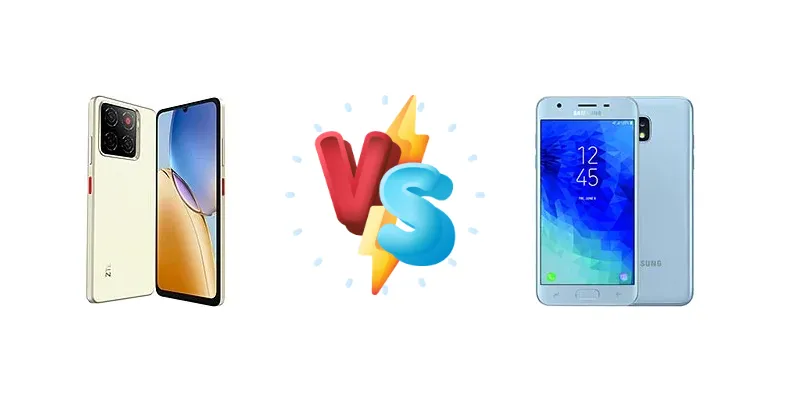
The ZTE Blade A56 and Samsung Galaxy J3 (2018) represent different eras of the budget smartphone market. The J3, released in 2018, was a mainstay for affordable connectivity. The Blade A56, a more recent offering, aims to deliver improved performance and endurance at a similar price point. This comparison dissects their key differences to determine which device offers the best value in 2024.
🏆 Quick Verdict
For the average user, the ZTE Blade A56 is the superior choice. Its Unisoc T7200 chipset, featuring an octa-core configuration, provides a significant performance boost over the Galaxy J3’s aging Exynos 7570 quad-core processor. Coupled with impressive 56-hour battery endurance, the A56 offers a more modern and capable experience.
| Network |
|---|
| 2G bands | GSM 850 / 900 / 1800 / 1900 | GSM 850 / 900 / 1800 / 1900 |
| 3G bands | HSDPA 850 / 900 / 1900 / 2100 | HSDPA 850 / 900 / 1700(AWS) / 1900 / 2100 - USA unlocked; Canada |
| 4G bands | 1, 3, 5, 7, 8, 20, 28, 38, 40, 41 | 2, 3, 4, 5, 7, 12, 14 - USA unlocked; AT&T |
| Speed | HSPA, LTE | HSPA, LTE |
| Technology | GSM / HSPA / LTE | GSM / HSPA / LTE |
| | - | 1, 2, 4, 5, 7, 12, 17, 66 - Canada |
| Launch |
|---|
| Announced | 2025, June 11 | 2018, June. Released 2018, June |
| Status | Available. Released 2025, July | Discontinued |
| Body |
|---|
| Build | - | Glass front, plastic back, plastic frame |
| Dimensions | 167.6 x 77.4 x 8.3 mm (6.60 x 3.05 x 0.33 in) | 142.7 x 70.1 x 8.9 mm (5.62 x 2.76 x 0.35 in) |
| SIM | Nano-SIM + Nano-SIM | Nano-SIM |
| Weight | 193 g (6.81 oz) | 152 g (5.36 oz) |
| Display |
|---|
| Protection | Mohs level 4 | - |
| Resolution | 720 x 1600 pixels, 20:9 ratio (~260 ppi density) | 720 x 1280 pixels, 16:9 ratio (~294 ppi density) |
| Size | 6.75 inches, 110.0 cm2 (~84.8% screen-to-body ratio) | 5.0 inches, 68.9 cm2 (~68.9% screen-to-body ratio) |
| Type | IPS LCD, 90Hz | IPS LCD |
| Platform |
|---|
| CPU | Octa-core (2x1.6 GHz Cortex-A75 & 6x1.6 GHz Cortex-A55) | Quad-core 1.4 GHz Cortex-A53 |
| Chipset | Unisoc T7200 (12 nm) | Exynos 7570 Quad (14 nm) |
| GPU | Mali-G57 MP1 | Mali-T720 |
| OS | Android 15 | Android 8.0 (Oreo) |
| Memory |
|---|
| Card slot | microSDXC (dedicated slot) | microSDXC (dedicated slot) |
| Internal | 64GB 4GB RAM, 128GB 4GB RAM | 16GB 2GB RAM |
| | - | eMMC 5.0 |
| Main Camera |
|---|
| Features | LED flash | LED flash, panorama, HDR |
| Single | 13 MP, AF
Auxiliary lenses | 8 MP, f/1.9, AF |
| Video | 1080p@30fps | 1080p@30fps |
| Selfie camera |
|---|
| Single | 8 MP | 5 MP, f/2.2 |
| Video | Yes | - |
| Sound |
|---|
| 3.5mm jack | - | Yes |
| 35mm jack | Yes | Yes |
| Loudspeaker | Yes | Yes |
| Comms |
|---|
| Bluetooth | 5.2, A2DP, LE | 4.2, A2DP, LE |
| NFC | No | No |
| Positioning | GPS, GALILEO, GLONASS | GPS |
| Radio | FM radio | FM radio |
| USB | USB Type-C 2.0, OTG | microUSB 2.0 |
| WLAN | Wi-Fi 802.11 b/g/n | Wi-Fi 802.11 b/g/n, Wi-Fi Direct |
| Features |
|---|
| Sensors | Fingerprint (side-mounted), accelerometer | Accelerometer, gyro, proximity, compass |
| Battery |
|---|
| Charging | 10W wired | - |
| Type | Li-Po 5000 mAh | Li-Ion 2600 mAh, removable |
| Misc |
|---|
| Colors | Black, Yellow | Black, Blue, Gold |
| Models | Z2473 | SM-J337U, SM-J337W, SM-J337A, SM-J337R, SM-J337T, SM-J337P, SM-J337AZ, SM-J337VPP |
| Price | € 69.00 / $ 87.12 / £ 66.75 | About 150 EUR |
| SAR | - | 1.20 W/kg (head) 1.13 W/kg (body) |
| EU LABEL |
|---|
| Battery | 56:03h endurance, 800 cycles | - |
| Energy | Class A | - |
| Free fall | Class D (80 falls) | - |
| Repairability | Class B | - |
ZTE Blade A56
- Significantly faster processor for smoother performance
- Exceptional battery life (56+ hours)
- More modern chipset architecture
- Slow 10W charging
- Likely basic camera performance
Samsung Galaxy J3 (2018)
- Very affordable price point
- Simple and easy-to-use interface
- Compact size
- Slow and outdated processor
- Poor battery life compared to the A56
- Limited software support
Display Comparison
Neither device boasts a standout display. Given the context data focuses on internal specs, we can infer both likely utilize LCD panels common in this price bracket. The J3’s display resolution is likely 720p, standard for its time. The Blade A56, being newer, *may* offer a slightly improved panel, but neither will compete with modern OLED displays. Bezels are expected to be substantial on both, reflecting their budget positioning. Color accuracy is unlikely to be a strong point on either device.
Camera Comparison
Camera performance is likely to be basic on both devices. Without specific sensor details, we can assume both feature modest sensors. The J3’s camera likely centers around an 8MP sensor, while the A56 may have a 13MP sensor. Image quality will be acceptable in good lighting conditions, but both will struggle in low light. Any 2MP macro or depth sensors included are unlikely to provide significant benefit. Image processing will be limited on both, resulting in less dynamic range and detail compared to higher-end smartphones.
Performance
The performance gap is the most significant differentiator. The ZTE Blade A56’s Unisoc T7200, built on a 12nm process, features an octa-core CPU with a mix of Cortex-A75 and A55 cores. This architecture provides a substantial advantage over the Samsung Galaxy J3 (2018)’s Exynos 7570 quad-core processor, based on the older Cortex-A53 architecture and a 14nm process. The A75 cores in the A56 offer significantly higher single-core performance, crucial for responsive app launching and smoother multitasking. The 12nm process also contributes to better power efficiency. Users will experience noticeably faster app loading times and a more fluid user interface on the Blade A56.
Battery Life
The ZTE Blade A56 shines in battery endurance, boasting 56:03 hours of usage. This is likely due to the more efficient Unisoc T7200 chipset and optimized software. While the Galaxy J3 (2018) likely has a comparable battery capacity (around 3000mAh), its less efficient Exynos 7570 will result in significantly shorter battery life. The A56’s 10W charging is slow by modern standards, but adequate given its exceptional endurance. The J3 likely supports similar charging speeds.
Buying Guide
Buy the ZTE Blade A56 if you prioritize performance for everyday tasks like social media, streaming, and light gaming, and require exceptional battery life. Buy the Samsung Galaxy J3 (2018) if you are looking for a very basic, extremely affordable phone for calls and texts, and are comfortable with significantly slower performance and a shorter battery lifespan. The J3 is best suited for those with minimal smartphone needs.
Frequently Asked Questions
❓ Does the Exynos 7570 chip in the Galaxy J3 (2018) overheat during prolonged use?
The Exynos 7570 is a relatively low-power chip, so overheating is unlikely during typical use. However, it will struggle with demanding tasks like gaming, and performance will likely be throttled to prevent overheating, resulting in a sluggish experience.
❓ Is the 2MP macro camera on the Samsung Galaxy J3 (2018) actually useful for taking close-up photos?
Unfortunately, 2MP macro cameras on budget phones like the J3 typically produce low-quality images with limited detail. The small sensor size and lack of autofocus result in blurry and noisy close-up shots. It's best to rely on the main camera for most photography.
❓ Can the ZTE Blade A56 handle popular mobile games like PUBG Mobile or Call of Duty Mobile?
The ZTE Blade A56 can run PUBG Mobile and Call of Duty Mobile, but you'll likely need to lower the graphics settings to medium or low to achieve a playable frame rate. The Unisoc T7200 is capable, but it's not a gaming powerhouse. Expect some occasional stuttering during intense action.
❓ How long will the battery on the ZTE Blade A56 last with moderate usage (calls, texts, social media, some browsing)?
With moderate usage, the ZTE Blade A56’s battery should easily last a full day, and potentially two days. The 56:03-hour endurance rating suggests it can handle around 8-10 hours of screen-on time, making it ideal for users who don't want to worry about frequent charging.