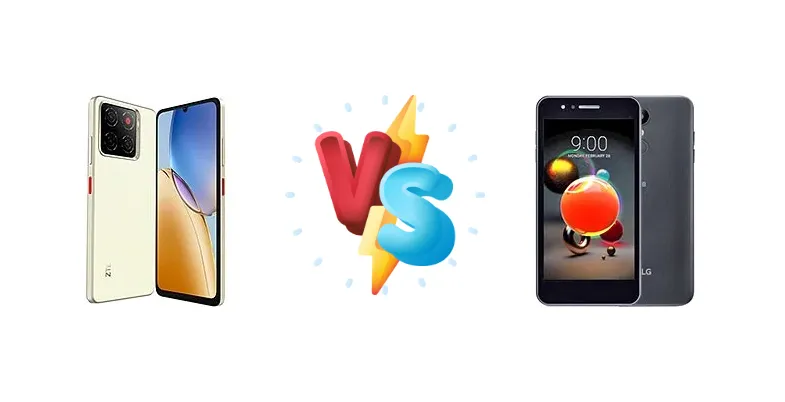
The ZTE Blade A56 and LG K8 (2018) represent two ends of the budget smartphone spectrum. The LG K8, released in 2018, offers a familiar, if dated, experience. The ZTE Blade A56, a more recent offering, aims to deliver modern features at an ultra-affordable price. This comparison dissects their key differences to help you choose the best option for your needs.
🏆 Quick Verdict
For the average user in 2024, the ZTE Blade A56 is the clear winner. Its significantly more powerful Unisoc T7200 chipset and impressive 56-hour battery endurance outweigh the LG K8 (2018)'s age and limited processing capabilities. While the LG K8 might be cheaper to find used, the A56 offers a far superior user experience.
| Network |
|---|
| 2G bands | GSM 850 / 900 / 1800 / 1900 | GSM 850 / 900 / 1800 / 1900 |
| 3G bands | HSDPA 850 / 900 / 1900 / 2100 | HSDPA 850 / 900 / 2100 |
| 4G bands | 1, 3, 5, 7, 8, 20, 28, 38, 40, 41 | 1, 3, 7, 8, 20 |
| Speed | HSPA, LTE | HSPA 42.2/5.76 Mbps, LTE Cat4 150/50 Mbps |
| Technology | GSM / HSPA / LTE | GSM / HSPA / LTE |
| | - | 2, 4, 5, 12 - USA |
| Launch |
|---|
| Announced | 2025, June 11 | 2018, February. Released 2018, June |
| Status | Available. Released 2025, July | Discontinued |
| Body |
|---|
| Build | - | Glass front (Gorilla Glass 3), plastic back, plastic frame |
| Dimensions | 167.6 x 77.4 x 8.3 mm (6.60 x 3.05 x 0.33 in) | 146.3 x 73.2 x 8.2 mm (5.76 x 2.88 x 0.32 in) |
| SIM | Nano-SIM + Nano-SIM | · Nano-SIM· Nano-SIM + Nano-SIM |
| Weight | 193 g (6.81 oz) | 152 g (5.36 oz) |
| Display |
|---|
| Protection | Mohs level 4 | Corning Gorilla Glass 3 |
| Resolution | 720 x 1600 pixels, 20:9 ratio (~260 ppi density) | 720 x 1280 pixels, 16:9 ratio (~294 ppi density) |
| Size | 6.75 inches, 110.0 cm2 (~84.8% screen-to-body ratio) | 5.0 inches, 68.9 cm2 (~64.4% screen-to-body ratio) |
| Type | IPS LCD, 90Hz | S-IPS LCD |
| Platform |
|---|
| CPU | Octa-core (2x1.6 GHz Cortex-A75 & 6x1.6 GHz Cortex-A55) | Quad-core 1.3 GHz Cortex-A7Quad-core 1.4 GHz Cortex-A53 |
| Chipset | Unisoc T7200 (12 nm) | Qualcomm MSM8909 Snapdragon 210 (28 nm) - GlobalQualcomm MSM8917 Snapdragon 425 (28 nm) - USA |
| GPU | Mali-G57 MP1 | Adreno 304Adreno 308 |
| OS | Android 15 | Android 7.1.2 (Nougat) |
| Memory |
|---|
| Card slot | microSDXC (dedicated slot) | microSDHC |
| Internal | 64GB 4GB RAM, 128GB 4GB RAM | 16GB 2GB RAM, 32GB 2GB RAM |
| | - | eMMC 5.1 or eMMC 4.5 |
| Main Camera |
|---|
| Features | LED flash | LED flash, HDR |
| Single | 13 MP, AF
Auxiliary lenses | - |
| Video | 1080p@30fps | 720p@30fps (Global), 1080p@30fps (USA) |
| Selfie camera |
|---|
| Single | 8 MP | - |
| Video | Yes | - |
| Sound |
|---|
| 3.5mm jack | - | Yes |
| 35mm jack | Yes | Yes |
| Loudspeaker | Yes | Yes |
| Comms |
|---|
| Bluetooth | 5.2, A2DP, LE | 4.2, A2DP, LE |
| NFC | No | No |
| Positioning | GPS, GALILEO, GLONASS | GPS, GLONASS |
| Radio | FM radio | FM radio |
| USB | USB Type-C 2.0, OTG | microUSB 2.0, OTG |
| WLAN | Wi-Fi 802.11 b/g/n | Wi-Fi 802.11 b/g/n, Wi-Fi Direct |
| Features |
|---|
| Sensors | Fingerprint (side-mounted), accelerometer | Accelerometer, proximity |
| Battery |
|---|
| Charging | 10W wired | - |
| Type | Li-Po 5000 mAh | Li-Ion 2500 mAh, removable |
| Misc |
|---|
| Colors | Black, Yellow | Aurora Black, Moroccan Blue, Terra Gold |
| Models | Z2473 | X210 |
| Price | € 69.00 / $ 87.12 / £ 66.75 | About 140 EUR |
| EU LABEL |
|---|
| Battery | 56:03h endurance, 800 cycles | - |
| Energy | Class A | - |
| Free fall | Class D (80 falls) | - |
| Repairability | Class B | - |
ZTE Blade A56
- Significantly faster processor for smoother performance
- Exceptional battery life (56h+ endurance)
- More modern chipset with better efficiency
- Slow 10W charging
- Likely basic camera performance
LG K8 (2018)
- Potentially lower price (especially used)
- Simple and straightforward user experience
- Compact size (likely)
- Very slow processor and limited performance
- Poor battery life compared to the A56
- Outdated software and limited support
Display Comparison
Neither device boasts a standout display. Given the context data focuses on internal specs, we can infer both likely utilize LCD panels common in this price bracket. The LG K8 (2018) likely has a 720p resolution, typical for its era, while the ZTE Blade A56’s resolution is unknown but likely similar. The age difference suggests the ZTE Blade A56 may benefit from slightly improved color reproduction and viewing angles, but neither will compete with modern AMOLED displays. Bezels are expected to be substantial on both devices.
Camera Comparison
Camera performance is likely to be limited on both devices. Without specific sensor details, it’s safe to assume both feature basic cameras suitable for casual snapshots. The LG K8 (2018) likely features a 8MP main sensor, while the ZTE Blade A56’s sensor resolution is unknown. Image processing will be basic on both, with limited dynamic range and detail in low-light conditions. Any secondary cameras (likely 2MP depth sensors) on either device will offer minimal practical benefit. The ZTE Blade A56’s newer image signal processor (ISP) within the Unisoc T7200 may provide slightly improved image quality, but don’t expect flagship-level results.
Performance
The performance gap between these two phones is substantial. The ZTE Blade A56’s Unisoc T7200, built on a 12nm process, features an octa-core configuration with a mix of Cortex-A75 and A55 cores. This architecture provides a significant leap in processing power compared to the LG K8 (2018)’s Qualcomm MSM8909 (Global) or MSM8917 (USA) Snapdragon 210, a quad-core processor built on a much older 28nm process. The A75 cores in the A56 offer considerably higher single-core performance, crucial for app responsiveness, while the six A55 cores handle background tasks efficiently. The older Snapdragon 210 will struggle with even moderately demanding apps, resulting in noticeable lag and slowdowns. The 12nm process of the Unisoc T7200 also translates to better thermal efficiency, reducing the likelihood of throttling during sustained use.
Battery Life
The ZTE Blade A56 excels in battery endurance, boasting a remarkable 56 hours and 3 minutes of usage time. This is likely due to the efficient Unisoc T7200 chipset and optimized software. The LG K8 (2018)’s battery capacity is unknown, but given its older, less efficient processor, it will likely fall significantly short of the A56’s performance. The ZTE Blade A56’s 10W charging is slow by modern standards, but adequate given its exceptional battery life. The LG K8 (2018) likely supports a similar charging speed, if not slower.
Buying Guide
Buy the ZTE Blade A56 if you need a phone capable of handling modern apps, multitasking, and occasional gaming without significant lag. It’s ideal for users who prioritize battery life and a responsive user interface. Buy the LG K8 (2018) if you absolutely need the lowest possible upfront cost and only require basic functionality like calls, texts, and light web browsing – and are comfortable with a very slow experience.
Frequently Asked Questions
❓ Will the ZTE Blade A56 be able to run popular social media apps like TikTok and Instagram smoothly?
Yes, the Unisoc T7200 chipset in the ZTE Blade A56 is powerful enough to run popular social media apps like TikTok and Instagram without significant lag. While it won't offer the same performance as a flagship device, it provides a usable and enjoyable experience for everyday social media browsing.
❓ Is the LG K8 (2018) still a viable option for making calls and sending texts?
Yes, the LG K8 (2018) is perfectly capable of making calls and sending texts. However, its slow processor may result in noticeable delays when opening the phone app or messaging applications. It's best suited for users who prioritize basic communication functionality over performance.
❓ Can I expect to play any mobile games on the ZTE Blade A56?
The ZTE Blade A56 can handle some mobile games, particularly less demanding titles. While it won't run graphically intensive games at high settings, you should be able to play games like Candy Crush, Subway Surfers, and some older titles without major issues. Expect lower frame rates and reduced graphical settings for more demanding games.
❓ How long will the ZTE Blade A56's battery last with moderate usage (calls, texts, browsing)?
With moderate usage, the ZTE Blade A56’s battery should easily last a full day, and potentially up to two days. The 56:03h endurance rating suggests it can handle around 8-10 hours of screen-on time, making it a great choice for users who need a phone that can last through a busy day.