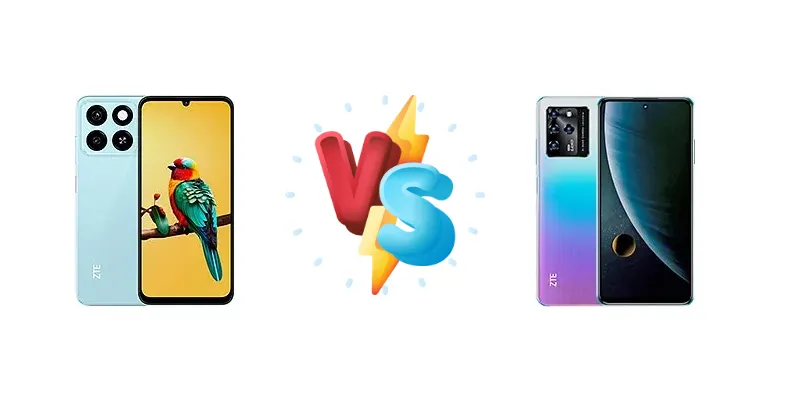
The ZTE Blade A55 and V30 represent ZTE’s commitment to the budget smartphone market, but cater to slightly different needs. The A55 prioritizes affordability, while the V30 aims for a balance of features and performance. This comparison dissects the key differences, focusing on the chipset, charging capabilities, and how these translate to everyday use.
🏆 Quick Verdict
For most users, the ZTE Blade V30 is the superior choice. Its Unisoc Tiger T618 chipset, built on a more efficient 12nm process, delivers noticeably better performance than the A55’s SC9863A1. The faster 18W charging also significantly reduces downtime, making the V30 a more practical daily driver.
| Network |
|---|
| 2G bands | GSM 850 / 900 / 1800 / 1900 | GSM 850 / 900 / 1800 / 1900 |
| 3G bands | HSDPA 850 / 900 / 1900 / 2100 | HSDPA 850 / 1700(AWS) / 1900 - Mexico |
| 4G bands | 1, 3, 5, 7, 8, 20, 28, 38, 40, 41 | 1, 2, 3, 4, 5, 7, 12, 13, 26, 28, 66 - Mexico |
| Speed | HSPA, LTE | HSPA, LTE |
| Technology | GSM / HSPA / LTE | GSM / HSPA / LTE |
| Launch |
|---|
| Announced | 2024, January | 2021, July 16 |
| Status | Available. Released 2024, July | Available. Released 2021, September 01 |
| Body |
|---|
| Dimensions | 167.7 x 77.4 x 8.5 mm (6.60 x 3.05 x 0.33 in) | 165.8 x 77.8 x 8.9 mm (6.53 x 3.06 x 0.35 in) |
| SIM | Nano-SIM + Nano-SIM | Nano-SIM + Nano-SIM |
| Weight | - | 193 g (6.81 oz) |
| Display |
|---|
| Resolution | 720 x 1600 pixels, 20:9 ratio (~260 ppi density) | 1080 x 2400 pixels, 20:9 ratio (~395 ppi density) |
| Size | 6.75 inches, 110.0 cm2 (~84.7% screen-to-body ratio) | 6.67 inches, 107.4 cm2 (~83.3% screen-to-body ratio) |
| Type | IPS LCD, 90Hz | IPS LCD |
| Platform |
|---|
| CPU | Octa-core (4x1.6 GHz Cortex-A55 & 4x1.2 GHz Cortex-A55) | Octa-core (2x2.0 GHz Cortex-A75 & 6x2.0 GHz Cortex-A55) |
| Chipset | Unisoc SC9863A1 (22 nm) | Unisoc Tiger T618 (12 nm) |
| GPU | IMG8322 | Mali G52 MP2 |
| OS | Android 14 (Go edition) | Android 11 |
| Memory |
|---|
| Card slot | microSDXC (dedicated slot) | microSDXC |
| Internal | 64GB 4GB RAM, 128GB 4GB RAM | 128GB 4GB RAM |
| Main Camera |
|---|
| Features | LED flash | LED flash, HDR, panorama |
| Single | 13 MP, AF
Auxiliary lens | 16 MP, f/2.0, (wide) |
| Triple | - | 64 MP, f/1.8, 26mm (wide), PDAF
8 MP, f/2.4, 120˚, 16mm (ultrawide)
5 MP (macro)
Auxiliary lens |
| Video | 1080p@30fps | 1080p@30fps |
| Selfie camera |
|---|
| Single | 8 MP | 16 MP, f/2.0, (wide) |
| Video | Yes | - |
| Sound |
|---|
| 3.5mm jack | - | Yes |
| 35mm jack | Yes | Yes |
| Loudspeaker | Yes | Yes |
| Comms |
|---|
| Bluetooth | 5.2, A2DP, LE | 5.0, A2DP, LE |
| NFC | No | No |
| Positioning | GPS, GALILEO, GLONASS | GPS |
| Radio | FM radio | Unspecified |
| USB | USB Type-C 2.0, OTG | USB Type-C 2.0 |
| WLAN | Wi-Fi 802.11 b/g/n | Wi-Fi 802.11 b/g/n/ac |
| Features |
|---|
| Sensors | Fingerprint (side-mounted), accelerometer | Fingerprint (side-mounted), accelerometer, gyro, proximity |
| Battery |
|---|
| Charging | 10W wired | 18W wired |
| Type | Li-Po 5000 mAh | Li-Po 5000 mAh |
| Misc |
|---|
| Colors | Mint Green, Starry Black, Sunset Orange | Black, Blue |
| Models | Z2450 | 9030 |
| Price | - | About 200 EUR |
ZTE Blade A55
- Lower price point makes it highly accessible.
- Sufficient for basic smartphone tasks.
- Potentially longer battery life due to less powerful chipset (though charging is slower).
- Significantly slower performance compared to the V30.
- Slow 10W charging.
- Limited multitasking capabilities.
ZTE Blade V30
- Faster and more responsive performance thanks to the Unisoc Tiger T618.
- Faster 18W charging reduces downtime.
- More capable for multitasking and light gaming.
- Higher price compared to the A55.
- May experience slightly shorter battery life under heavy use.
- Still a budget device with limitations in camera and display quality.
Display Comparison
Neither ZTE provides detailed display specifications beyond resolution. However, given the price points, both likely utilize IPS LCD panels. The absence of information regarding peak brightness or color gamut suggests neither phone excels in this area. Bezels are expected to be noticeable on both devices, typical for this segment. The focus here is clearly not on display quality.
Camera Comparison
Without detailed camera specs, a direct comparison is difficult. However, it’s safe to assume both phones feature basic camera setups geared towards casual photography. Given the market segment, image processing will likely prioritize speed over detail. The absence of OIS on either device suggests low-light performance will be limited. Any differences in image quality will likely stem from the main sensor’s resolution and aperture, information not provided. Focusing on the chipset, the V30’s ISP (Image Signal Processor) within the T618 will likely offer slightly faster image processing capabilities.
Performance
The core difference lies in the chipsets. The ZTE Blade V30’s Unisoc Tiger T618, fabricated on a 12nm process, is a significant upgrade over the A55’s Unisoc SC9863A1 (22nm). The T618’s CPU configuration – 2x2.0 GHz Cortex-A75 and 6x2.0 GHz Cortex-A55 – provides a substantial performance boost over the A55’s 4x1.6 GHz Cortex-A55 & 4x1.2 GHz Cortex-A55. The A75 cores in the V30 are considerably more powerful, resulting in faster app loading times and smoother multitasking. The 12nm process also contributes to better thermal efficiency, potentially reducing throttling during sustained workloads. While neither chipset is a powerhouse, the V30 offers a demonstrably more responsive experience.
Battery Life
While battery capacity isn’t specified, the charging wattage difference is crucial. The ZTE Blade V30’s 18W wired charging is a significant advantage over the A55’s 10W charging. This translates to a much faster 0-100% charge time, reducing downtime. Even if the V30 has a slightly smaller battery, the faster charging can offset this, providing more usable time throughout the day. The A55’s 10W charging will require a considerably longer time to fully replenish the battery.
Buying Guide
Buy the ZTE Blade A55 if you need an extremely affordable device for basic tasks like calls, texts, and light social media browsing, and are willing to accept slower performance and charging. Buy the ZTE Blade V30 if you prioritize smoother multitasking, occasional gaming, and faster charging, even if it means spending a bit more upfront. The V30 is ideal for users who want a phone that can handle more than just the essentials.
Frequently Asked Questions
❓ Will the ZTE Blade V30 handle popular games like PUBG Mobile or Call of Duty Mobile?
The Unisoc Tiger T618 in the V30 can run PUBG Mobile and Call of Duty Mobile, but expect to play at medium settings to maintain a stable frame rate. The A55’s SC9863A1 will struggle with these titles, likely requiring very low settings and potentially experiencing significant lag.
❓ How much faster is the 18W charging on the ZTE Blade V30 compared to the 10W charging on the A55?
While exact charge times depend on battery capacity (which isn't specified), 18W charging will typically reduce a full charge time by 30-50% compared to 10W. This means the V30 could fully charge in around 2-3 hours, while the A55 might take 4-6 hours.
❓ Is the difference in CPU architecture (Cortex-A75 vs Cortex-A55) noticeable in everyday tasks?
Yes, the Cortex-A75 cores in the V30’s chipset provide a significant performance boost in everyday tasks like opening apps, browsing the web, and switching between applications. The A55 cores in both phones are efficient, but the A75 cores offer a much higher peak performance.
❓ Does the ZTE Blade V30 support software updates beyond the initial Android version?
ZTE’s update track record for budget devices is limited. While the V30 will likely receive at least one major Android update, long-term software support cannot be guaranteed. Expect security patches to be infrequent.