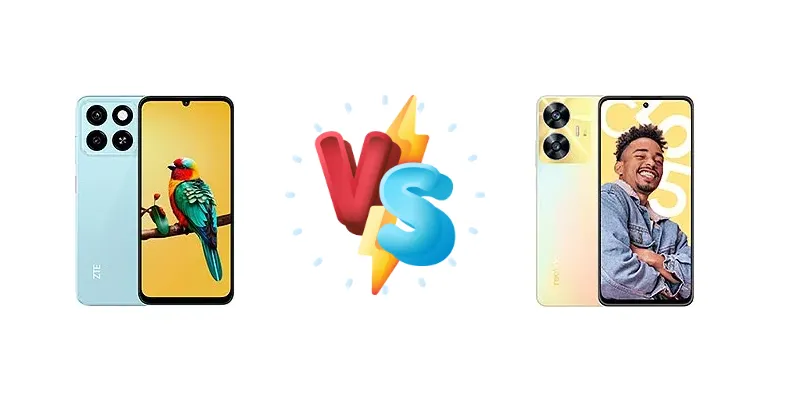
The sub-$200 smartphone market is fiercely competitive. The ZTE Blade A55 and Realme C55 both aim to deliver essential features at an accessible price, but they take different approaches. The Blade A55 relies on a Unisoc chipset for efficiency, while the C55 opts for a Mediatek Helio G88, prioritizing performance. This comparison dissects their key differences to determine which phone offers the best value.
🏆 Quick Verdict
For most users, the Realme C55 emerges as the better choice. Its significantly faster 33W charging, coupled with the more powerful Helio G88 chipset, provides a smoother user experience and reduces downtime. While the Blade A55 offers a basic experience, the C55’s advantages justify the potential price difference.
| Network |
|---|
| 2G bands | GSM 850 / 900 / 1800 / 1900 | GSM 850 / 900 / 1800 / 1900 |
| 3G bands | HSDPA 850 / 900 / 1900 / 2100 | HSDPA 850 / 900 / 2100 |
| 4G bands | 1, 3, 5, 7, 8, 20, 28, 38, 40, 41 | 1, 3, 5, 8, 38, 40, 41 |
| Speed | HSPA, LTE | HSPA, LTE |
| Technology | GSM / HSPA / LTE | GSM / HSPA / LTE |
| Launch |
|---|
| Announced | 2024, January | 2023, March 07 |
| Status | Available. Released 2024, July | Available. Released 2023, March 08 |
| Body |
|---|
| Build | - | Glass front, plastic frame, plastic back |
| Dimensions | 167.7 x 77.4 x 8.5 mm (6.60 x 3.05 x 0.33 in) | 165.6 x 75.9 x 7.9 mm (6.52 x 2.99 x 0.31 in) |
| SIM | Nano-SIM + Nano-SIM | Nano-SIM + Nano-SIM |
| Weight | - | 189.5 g (6.70 oz) |
| Display |
|---|
| Resolution | 720 x 1600 pixels, 20:9 ratio (~260 ppi density) | 1080 x 2400 pixels, 20:9 ratio (~392 ppi density) |
| Size | 6.75 inches, 110.0 cm2 (~84.7% screen-to-body ratio) | 6.72 inches, 109.0 cm2 (~86.7% screen-to-body ratio) |
| Type | IPS LCD, 90Hz | IPS LCD, 90Hz, 680 nits (peak) |
| Platform |
|---|
| CPU | Octa-core (4x1.6 GHz Cortex-A55 & 4x1.2 GHz Cortex-A55) | Octa-core (2x2.0 GHz Cortex-A75 & 6x1.8 GHz Cortex-A55) |
| Chipset | Unisoc SC9863A1 (22 nm) | Mediatek MT6769H Helio G88 (12 nm) |
| GPU | IMG8322 | Mali-G52 MC2 |
| OS | Android 14 (Go edition) | Android 13, Realme UI 4.0 |
| Memory |
|---|
| Card slot | microSDXC (dedicated slot) | microSDXC (dedicated slot) |
| Internal | 64GB 4GB RAM, 128GB 4GB RAM | 64GB 4GB RAM, 64GB 6GB RAM, 128GB 4GB RAM, 128GB 6GB RAM, 128GB 8GB RAM, 256GB 8GB RAM |
| Main Camera |
|---|
| Dual | - | 64 MP, (wide), 1/2.0", PDAF
Auxiliary lens |
| Features | LED flash | LED flash, HDR, panorama |
| Single | 13 MP, AF
Auxiliary lens | 8 MP, (wide) |
| Video | 1080p@30fps | 1080p@30/60fps |
| Selfie camera |
|---|
| Features | - | HDR, panorama |
| Single | 8 MP | 8 MP, (wide) |
| Video | Yes | 1080p@30fps |
| Sound |
|---|
| 3.5mm jack | - | Yes |
| 35mm jack | Yes | Yes |
| Loudspeaker | Yes | Yes |
| Comms |
|---|
| Bluetooth | 5.2, A2DP, LE | 5.2, A2DP, LE |
| NFC | No | Yes, 360˚ (market/region dependent) |
| Positioning | GPS, GALILEO, GLONASS | GPS, GLONASS, GALILEO, BDS |
| Radio | FM radio | No |
| USB | USB Type-C 2.0, OTG | USB Type-C 2.0 |
| WLAN | Wi-Fi 802.11 b/g/n | Wi-Fi 802.11 a/b/g/n/ac, dual-band |
| Features |
|---|
| Sensors | Fingerprint (side-mounted), accelerometer | Fingerprint (side-mounted), accelerometer, proximity, compass |
| Battery |
|---|
| Charging | 10W wired | 33W wired, 50% in 29 min |
| Type | Li-Po 5000 mAh | 5000 mAh |
| Misc |
|---|
| Colors | Mint Green, Starry Black, Sunset Orange | Sun Shower, Rainy Night, Rainforest |
| Models | Z2450 | RMX3710 |
| Price | - | ₹ 8,399 |
| Tests |
|---|
| Battery life | - |
Endurance rating 123h
|
| Camera | - |
Photo / Video |
| Display | - |
Contrast ratio: 1264:1 (nominal) |
| Loudspeaker | - |
-31.8 LUFS (Below average)
|
| Performance | - |
AnTuTu: 257263 (v9)
GeekBench: 1452 (v5.1), 1413 (v6)
GFXBench: 9fps (ES 3.1 onscreen) |
ZTE Blade A55
- Potentially lower price point
- Focus on power efficiency
- Simple, straightforward user experience
- Significantly slower charging
- Less powerful processor
- Lower peak display brightness
Realme C55
- Faster 33W charging
- More powerful Helio G88 processor
- Brighter display for outdoor visibility
- Potentially higher price
- May experience slightly faster battery drain due to higher performance
- Software bloatware (typical of Realme)
Display Comparison
Both phones feature similar contrast ratios at 1264:1, suggesting comparable image quality in ideal conditions. However, the Realme C55 boasts a measured peak brightness of 659 nits, significantly exceeding what we’d expect from the Blade A55 given its lack of published brightness data. This brighter display will be noticeably more visible outdoors. While neither phone is likely to feature high refresh rate panels, the C55’s superior brightness provides a better viewing experience overall.
Camera Comparison
Both devices list 'Photo / Video' capabilities, but lack specific details. Given the price point, image quality will likely be similar in good lighting conditions. However, the Realme C55’s potential for better image processing, driven by the more capable Helio G88 chipset, could result in superior low-light performance. The absence of detailed camera specs makes a definitive judgment difficult, but the C55’s processing power gives it an edge. We can assume both phones will include basic sensors, and the 2MP macro cameras often found in this segment are unlikely to deliver significant value.
Performance
The Realme C55’s Mediatek Helio G88 (12nm) represents a substantial upgrade over the ZTE Blade A55’s Unisoc SC9863A1 (22nm). The Helio G88’s CPU configuration – 2x2.0 GHz Cortex-A75 and 6x1.8 GHz Cortex-A55 – offers a more potent combination for multitasking and gaming compared to the Blade A55’s 4x1.6 GHz Cortex-A55 and 4x1.2 GHz Cortex-A55. The smaller 12nm process node of the Helio G88 also contributes to improved thermal efficiency, potentially reducing throttling during sustained workloads. This translates to a smoother, more responsive experience on the C55.
Battery Life
Both phones achieve an endurance rating of 123 hours, suggesting comparable battery life under similar usage patterns. However, the Realme C55’s 33W wired charging is a game-changer, achieving 50% charge in just 29 minutes. The ZTE Blade A55’s 10W charging is significantly slower, requiring considerably more time to fully replenish the battery. This difference in charging speed dramatically impacts the user experience, making the C55 far more convenient for users who need to quickly top up their device.
Buying Guide
Buy the ZTE Blade A55 if you prioritize absolute affordability and minimal smartphone usage – primarily for calls, texts, and light browsing. Its focus is on extending battery life through a less demanding processor. Buy the Realme C55 if you value faster performance for social media, streaming, and casual gaming, and appreciate the convenience of rapid charging. It’s the better option for users who actively use their smartphones throughout the day.
Frequently Asked Questions
❓ Is the Mediatek Helio G88 in the Realme C55 capable of handling popular games like PUBG Mobile?
Yes, the Helio G88 is capable of running PUBG Mobile at medium settings with reasonable frame rates. While it won't deliver a flagship gaming experience, it provides a playable experience for casual gamers. The Unisoc SC9863A1 in the ZTE Blade A55 would struggle to maintain consistent performance in demanding titles.
❓ How much faster is the 33W charging on the Realme C55 compared to the 10W charging on the ZTE Blade A55 in real-world use?
The 33W charging on the Realme C55 can take a phone from 0% to 50% in approximately 29 minutes. The 10W charging on the ZTE Blade A55 would likely take over 2 hours to achieve the same level of charge. This difference is substantial and significantly impacts the convenience of topping up the battery throughout the day.
❓ Does the Realme C55 have a noticeable amount of bloatware pre-installed?
Realme devices are known to include some pre-installed apps (bloatware). While the amount varies, users can typically uninstall or disable many of these apps to free up storage space and improve the user experience. The ZTE Blade A55 is likely to have a cleaner software experience, but may lack some of the features found on Realme's UI.