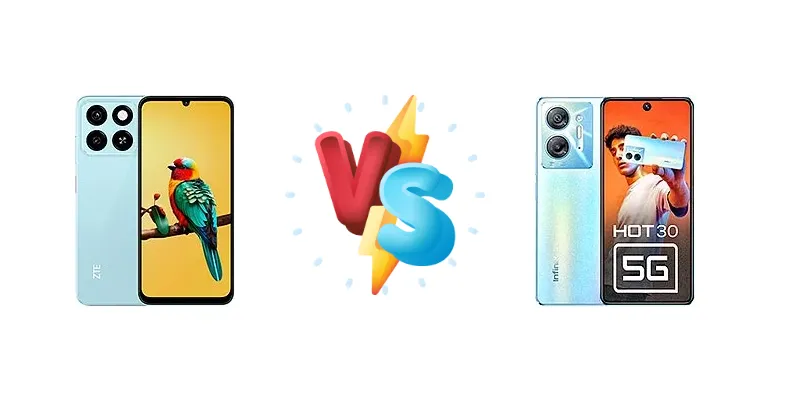
The sub-$200 smartphone market is fiercely competitive, and both the ZTE Blade A55 and the Infinix Hot 30 5G aim to deliver 5G connectivity at an accessible price. However, they take drastically different approaches to achieving this, particularly in their core processing power and charging capabilities. This comparison will dissect the key differences to help you determine which device best suits your needs.
🏆 Quick Verdict
For the average user prioritizing responsiveness and future-proofing, the Infinix Hot 30 5G is the clear winner. Its Mediatek Dimensity 6020 chipset provides a substantial performance advantage over the ZTE Blade A55’s Unisoc SC9863A1, making it better suited for multitasking and demanding apps. While the ZTE offers a slightly simpler experience, the performance gap is too significant to ignore.
| Network |
|---|
| 2G bands | GSM 850 / 900 / 1800 / 1900 | GSM 850 / 900 / 1800 / 1900 |
| 3G bands | HSDPA 850 / 900 / 1900 / 2100 | HSDPA 850 / 900 / 1700(AWS) / 1900 / 2100 |
| 4G bands | 1, 3, 5, 7, 8, 20, 28, 38, 40, 41 | LTE |
| 5G bands | - | 1, 3, 5, 8, 28, 38, 40, 41, 77, 78 SA/NSA |
| Speed | HSPA, LTE | HSPA, LTE, 5G |
| Technology | GSM / HSPA / LTE | GSM / HSPA / LTE / 5G |
| Launch |
|---|
| Announced | 2024, January | 2023, July 14 |
| Status | Available. Released 2024, July | Available. Released 2023, July 18 |
| Body |
|---|
| Build | - | Glass front, plastic frame, plastic back |
| Dimensions | 167.7 x 77.4 x 8.5 mm (6.60 x 3.05 x 0.33 in) | 168.5 x 76.5 x 9.2 mm (6.63 x 3.01 x 0.36 in) |
| SIM | Nano-SIM + Nano-SIM | Nano-SIM + Nano-SIM |
| Weight | - | 215 g (7.58 oz) |
| Display |
|---|
| Resolution | 720 x 1600 pixels, 20:9 ratio (~260 ppi density) | 1080 x 2460 pixels (~396 ppi density) |
| Size | 6.75 inches, 110.0 cm2 (~84.7% screen-to-body ratio) | 6.78 inches, 109.2 cm2 (~84.7% screen-to-body ratio) |
| Type | IPS LCD, 90Hz | IPS LCD, 120Hz, 580 nits (peak) |
| Platform |
|---|
| CPU | Octa-core (4x1.6 GHz Cortex-A55 & 4x1.2 GHz Cortex-A55) | Octa-core (2x2.2 GHz Cortex-A76 & 6x2.0 GHz Cortex-A55) |
| Chipset | Unisoc SC9863A1 (22 nm) | Mediatek Dimensity 6020 (7 nm) |
| GPU | IMG8322 | Mali-G57 MC2 |
| OS | Android 14 (Go edition) | Android 13, XOS 13 |
| Memory |
|---|
| Card slot | microSDXC (dedicated slot) | microSDXC (dedicated slot) |
| Internal | 64GB 4GB RAM, 128GB 4GB RAM | 128GB 4GB RAM, 128GB 8GB RAM |
| Main Camera |
|---|
| Features | LED flash | Quad-LED flash, HDR, panorama |
| Single | 13 MP, AF
Auxiliary lens | 50 MP, f/1.6, (wide), 1/2.55", AF
Auxiliary lens |
| Video | 1080p@30fps | 1440p@30fps, 1080p@30fps |
| Selfie camera |
|---|
| Features | - | Dual-LED flash |
| Single | 8 MP | 8 MP, f/2.0, (wide) |
| Video | Yes | 1080p@30fps |
| Sound |
|---|
| 35mm jack | Yes | Yes |
| Loudspeaker | Yes | Yes, with stereo speakers |
| Comms |
|---|
| Bluetooth | 5.2, A2DP, LE | 5.1, A2DP, LE |
| NFC | No | No |
| Positioning | GPS, GALILEO, GLONASS | GPS, GLONASS, GALILEO, BDS |
| Radio | FM radio | FM radio |
| USB | USB Type-C 2.0, OTG | USB Type-C 2.0 |
| WLAN | Wi-Fi 802.11 b/g/n | Wi-Fi 802.11 a/b/g/n/ac, dual-band |
| Features |
|---|
| Sensors | Fingerprint (side-mounted), accelerometer | Fingerprint (side-mounted), accelerometer, proximity, compass |
| Battery |
|---|
| Charging | 10W wired | 18W wired |
| Type | Li-Po 5000 mAh | 5000 mAh |
| Misc |
|---|
| Colors | Mint Green, Starry Black, Sunset Orange | Knight Black, Aurora Blue |
| Models | Z2450 | X6832 |
| Price | - | About 140 EUR |
ZTE Blade A55
- Simpler user experience
- Potentially lower price point
- Functional for basic tasks
- Significantly slower performance
- Slower charging speed
- Less future-proof
Infinix Hot 30 5G
- Much faster processor
- Faster charging (18W)
- Better multitasking capabilities
- More efficient processor for longer battery life
- Potentially slightly higher price
- More complex software experience (typical of Infinix)
- May require more frequent software updates
Display Comparison
Neither ZTE nor Infinix provide detailed display specifications beyond the basic panel type. However, the chipset difference hints at potential display capabilities. The Dimensity 6020 in the Infinix Hot 30 5G supports higher resolution displays and faster refresh rates, suggesting a potentially sharper and smoother visual experience compared to the ZTE Blade A55, which is likely limited by the processing power of the Unisoc SC9863A1. Bezels are likely comparable given the price point, and color accuracy is expected to be standard for this segment.
Camera Comparison
Detailed camera specifications are unavailable, but given the price bracket, expectations should be tempered. Both phones likely feature a primary camera alongside depth or macro sensors. The Infinix Hot 30 5G benefits from the image signal processor (ISP) within the Dimensity 6020, which offers more advanced image processing capabilities, potentially leading to better dynamic range and low-light performance. The ZTE Blade A55’s Unisoc chipset has a less capable ISP, limiting its ability to enhance image quality. The presence of a more powerful processor in the Infinix allows for faster image processing and potentially better video recording capabilities.
Performance
The performance disparity is the most significant difference between these two devices. The Infinix Hot 30 5G’s Mediatek Dimensity 6020, fabricated on a 7nm process, is a substantial upgrade over the ZTE Blade A55’s 22nm Unisoc SC9863A1. The Dimensity 6020 features two high-performance Cortex-A76 cores clocked at 2.2 GHz, alongside six efficiency cores, offering a significant boost in CPU performance for tasks like gaming and app loading. The ZTE’s processor relies solely on Cortex-A55 cores, split between 1.6 GHz and 1.2 GHz, resulting in noticeably slower performance. This translates to a smoother user experience and better multitasking on the Infinix.
Battery Life
While battery capacity isn't specified, the charging wattage provides a clear advantage to the Infinix Hot 30 5G. Its 18W wired charging is significantly faster than the ZTE Blade A55’s 10W charging. This means the Infinix will reach a full charge in considerably less time, reducing downtime. The more efficient 7nm Dimensity 6020 also contributes to better battery life during typical usage, offsetting any potential capacity differences.
Buying Guide
Buy the ZTE Blade A55 if you need a basic, functional smartphone for essential tasks like calls, texts, and light social media browsing, and prioritize simplicity over performance. Buy the Infinix Hot 30 5G if you prefer a phone capable of handling more demanding applications, enjoy smoother multitasking, and want a device that will remain relevant for longer thanks to its more powerful processor and 5G capabilities.
Frequently Asked Questions
❓ Will the Unisoc SC9863A1 in the ZTE Blade A55 struggle with modern mobile games?
Yes, the Unisoc SC9863A1 is a low-end processor and will likely struggle with graphically demanding games. Expect low frame rates and significant lag, even on lower settings. The Infinix Hot 30 5G’s Dimensity 6020 offers a much more playable gaming experience.
❓ Does the Infinix Hot 30 5G’s 5G connectivity actually make a difference in real-world usage?
The benefit of 5G depends on network availability in your area. If you have access to a 5G network, you’ll experience significantly faster download and upload speeds compared to 4G. However, if 5G coverage is limited, the difference will be minimal. The Dimensity 6020 is a 5G modem, while the ZTE Blade A55's modem capabilities are not specified, but likely limited to 4G.
❓ Is the 10W charging on the ZTE Blade A55 painfully slow?
Yes, 10W charging is quite slow by today's standards. Expect it to take several hours to fully charge the device. The Infinix Hot 30 5G’s 18W charging is a significant improvement, reducing charging times considerably.