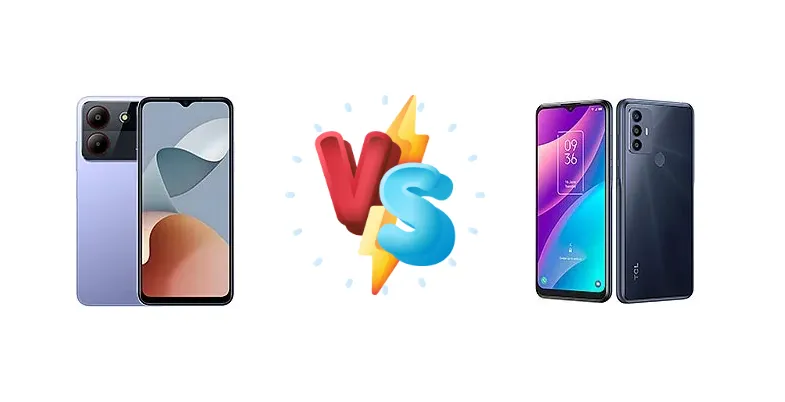
The ZTE Blade A54 and TCL 30 SE represent the fiercely competitive sub-$150 smartphone market. Both aim to deliver essential functionality at an accessible price, but they take different approaches to achieving this. The core difference lies in their chipsets: the ZTE utilizes a Unisoc SC9863A, while the TCL opts for a MediaTek Helio G25. This comparison will dissect these differences and determine which device offers the best value for budget-conscious consumers.
🏆 Quick Verdict
For the average user prioritizing a slightly faster charging experience and a more modern fabrication process, the TCL 30 SE is the better choice. Its 12nm Helio G25 offers a modest performance advantage and the inclusion of 15W charging is a practical benefit over the ZTE Blade A54’s unspecified charging speed.
| Network |
|---|
| 2G bands | GSM 850 / 900 / 1800 / 1900 | GSM 850 / 900 / 1800 / 1900 |
| 3G bands | HSDPA 850 / 900 / 1900 / 2100 | HSDPA 850 / 900 / 1900 / 2100 - EMEA/APAC |
| 4G bands | LTE | 1, 3, 5, 7, 8, 20, 28, 38, 40, 41 - EMEA |
| Speed | HSPA, LTE | HSPA 42.2/11.5 Mbps, LTE Cat4 150/50 Mbps |
| Technology | GSM / HSPA / LTE | GSM / HSPA / LTE |
| | - | 2, 3, 4, 5, 7, 8, 12, 13, 17, 26, 28, 66 - LATAM |
| Launch |
|---|
| Announced | 2023, September | 2022, February 27 |
| Status | Available. Released 2023, November | Available. Released 2022, April 20 |
| Body |
|---|
| Build | - | Glass front, plastic frame, plastic back |
| Dimensions | 164 x 75.8 x 8.5 mm (6.46 x 2.98 x 0.33 in) | 165.2 x 75.5 x 8.9 mm (6.50 x 2.97 x 0.35 in) |
| SIM | Nano-SIM + Nano-SIM | · Nano-SIM· Nano-SIM + Nano-SIM |
| Weight | 185 g (6.53 oz) | 190 g (6.70 oz) |
| Display |
|---|
| Resolution | 720 x 1612 pixels, 20:9 ratio (~267 ppi density) | 720 x 1600 pixels, 20:9 ratio (~269 ppi density) |
| Size | 6.6 inches, 104.6 cm2 (~84.2% screen-to-body ratio) | 6.52 inches, 102.6 cm2 (~82.3% screen-to-body ratio) |
| Type | IPS LCD, 90Hz | IPS LCD, 450 nits (typ) |
| Platform |
|---|
| CPU | Octa-core (4x1.6 GHz Cortex-A55 & 4x1.2 GHz Cortex-A55) | Octa-core (4x2.0 GHz Cortex-A53 & 4x1.5 GHz Cortex-A53) |
| Chipset | Unisoc SC9863A (28 nm) | Mediatek MT6762G Helio G25 (12 nm) |
| GPU | IMG8322 | PowerVR GE8320 |
| OS | Android 13 | Android 12, TCL UI 4.0 |
| Memory |
|---|
| Card slot | microSDXC (dedicated slot) | microSDXC (dedicated slot) |
| Internal | 64GB 4GB RAM, 128GB 4GB RAM | 64GB 4GB RAM, 128GB 4GB RAM |
| | - | eMMC 5.1 |
| Main Camera |
|---|
| Features | LED flash, HDR | LED flash, HDR, panorama |
| Single | 13 MP, (wide), AF
Auxiliary lens | 8 MP, f/2.0, 26mm (wide), 1/4", 1.12µm |
| Triple | - | 50 MP, f/1.9, 28mm (wide), 1/2.76", 0.64µm, PDAF
2 MP (macro)
Auxiliary lens |
| Video | 1080p@30fps | 1080p@30fps |
| Selfie camera |
|---|
| Features | - | HDR |
| Single | 2 MP (interpolated to 5 MP) | 8 MP, f/2.0, 26mm (wide), 1/4.0", 1.12µm |
| Video | Yes | 1080p@30fps |
| Sound |
|---|
| 3.5mm jack | - | Yes |
| 35mm jack | Yes | Yes |
| Loudspeaker | Yes | Yes |
| Comms |
|---|
| Bluetooth | 5.2, A2DP, LE | 5.0, A2DP, LE |
| NFC | Yes (market/region dependent) | Yes (6165H/6165H1 only) |
| Positioning | GPS | GPS, GLONASS, GALILEO, BDS |
| Radio | Unspecified | Unspecified |
| USB | USB Type-C 2.0 | USB Type-C 2.0 |
| WLAN | Wi-Fi 802.11 a/b/g/n/ac, dual-band | Wi-Fi 802.11 b/g/n, Wi-Fi Direct |
| Features |
|---|
| Sensors | Fingerprint (side-mounted), accelerometer | Fingerprint (rear-mounted), accelerometer, proximity, compass |
| Battery |
|---|
| Charging | - | 15W wired |
| Type | 5000 mAh | Li-Po 5000 mAh |
| Misc |
|---|
| Colors | Gray, Blue, Lilac | Atlantic Blue, Space Gray, Glacial Blue |
| Models | - | 6165H, 6156H1, 6165A, 6165A1, 6165S |
| Price | About 90 EUR | - |
ZTE Blade A54
- Potentially lower price point
- May offer longer standby time due to potentially larger battery (unconfirmed)
- Simple and straightforward user experience
- Less powerful processor
- Older 28nm chipset technology
- Slower charging (unspecified wattage)
TCL 30 SE
- More efficient 12nm chipset
- Faster 15W wired charging
- Slightly better CPU performance
- May be slightly more expensive
- Potentially smaller battery capacity (unconfirmed)
- Basic camera system
Display Comparison
Neither ZTE nor TCL provide detailed display specifications. Given the price bracket, both likely utilize LCD panels with 720p+ resolutions. However, the lack of information prevents a meaningful comparison of brightness, color accuracy, or viewing angles. Bezels are expected to be substantial on both devices, reflecting their budget nature. The absence of high refresh rate support is also a safe assumption.
Camera Comparison
Both devices are expected to feature basic camera setups. Without specific sensor details, it’s difficult to make a definitive judgment. However, the focus should be on the main sensor performance, as auxiliary lenses (often 2MP macro cameras) typically offer limited utility. Image processing will likely be basic on both, prioritizing speed over advanced features. Expect adequate results in well-lit conditions, but struggles in low light.
Performance
The TCL 30 SE’s MediaTek Helio G25, fabricated on a 12nm process, holds a clear architectural advantage over the ZTE Blade A54’s Unisoc SC9863A (28nm). While both are octa-core CPUs, the Helio G25 utilizes Cortex-A53 cores clocked at 2.0 GHz, compared to the A55 cores in the Unisoc chip clocked at 1.6 GHz and 1.2 GHz. This translates to a noticeable performance difference in app loading times and general responsiveness. The 12nm process also contributes to better thermal efficiency, potentially reducing throttling during sustained use. The Unisoc chip’s older 28nm node will likely result in higher power consumption for similar tasks.
Battery Life
Battery capacity is not specified for either device. However, the TCL 30 SE’s inclusion of 15W wired charging is a significant advantage. The ZTE Blade A54 lacks any charging specification, suggesting a slower charging rate. While a larger battery capacity on the ZTE could offset the slower charging, the Helio G25’s more efficient 12nm process in the TCL 30 SE may result in comparable or even better real-world battery life despite a potentially smaller capacity.
Buying Guide
Buy the ZTE Blade A54 if you prioritize a potentially lower price point and are comfortable with a less powerful processor for basic tasks like calls, texts, and light social media. Buy the TCL 30 SE if you prefer a slightly more responsive user experience, faster charging, and a chipset built on a more efficient manufacturing node, making it better suited for occasional gaming or multitasking.
Frequently Asked Questions
❓ Will the Helio G25 in the TCL 30 SE handle popular games like PUBG Mobile?
The Helio G25 can run PUBG Mobile, but expect to play at lower graphics settings and frame rates to maintain a stable experience. It's not a gaming-focused chipset, so demanding titles will likely require significant compromises.
❓ Is the Unisoc SC9863A known for overheating under load?
The Unisoc SC9863A, due to its older 28nm process, is more prone to thermal throttling than the Helio G25. Prolonged use of demanding apps may result in reduced performance as the chip attempts to manage heat.
❓ What type of storage and RAM do these phones use?
Details on storage and RAM types (eMMC vs UFS, LPDDR4 vs LPDDR4X) are not provided. However, given the price point, expect eMMC storage and LPDDR4 RAM in both devices. This will impact app loading times and multitasking performance compared to faster storage and RAM technologies.
❓ Do either of these phones support fast charging beyond the specified 15W?
No, neither phone is expected to support faster charging protocols. The TCL 30 SE’s 15W charging is the fastest available on either device, and the ZTE Blade A54’s charging speed is unspecified but likely slower.