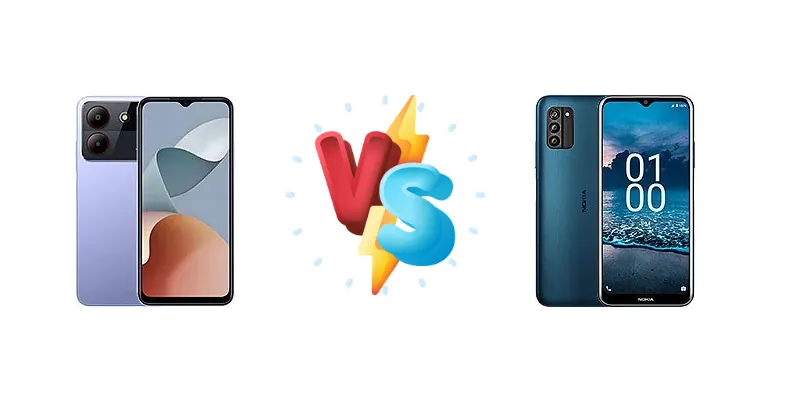
The sub-$200 smartphone market is fiercely competitive. The ZTE Blade A54 and Nokia G100 both aim to deliver essential smartphone functionality at an accessible price point, but they take different approaches. The Blade A54 relies on a Unisoc chipset, while the Nokia G100 opts for Qualcomm's Snapdragon 662. This comparison dives deep into the hardware to determine which phone offers the best value for your money.
🏆 Quick Verdict
For most users, the Nokia G100 emerges as the better choice. Its Snapdragon 662 chipset, built on an 11nm process, provides a noticeable performance advantage over the ZTE Blade A54’s 28nm Unisoc SC9863A. While the A54 may offer slightly longer battery life due to the less powerful processor, the G100’s smoother experience justifies the trade-off.
| Network |
|---|
| 2G bands | GSM 850 / 900 / 1800 / 1900 | GSM 850 / 900 / 1800 / 1900 |
| 3G bands | HSDPA 850 / 900 / 1900 / 2100 | HSDPA 850 / 1700(AWS) / 1900 |
| 4G bands | LTE | 2, 4, 5, 7, 12, 13, 17, 44, 66, 71 |
| Speed | HSPA, LTE | HSPA, LTE |
| Technology | GSM / HSPA / LTE | GSM / HSPA / LTE |
| Launch |
|---|
| Announced | 2023, September | 2022, September 22 |
| Status | Available. Released 2023, November | Available. Released 2022, October |
| Body |
|---|
| Build | - | Glass front, plastic frame, plastic back |
| Dimensions | 164 x 75.8 x 8.5 mm (6.46 x 2.98 x 0.33 in) | 166.6 x 76.7 x 8.9 mm (6.56 x 3.02 x 0.35 in) |
| SIM | Nano-SIM + Nano-SIM | Nano-SIM |
| Weight | 185 g (6.53 oz) | 195.1 g (6.88 oz) |
| Display |
|---|
| Resolution | 720 x 1612 pixels, 20:9 ratio (~267 ppi density) | 720 x 1600 pixels, 20:9 ratio (~269 ppi density) |
| Size | 6.6 inches, 104.6 cm2 (~84.2% screen-to-body ratio) | 6.52 inches, 102.6 cm2 (~80.3% screen-to-body ratio) |
| Type | IPS LCD, 90Hz | IPS LCD |
| Platform |
|---|
| CPU | Octa-core (4x1.6 GHz Cortex-A55 & 4x1.2 GHz Cortex-A55) | Octa-core (4x2.0 GHz Kryo 260 Gold & 4x1.8 GHz Kryo 260 Silver) |
| Chipset | Unisoc SC9863A (28 nm) | Qualcomm SM6115 Snapdragon 662 (11 nm) |
| GPU | IMG8322 | Adreno 610 |
| OS | Android 13 | Android 12 |
| Memory |
|---|
| Card slot | microSDXC (dedicated slot) | microSDXC |
| Internal | 64GB 4GB RAM, 128GB 4GB RAM | 32GB 3GB RAM, 128GB 4GB RAM |
| Main Camera |
|---|
| Features | LED flash, HDR | LED flash, HDR, panorama |
| Single | 13 MP, (wide), AF
Auxiliary lens | - |
| Triple | - | 13 MP, f/1.8, (wide), AF
5 MP, f/2.2, 115˚ (ultrawide), 1/5.0"
Auxiliary lens |
| Video | 1080p@30fps | 1080p@30fps |
| Selfie camera |
|---|
| Single | 2 MP (interpolated to 5 MP) | 8 MP, f/2.0, (wide), 1/4.0", 1.12µm |
| Video | Yes | 1080p@30fps |
| Sound |
|---|
| 35mm jack | Yes | Yes |
| Loudspeaker | Yes | Yes |
| Comms |
|---|
| Bluetooth | 5.2, A2DP, LE | 5.0, A2DP, LE |
| NFC | Yes (market/region dependent) | No |
| Positioning | GPS | GPS |
| Radio | Unspecified | FM radio |
| USB | USB Type-C 2.0 | USB Type-C 2.0, OTG |
| WLAN | Wi-Fi 802.11 a/b/g/n/ac, dual-band | Wi-Fi 802.11 b/g/n/ac, dual-band |
| Features |
|---|
| Sensors | Fingerprint (side-mounted), accelerometer | Fingerprint (side-mounted), accelerometer, gyro, proximity, barometer |
| Battery |
|---|
| Charging | - | 15W wired |
| Type | 5000 mAh | Li-Po 5000 mAh |
| Misc |
|---|
| Colors | Gray, Blue, Lilac | Nordic Blue |
| Price | About 90 EUR | About 60 EUR |
ZTE Blade A54
- Potentially longer battery life due to less powerful chipset
- Likely the more affordable option
- May include features not found on the G100 (dependent on regional variations)
- Significantly slower performance compared to the Snapdragon 662
- Less efficient chipset leading to potential heat issues
- Likely lower quality display
Nokia G100
- Faster and more responsive performance thanks to the Snapdragon 662
- More efficient chipset for better sustained performance
- Superior image processing capabilities
- Slightly shorter battery life compared to the ZTE Blade A54
- 15W charging is relatively slow
- May be slightly more expensive
Display Comparison
Neither device boasts a standout display. Given the provided data, a direct comparison is limited. However, the Nokia G100, being a slightly more recent release, likely benefits from improved color calibration and viewing angles. The ZTE Blade A54’s display specifications are unavailable, but given its price point, it likely utilizes a lower-quality panel. Both will likely feature 720p+ resolution displays, adequate for the screen sizes typically found in this segment.
Camera Comparison
Without detailed camera specifications, a precise comparison is difficult. However, it’s reasonable to assume both phones feature basic camera setups geared towards casual photography. The Nokia G100, benefiting from Qualcomm’s image signal processor (ISP) within the Snapdragon 662, likely offers superior image processing capabilities, resulting in better dynamic range and noise reduction. The ZTE Blade A54’s Unisoc chipset likely has a less sophisticated ISP, potentially leading to less refined image quality. The presence of a 2MP macro camera on either device is largely a marketing gimmick and should not be a deciding factor.
Performance
The core difference lies in the chipsets. The Nokia G100’s Qualcomm Snapdragon 662 (11nm) is significantly more efficient and powerful than the ZTE Blade A54’s Unisoc SC9863A (28nm). The 11nm fabrication process allows for higher transistor density and lower power consumption, translating to better sustained performance and reduced thermal throttling. The Snapdragon 662’s Kryo 260 Gold cores, clocked at 2.0 GHz, offer a substantial performance boost over the Cortex-A55 cores in the Unisoc chip, which are split between 1.6 GHz and 1.2 GHz. This means faster app loading times, smoother multitasking, and a more responsive overall experience on the Nokia G100.
Battery Life
The ZTE Blade A54, with its less power-hungry Unisoc chipset, likely offers slightly longer battery life on a single charge. However, the Nokia G100’s 15W wired charging provides a faster replenishment rate. While neither phone offers particularly fast charging, the G100’s ability to top up quicker is a convenience. The actual battery capacity of both devices is unknown, but the efficiency of the Snapdragon 662 will minimize the impact of a potentially smaller battery size.
Buying Guide
Buy the ZTE Blade A54 if your primary need is absolute minimal cost and you prioritize maximizing battery life over performance, understanding that multitasking and demanding apps will be sluggish. Buy the Nokia G100 if you value a more responsive user experience, smoother app switching, and a chipset capable of handling everyday tasks with greater ease, even if it means slightly faster battery drain and a reliance on 15W charging.
Frequently Asked Questions
❓ Will the Unisoc SC9863A in the ZTE Blade A54 struggle with popular apps like TikTok or Facebook?
Yes, the Unisoc SC9863A is a low-end chipset and will likely exhibit noticeable lag and slowdowns when running demanding apps like TikTok or Facebook, especially with multiple apps open simultaneously. Expect longer loading times and occasional stutters.
❓ Is the 15W charging on the Nokia G100 slow compared to other smartphones?
Yes, 15W charging is considered relatively slow by today's standards. While it will still charge the phone overnight, it will take significantly longer to reach a full charge compared to phones with 30W or higher charging capabilities. Expect a 0-100% charge to take around 2.5 to 3.5 hours.
❓ Can the Nokia G100 handle basic mobile gaming?
The Nokia G100, with its Snapdragon 662, can handle basic mobile gaming at low to medium settings. Demanding titles like PUBG Mobile or Call of Duty: Mobile will likely require significant graphical compromises to maintain a playable frame rate. The ZTE Blade A54 will struggle even with the lowest settings.