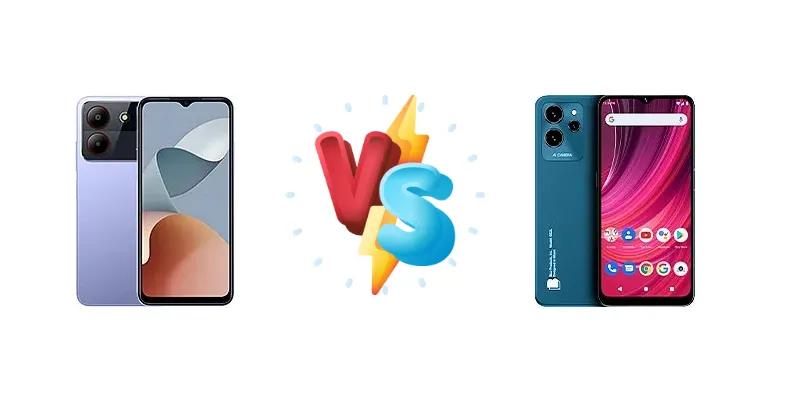
The ZTE Blade A54 and BLU G52L represent the fiercely competitive sub-$150 smartphone market. Both aim to deliver essential functionality at an accessible price point, but differ in their underlying hardware. This comparison dissects those differences, focusing on the impact of the ZTE’s Unisoc SC9863A chipset versus the BLU’s octa-core processor, to determine which device offers the best value.
🏆 Quick Verdict
For the average user prioritizing consistent performance, the ZTE Blade A54 emerges as the slightly better choice. Its Unisoc SC9863A chipset, while not a powerhouse, offers a more defined architecture with a mix of Cortex-A55 cores clocked at different speeds, potentially leading to smoother multitasking than the BLU G52L’s uniformly clocked cores.
| Network |
|---|
| 2G bands | GSM 850 / 900 / 1800 / 1900 | GSM 850 / 900 / 1800 / 1900 |
| 3G bands | HSDPA 850 / 900 / 1900 / 2100 | HSDPA 850 / 900 / 1700(AWS) / 1900 / 2100 |
| 4G bands | LTE | 2, 3, 4, 5, 7, 12, 17, 28, 66 |
| Speed | HSPA, LTE | HSPA, LTE |
| Technology | GSM / HSPA / LTE | GSM / HSPA / LTE |
| Launch |
|---|
| Announced | 2023, September | 2023, January |
| Status | Available. Released 2023, November | Available. Released 2023, February |
| Body |
|---|
| Dimensions | 164 x 75.8 x 8.5 mm (6.46 x 2.98 x 0.33 in) | 164.5 x 76 x 9.2 mm (6.48 x 2.99 x 0.36 in) |
| SIM | Nano-SIM + Nano-SIM | Nano-SIM + Nano-SIM |
| Weight | 185 g (6.53 oz) | 195 g (6.88 oz) |
| Display |
|---|
| Resolution | 720 x 1612 pixels, 20:9 ratio (~267 ppi density) | 720 x 1600 pixels, 20:9 ratio (~270 ppi density) |
| Size | 6.6 inches, 104.6 cm2 (~84.2% screen-to-body ratio) | 6.5 inches, 102.0 cm2 (~81.6% screen-to-body ratio) |
| Type | IPS LCD, 90Hz | IPS LCD |
| Platform |
|---|
| CPU | Octa-core (4x1.6 GHz Cortex-A55 & 4x1.2 GHz Cortex-A55) | Octa-core 1.6 GHz Cortex-A55 |
| Chipset | Unisoc SC9863A (28 nm) | - |
| GPU | IMG8322 | - |
| OS | Android 13 | Android 12 |
| Memory |
|---|
| Card slot | microSDXC (dedicated slot) | microSDXC |
| Internal | 64GB 4GB RAM, 128GB 4GB RAM | 64GB 2GB RAM |
| | - | eMMC 5.1 |
| Main Camera |
|---|
| Features | LED flash, HDR | LED flash, HDR, panorama |
| Single | 13 MP, (wide), AF
Auxiliary lens | 8 MP |
| Triple | - | 13 MP
0.3 MP (macro)
Auxiliary lens |
| Video | 1080p@30fps | 1080p@30fps |
| Selfie camera |
|---|
| Single | 2 MP (interpolated to 5 MP) | 8 MP |
| Video | Yes | 1080p@30fps |
| Sound |
|---|
| 3.5mm jack | - | Yes |
| 35mm jack | Yes | Yes |
| Loudspeaker | Yes | Yes |
| Comms |
|---|
| Bluetooth | 5.2, A2DP, LE | 4.2, A2DP, LE |
| NFC | Yes (market/region dependent) | No |
| Positioning | GPS | GPS |
| Radio | Unspecified | FM radio |
| USB | USB Type-C 2.0 | USB Type-C 2.0 |
| WLAN | Wi-Fi 802.11 a/b/g/n/ac, dual-band | Wi-Fi 802.11 а/b/g/n, Wi-Fi Direct |
| Features |
|---|
| Sensors | Fingerprint (side-mounted), accelerometer | Fingerprint (side-mounted), accelerometer |
| Battery |
|---|
| Type | 5000 mAh | Li-Po 5000 mAh |
| Misc |
|---|
| Colors | Gray, Blue, Lilac | Grey, Blue, Burgundy, Mint Blue |
| Price | About 90 EUR | About 90 EUR |
ZTE Blade A54
- Potentially smoother multitasking due to chipset architecture.
- Unisoc chipset may offer slightly better sustained performance.
- ZTE has a longer track record in the smartphone market.
- Unisoc SC9863A is a relatively older chipset.
- Limited information available on display and camera specs.
BLU G52L
- Potentially lower price point.
- Simple and straightforward processor configuration.
- BLU offers a wide range of affordable devices.
- Uniformly clocked cores may lead to less efficient task management.
- Limited brand recognition compared to ZTE.
Display Comparison
Neither ZTE nor BLU provide display specifications beyond resolution. Given the price bracket, both likely utilize LCD panels. The absence of details like peak brightness or color gamut makes a direct comparison impossible. However, the ZTE Blade A54’s potential for a slightly more refined display experience isn’t ruled out, as ZTE often incorporates basic display enhancements even in budget models. The BLU G52L likely prioritizes cost savings, potentially resulting in a more basic display.
Camera Comparison
Detailed camera specifications are unavailable for either device. Given the market segment, both likely feature basic camera setups. It’s reasonable to assume both will include a primary camera and potentially a depth or macro sensor. Without knowing sensor sizes, apertures, or image processing capabilities, a meaningful comparison is impossible. The presence of a 2MP macro lens on either device should be viewed with skepticism, as image quality is likely to be limited.
Performance
The core difference lies in the chipsets. The ZTE Blade A54’s Unisoc SC9863A is an octa-core processor built on a 28nm process, featuring a heterogeneous core configuration: four Cortex-A55 cores clocked at 1.6GHz and four at 1.2GHz. This tiered approach allows for power efficiency during light tasks and a performance boost when needed. The BLU G52L, conversely, utilizes an octa-core processor with all cores clocked at 1.6GHz Cortex-A55. While both are entry-level, the Unisoc’s architecture *suggests* better task scheduling and potentially smoother performance in multi-threaded applications. The 28nm process node of the Unisoc is less efficient than newer nodes, but the difference is unlikely to be significant in these devices.
Battery Life
Battery capacity and charging wattage are not specified for either device. In this price range, expect capacities around 3000-4000mAh. The lack of fast charging support is almost certain. Real-world battery life will heavily depend on usage patterns, but the slightly more efficient chipset architecture of the ZTE Blade A54 *could* translate to marginally longer battery life under similar workloads. Without concrete data, this remains speculative.
Buying Guide
Buy the ZTE Blade A54 if you need a device capable of handling moderate multitasking and appreciate the potential for slightly better sustained performance due to its chipset architecture. Buy the BLU G52L if you prioritize simplicity and a potentially lower price point, and your usage primarily revolves around basic tasks like calls, texts, and light social media browsing.
Frequently Asked Questions
❓ Will the Unisoc SC9863A in the ZTE Blade A54 struggle with modern mobile games?
The Unisoc SC9863A is an entry-level chipset and will likely struggle with graphically demanding games at high settings. Expect to play simpler games or reduce graphics settings significantly for a playable experience. The BLU G52L will likely perform similarly, if not slightly worse, in gaming scenarios.
❓ Is the BLU G52L a good option for someone who primarily uses their phone for calls and texts?
Yes, the BLU G52L is a perfectly adequate option for basic communication. Its octa-core processor is sufficient for handling calls, texts, and light web browsing. If your needs are minimal, the BLU G52L offers a cost-effective solution.
❓ Does either phone support VoLTE or Wi-Fi calling?
Support for VoLTE and Wi-Fi calling varies by carrier and region. Neither ZTE nor BLU explicitly lists these features for these specific models. It's crucial to check with your carrier to confirm compatibility before purchasing either device.