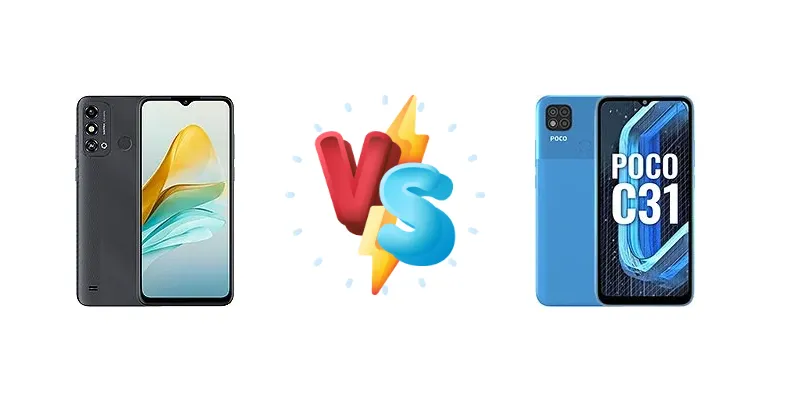
The sub-$150 smartphone market is fiercely competitive. Both the ZTE Blade A53 and Xiaomi Poco C31 aim to deliver essential smartphone functionality at an incredibly affordable price. However, they take different approaches to achieving this, primarily through their chipset choices. This comparison dissects those differences and determines which device offers the best value for your money.
🏆 Quick Verdict
For the average user prioritizing responsiveness and a slightly smoother experience, the Xiaomi Poco C31 is the better choice. Its MediaTek Helio G35, built on a more efficient 12nm process, provides a noticeable performance advantage over the ZTE Blade A53’s Unisoc SC9863A1, despite both being entry-level processors. Both offer similar battery and charging capabilities.
| Network |
|---|
| 2G bands | GSM 850 / 900 / 1800 / 1900 | GSM 850 / 900 / 1800 / 1900 |
| 3G bands | HSDPA 850 / 900 / 1900 / 2100 | HSDPA 850 / 900 / 2100 |
| 4G bands | LTE | 1, 3, 5, 8, 40, 41 |
| Speed | HSPA, LTE | HSPA, LTE |
| Technology | GSM / HSPA / LTE | GSM / HSPA / LTE |
| Launch |
|---|
| Announced | 2023, April | 2021, September 30 |
| Status | Available. Released 2023, April | Available. Released 2021, October 02 |
| Body |
|---|
| Dimensions | 165.7 x 76.4 x 9.1 mm (6.52 x 3.01 x 0.36 in) | 164.9 x 77.1 x 9 mm (6.49 x 3.04 x 0.35 in) |
| SIM | Nano-SIM + Nano-SIM | Nano-SIM + Nano-SIM |
| Weight | - | 194 g (6.84 oz) |
| Display |
|---|
| Resolution | 720 x 1600 pixels, 20:9 ratio (~269 ppi density) | 720 x 1600 pixels, 20:9 ratio (~269 ppi density) |
| Size | 6.52 inches, 102.6 cm2 (~81.1% screen-to-body ratio) | 6.53 inches, 102.9 cm2 (~81.0% screen-to-body ratio) |
| Type | IPS LCD | IPS LCD |
| Platform |
|---|
| CPU | Octa-core (4x1.6 GHz Cortex-A55 & 4x1.2 GHz Cortex-A55) | Octa-core (4x2.3 GHz Cortex-A53 & 4x1.8 GHz Cortex-A53) |
| Chipset | Unisoc SC9863A1 (22 nm) | Mediatek MT6765G Helio G35 (12 nm) |
| GPU | IMG8322 | PowerVR GE8320 |
| OS | Android 12 (Go edition) | Android 10, MIUI 12 |
| Memory |
|---|
| Card slot | microSDXC (uses shared SIM slot) | microSDXC (dedicated slot) |
| Internal | 32GB 2GB RAM | 32GB 3GB RAM, 64GB 4GB RAM |
| | - | eMMC 5.1 |
| Main Camera |
|---|
| Features | LED flash | LED flash, HDR |
| Single | 8 MP, AF | 5 MP, f/2.2, (wide), 1.12µm |
| Triple | - | 13 MP, f/2.2, (wide), 1.0µm, PDAF
2 MP (macro)
Auxiliary lens |
| Video | 1080p@30fps | 1080p@30fps |
| Selfie camera |
|---|
| Features | - | HDR |
| Single | 5 MP | 5 MP, f/2.2, (wide), 1.12µm |
| Video | Yes | 1080p@30fps |
| Sound |
|---|
| 3.5mm jack | - | Yes |
| 35mm jack | Yes | Yes |
| Loudspeaker | Yes | Yes |
| Comms |
|---|
| Bluetooth | 4.2, A2DP | 5.0, A2DP, LE |
| NFC | Yes (market/region dependent) | No |
| Positioning | GPS | GPS, GLONASS, BDS |
| Radio | Unspecified | FM radio |
| USB | microUSB | microUSB 2.0, OTG |
| WLAN | Wi-Fi 802.11 b/g/n | Wi-Fi 802.11 a/b/g/n, Wi-Fi Direct |
| Features |
|---|
| Sensors | Fingerprint (rear-mounted), accelerometer, proximity | Fingerprint (rear-mounted), accelerometer, proximity |
| Battery |
|---|
| Charging | 10W wired | 10W wired |
| Type | 4000 mAh | Li-Po 5000 mAh |
| Misc |
|---|
| Colors | Gray, Blue, Green | Royal Blue, Shadow Gray |
| Models | - | MZB0A0MIN, MZB0A0KIN, 211033MI, 22031116AI |
| Price | - | About 90 EUR |
| SAR | - | 0.51 W/kg (head) 0.83 W/kg (body) |
ZTE Blade A53
- Potentially lower price point
- Adequate for basic smartphone tasks
- Simple and straightforward user experience
- Less powerful processor
- Older 22nm manufacturing process
- Potentially slower app loading times
Xiaomi Poco C31
- More responsive performance
- More efficient 12nm processor
- Slightly better gaming capabilities
- May be slightly more expensive
- Basic camera system
- Slow 10W charging
Display Comparison
Neither ZTE nor Xiaomi provide detailed display specifications beyond resolution. Given the price point, both likely utilize LCD panels. The absence of information regarding peak brightness, color gamut coverage, or refresh rates suggests both displays are geared towards basic visibility rather than media consumption. Bezels are expected to be substantial on both devices, maximizing screen real estate within a budget-friendly form factor. Color accuracy is likely to be standard for this segment.
Camera Comparison
Detailed camera specifications are scarce for both devices. It’s safe to assume both feature basic camera setups geared towards casual photography. Without sensor size or aperture information, a direct comparison is difficult. However, the focus should be on the primary sensor’s capabilities, as auxiliary lenses (often 2MP macro lenses found in this segment) offer limited practical benefit. Image processing will likely be basic on both, relying heavily on software algorithms to enhance image quality. Expect acceptable results in well-lit conditions, but struggles in low light.
Performance
The core difference lies in the chipsets. The Poco C31’s MediaTek Helio G35 (12nm) boasts a faster CPU clock speed (2.3 GHz vs 1.6 GHz) and utilizes Cortex-A53 cores across all eight, while the ZTE Blade A53’s Unisoc SC9863A1 mixes Cortex-A55 and A55 cores with varying clock speeds. The 12nm process of the Helio G35 offers improved power efficiency compared to the 22nm process of the Unisoc chip, translating to potentially better sustained performance and less heat generation. While both are entry-level, the Helio G35 is a more recent design, offering a slight architectural advantage. This will be most noticeable in app loading times and multitasking.
Battery Life
Both the ZTE Blade A53 and Xiaomi Poco C31 feature 10W wired charging. This is standard for this price range and translates to a relatively slow charging speed – expect over 3 hours for a full charge from 0%. Battery capacity is not specified, but given the similar form factors and target market, they likely hover around the 4000-5000 mAh range. The Helio G35’s improved power efficiency might translate to slightly longer battery life on the Poco C31, but the difference will likely be marginal in real-world usage.
Buying Guide
Buy the ZTE Blade A53 if you prioritize a potentially lower price point and are primarily focused on basic tasks like calls, texts, and light social media browsing. The Unisoc chipset is adequate for these scenarios. Buy the Xiaomi Poco C31 if you want a more responsive user experience, slightly better gaming performance, and a processor built on a more modern manufacturing process, even if it means spending a little more.
Frequently Asked Questions
❓ Will the Poco C31 handle popular games like PUBG Mobile?
The Helio G35 in the Poco C31 can run PUBG Mobile, but you'll need to lower the graphics settings to medium or low and the frame rate to achieve a playable experience. Don't expect high frame rates or ultra-smooth gameplay. The ZTE Blade A53 will struggle even more with demanding titles.
❓ Is the Unisoc SC9863A1 chipset known for overheating?
The Unisoc SC9863A1 is an entry-level chipset and can experience some thermal throttling under sustained load. While it won't get dangerously hot, you might notice performance slowdowns during prolonged gaming or video recording. The Helio G35 in the Poco C31, due to its more efficient process, is less prone to overheating.
❓ How long will it take to fully charge both phones?
With their 10W charging capabilities, both the ZTE Blade A53 and Xiaomi Poco C31 will take approximately 3 to 4 hours to fully charge from 0% to 100%. This is typical for budget smartphones and requires overnight charging.