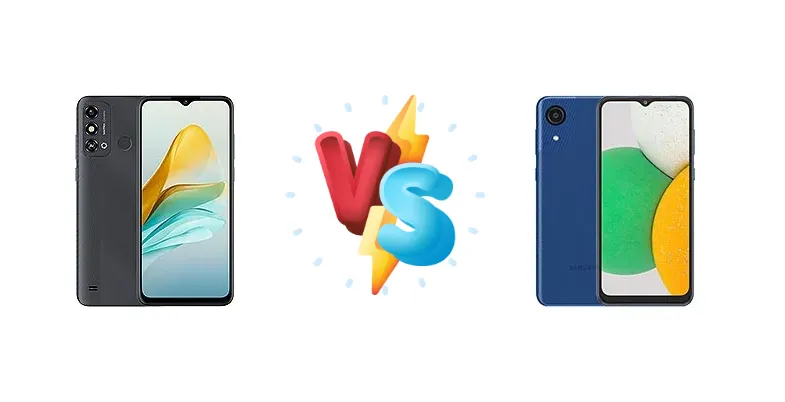
The ZTE Blade A53 and Samsung Galaxy A03 Core represent the absolute entry point into the Android ecosystem. Both target users prioritizing affordability, but subtle differences in their underlying hardware can significantly impact the user experience. This comparison dissects those differences, focusing on the core performance and efficiency trade-offs.
🏆 Quick Verdict
For the average user seeking a functional, no-frills Android experience, the ZTE Blade A53 emerges as the slightly better choice. Its Unisoc SC9863A1 chipset, fabricated on a smaller 22nm process, offers a marginal efficiency advantage over the A03 Core’s 28nm SC9863A, potentially leading to slightly better battery life during sustained use.
| Network |
|---|
| 2G bands | GSM 850 / 900 / 1800 / 1900 | GSM 850 / 900 / 1800 / 1900 |
| 3G bands | HSDPA 850 / 900 / 1900 / 2100 | HSDPA 850 / 900 / 2100 |
| 4G bands | LTE | 1, 3, 5, 7, 8, 20, 28, 38, 40, 41 |
| Speed | HSPA, LTE | HSPA 21.1/5.76 Mbps, LTE |
| Technology | GSM / HSPA / LTE | GSM / HSPA / LTE |
| Launch |
|---|
| Announced | 2023, April | 2021, November 15 |
| Status | Available. Released 2023, April | Available. Released 2021, December 06 |
| Body |
|---|
| Build | - | Plastic back, plastic frame |
| Dimensions | 165.7 x 76.4 x 9.1 mm (6.52 x 3.01 x 0.36 in) | 164.2 x 75.9 x 9.1 mm (6.46 x 2.99 x 0.36 in) |
| SIM | Nano-SIM + Nano-SIM | · Nano-SIM· Nano-SIM + Nano-SIM |
| Weight | - | 211 g (7.44 oz) |
| Display |
|---|
| Resolution | 720 x 1600 pixels, 20:9 ratio (~269 ppi density) | 720 x 1600 pixels, 20:9 ratio (~270 ppi density) |
| Size | 6.52 inches, 102.6 cm2 (~81.1% screen-to-body ratio) | 6.5 inches, 102.0 cm2 (~81.8% screen-to-body ratio) |
| Type | IPS LCD | PLS LCD |
| Platform |
|---|
| CPU | Octa-core (4x1.6 GHz Cortex-A55 & 4x1.2 GHz Cortex-A55) | Octa-core (4x1.6 GHz Cortex-A55 & 4x1.2 GHz Cortex-A55) |
| Chipset | Unisoc SC9863A1 (22 nm) | Unisoc SC9863A (28 nm) |
| GPU | IMG8322 | IMG8322 |
| OS | Android 12 (Go edition) | Android 11 (Go edition) |
| Memory |
|---|
| Card slot | microSDXC (uses shared SIM slot) | microSDXC (dedicated slot) |
| Internal | 32GB 2GB RAM | 32GB 2GB RAM |
| | - | eMMC 5.1 |
| Main Camera |
|---|
| Features | LED flash | LED flash |
| Single | 8 MP, AF | 8 MP, f/2.0, AF |
| Video | 1080p@30fps | 1080p@30fps |
| Selfie camera |
|---|
| Single | 5 MP | 5 MP, f/2.2 |
| Video | Yes | - |
| Sound |
|---|
| 3.5mm jack | - | Yes |
| 35mm jack | Yes | Yes |
| Loudspeaker | Yes | Yes |
| Comms |
|---|
| Bluetooth | 4.2, A2DP | 4.2, A2DP |
| NFC | Yes (market/region dependent) | No |
| Positioning | GPS | GPS, GLONASS |
| Radio | Unspecified | Unspecified |
| USB | microUSB | microUSB 2.0, OTG |
| WLAN | Wi-Fi 802.11 b/g/n | Wi-Fi 802.11 b/g/n, Wi-Fi Direct |
| Features |
|---|
| Sensors | Fingerprint (rear-mounted), accelerometer, proximity | Accelerometer, proximity |
| Battery |
|---|
| Charging | 10W wired | - |
| Type | 4000 mAh | Li-Ion 5000 mAh |
| Misc |
|---|
| Colors | Gray, Blue, Green | Black, Blue |
| Models | - | SM-A032F, SM-A032F/DS, SM-A032M |
| Price | - | £ 74.99 |
| SAR | - | 0.30 W/kg (head) |
| SAR EU | - | 0.24 W/kg (head) 1.39 W/kg (body) |
ZTE Blade A53
- More efficient chipset (22nm process)
- Potentially better thermal management
- Slightly better battery life expected
- Less established brand reputation
- Potentially less refined software experience
Samsung Galaxy A03 Core
- Samsung brand recognition
- Potentially smoother software experience (Android Go)
- Wider availability in some markets
- Less efficient chipset (28nm process)
- Potentially shorter battery life
- May experience more thermal throttling
Display Comparison
Neither device boasts a standout display. Both likely utilize LCD panels, typical for this price bracket. Detailed display specs (resolution, brightness) are unavailable, but the focus here is on internal components. The absence of higher refresh rates or advanced panel technologies like LTPO is expected, meaning users should anticipate standard 60Hz refresh rates and average viewing experiences.
Camera Comparison
Camera performance on both devices will be limited. Detailed camera specs are unavailable, but it’s safe to assume both feature basic camera setups. The market segment suggests reliance on software processing to enhance image quality. Any differences in image quality will likely stem from Samsung’s image processing algorithms, which are generally more refined, rather than superior hardware. The presence of low-resolution auxiliary cameras (often 2MP) on both devices is likely, and these should be considered largely for marketing purposes rather than practical use.
Performance
The core of the performance difference lies in the chipset fabrication process. The ZTE Blade A53’s Unisoc SC9863A1 is built on a 22nm process, while the Samsung Galaxy A03 Core uses the 28nm Unisoc SC9863A. A smaller process node generally translates to improved power efficiency and potentially higher transistor density, allowing for better performance at a given power level. Both devices share the same CPU configuration – an octa-core setup with 4x1.6 GHz Cortex-A55 cores and 4x1.2 GHz Cortex-A55 cores – meaning raw CPU performance will be very similar. However, the 22nm node of the A53 *should* result in less heat generation under sustained load, potentially mitigating thermal throttling. The impact on GPU performance is also likely to be minimal, but the A53 has a slight edge.
Battery Life
Battery capacity is not specified for either device. However, the 22nm process of the ZTE Blade A53’s chipset offers a potential advantage in battery life. A more efficient chipset consumes less power for the same tasks, translating to longer runtimes. While the Samsung Galaxy A03 Core’s 28nm chipset will still provide adequate battery life for basic usage, the A53 is likely to last slightly longer on a single charge. Both devices feature 10W wired charging, indicating relatively slow charging speeds – expect several hours to fully charge from 0%.
Buying Guide
Buy the ZTE Blade A53 if you prioritize a marginally more efficient processor for longer app usage and are comfortable with a potentially less polished software experience. Buy the Samsung Galaxy A03 Core if you value the Samsung brand reputation, a potentially more streamlined software experience (often with Android Go Edition), and are willing to accept a slightly less efficient chipset. Both are ideal for basic communication, social media, and light web browsing.
Frequently Asked Questions
❓ Will the Unisoc SC9863A chipset struggle with multitasking?
The Unisoc SC9863A and SC9863A1 are entry-level chipsets. While capable of handling basic multitasking (switching between messaging, web browsing, and music), they will likely struggle with demanding applications or running multiple apps simultaneously. Expect some slowdowns and app reloading when pushing the limits.
❓ Is the 10W charging speed acceptable for daily use?
10W charging is relatively slow by modern standards. Expect a full charge to take several hours (likely 3-5 hours). This is acceptable for overnight charging, but inconvenient if you need a quick top-up during the day. Both devices are designed for light usage, so running out of battery completely shouldn't be a frequent occurrence.
❓ Does either phone support VoLTE or Wi-Fi calling?
Support for VoLTE (Voice over LTE) and Wi-Fi calling varies by carrier and region. It's crucial to check with your mobile carrier to confirm compatibility before purchasing either device, as these features are essential for reliable voice calls in areas with limited cellular coverage.