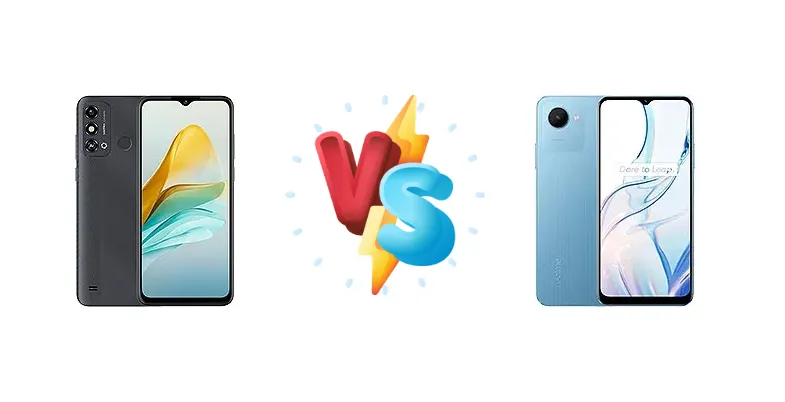
The ZTE Blade A53 and Realme C30s represent the ultra-budget end of the smartphone spectrum, targeting first-time buyers or those needing a reliable secondary device. Both devices aim to deliver essential smartphone functionality at the lowest possible price point, but differ in their underlying hardware. This comparison dissects those differences to determine which offers the best value.
🏆 Quick Verdict
For the average user prioritizing consistent, if modest, performance, the Realme C30s edges out the ZTE Blade A53. While both utilize 10W charging, the Realme C30s’ slightly higher clocked CPU provides a smoother experience in everyday tasks, making it the better choice for basic smartphone use.
| Network |
|---|
| 2G bands | GSM 850 / 900 / 1800 / 1900 | GSM 850 / 900 / 1800 / 1900 |
| 3G bands | HSDPA 850 / 900 / 1900 / 2100 | HSDPA 850 / 900 / 2100 |
| 4G bands | LTE | 1, 3, 5, 8, 38, 40, 41 |
| Speed | HSPA, LTE | HSPA, LTE |
| Technology | GSM / HSPA / LTE | GSM / HSPA / LTE |
| Launch |
|---|
| Announced | 2023, April | 2022, September 14 |
| Status | Available. Released 2023, April | Available. Released 2022, September 23 |
| Body |
|---|
| Build | - | Glass front, plastic frame, plastic back |
| Dimensions | 165.7 x 76.4 x 9.1 mm (6.52 x 3.01 x 0.36 in) | 164.2 x 75.7 x 8.5 mm (6.46 x 2.98 x 0.33 in) |
| SIM | Nano-SIM + Nano-SIM | Nano-SIM + Nano-SIM |
| Weight | - | 186 g (6.56 oz) |
| Display |
|---|
| Resolution | 720 x 1600 pixels, 20:9 ratio (~269 ppi density) | 720 x 1600 pixels, 20:9 ratio (~270 ppi density) |
| Size | 6.52 inches, 102.6 cm2 (~81.1% screen-to-body ratio) | 6.5 inches, 102.0 cm2 (~82.1% screen-to-body ratio) |
| Type | IPS LCD | IPS LCD |
| Platform |
|---|
| CPU | Octa-core (4x1.6 GHz Cortex-A55 & 4x1.2 GHz Cortex-A55) | Octa-core 1.6 GHz Cortex-A55 |
| Chipset | Unisoc SC9863A1 (22 nm) | - |
| GPU | IMG8322 | IMG8322 |
| OS | Android 12 (Go edition) | Android 12, Realme UI Go |
| Memory |
|---|
| Card slot | microSDXC (uses shared SIM slot) | microSDXC (dedicated slot) |
| Internal | 32GB 2GB RAM | 32GB 2GB RAM, 32GB 3GB RAM, 64GB 3GB RAM, 64GB 4GB RAM |
| Main Camera |
|---|
| Features | LED flash | LED flash, HDR, panorama |
| Single | 8 MP, AF | 8 MP, (wide), 1/4.0", 1.12µm |
| Video | 1080p@30fps | 1080p@30fps |
| Selfie camera |
|---|
| Features | - | HDR |
| Single | 5 MP | 5 MP, (wide), 1/5.0", 1.12µm |
| Video | Yes | 720p@30fps |
| Sound |
|---|
| 3.5mm jack | - | Yes |
| 35mm jack | Yes | Yes |
| Loudspeaker | Yes | Yes |
| Comms |
|---|
| Bluetooth | 4.2, A2DP | 4.2, A2DP |
| NFC | Yes (market/region dependent) | No |
| Positioning | GPS | GPS, GLONASS |
| Radio | Unspecified | Unspecified |
| USB | microUSB | microUSB 2.0, OTG |
| WLAN | Wi-Fi 802.11 b/g/n | Wi-Fi 802.11 b/g/n |
| Features |
|---|
| Sensors | Fingerprint (rear-mounted), accelerometer, proximity | Fingerprint (side-mounted), accelerometer, proximity |
| Battery |
|---|
| Charging | 10W wired | 10W wired |
| Type | 4000 mAh | 5000 mAh |
| Misc |
|---|
| Colors | Gray, Blue, Green | Stripe Blue, Stripe Black |
| Models | - | RMX3690 |
| Price | - | About 100 EUR |
ZTE Blade A53
- Unisoc chipset offers potential carrier compatibility advantages.
- Potentially slightly better battery life under light use due to chipset efficiency.
- May be available at a lower price point.
- Split-core CPU configuration may introduce minor latency.
- Likely less optimized software experience compared to Realme.
Realme C30s
- Uniformly clocked CPU for potentially smoother performance.
- Realme UI typically offers a cleaner and more refined software experience.
- Slightly better responsiveness in everyday tasks.
- May be slightly more expensive than the ZTE Blade A53.
- 10W charging is slow and inconvenient.
Display Comparison
Neither ZTE nor Realme provide display specifications beyond size. Given the price point, both likely utilize LCD panels with 720p+ resolution. The absence of details like peak brightness or color gamut suggests a focus on cost reduction, meaning users should expect basic viewing experiences. Bezels are likely substantial on both devices, further emphasizing their budget nature.
Camera Comparison
Camera details are sparse for both devices. It’s safe to assume both feature a primary camera and potentially a secondary depth sensor. Given the target market, image quality will be basic, suitable for casual snapshots in good lighting conditions. The absence of OIS (Optical Image Stabilization) on either device means low-light performance will be limited. Focusing on megapixel counts alone is misleading; sensor size and image processing algorithms are far more critical, and details on these are unavailable.
Performance
The core difference lies in the chipset. The ZTE Blade A53 features the Unisoc SC9863A1, an octa-core processor with a split core configuration: four Cortex-A55 cores clocked at 1.6 GHz and four at 1.2 GHz. The Realme C30s, however, utilizes an octa-core CPU clocked uniformly at 1.6 GHz, all Cortex-A55 cores. While both are based on the efficient Cortex-A55 architecture, the Realme’s consistent clock speed across all cores *should* translate to slightly smoother multitasking and app launches. The Unisoc’s dual-clock approach might introduce minor latency as tasks switch between core groups. Both devices will struggle with demanding games or heavy multitasking.
Battery Life
Both the ZTE Blade A53 and Realme C30s support 10W wired charging. This is a significant limitation, meaning a full charge will take a considerable amount of time – likely exceeding 3 hours. Battery capacity is not specified, but given the device size and target price, it’s reasonable to expect capacities around 5000mAh. The slower charging speed means users will need to plan ahead and charge overnight, or during extended periods of inactivity. The efficiency of the Unisoc chipset in the ZTE Blade A53 *might* offer slightly better battery life under light usage, but the difference will likely be minimal.
Buying Guide
Buy the ZTE Blade A53 if you need a device with a Unisoc chipset and potentially wider carrier compatibility, or if you find it significantly cheaper than the Realme C30s. Buy the Realme C30s if you prefer a slightly more responsive user experience thanks to its marginally faster CPU clock speed, and value a cleaner software experience (typically found on Realme devices).
Frequently Asked Questions
❓ Will the Unisoc SC9863A1 in the ZTE Blade A53 struggle with popular apps like WhatsApp and Facebook?
While the Unisoc SC9863A1 can run basic apps like WhatsApp and Facebook, expect some lag and slower loading times, especially with multiple apps open. It's designed for light usage, and heavy multitasking will likely result in a sluggish experience.
❓ Is the 10W charging on either phone sufficient for daily use?
10W charging is quite slow. You'll need to charge the phone overnight or during extended periods of inactivity to ensure it's fully charged. It's not ideal for users who need quick top-ups throughout the day.
❓ Can either of these phones handle basic mobile gaming?
Both phones can handle very basic 2D games, but don't expect to play demanding 3D titles like PUBG or Call of Duty. Frame rates will be low, and you may experience significant lag and stuttering.
❓ Which phone is more likely to receive software updates?
Realme generally provides more consistent software updates, even for their budget devices, compared to ZTE. While neither phone is guaranteed frequent updates, Realme users are more likely to receive security patches and minor feature improvements.