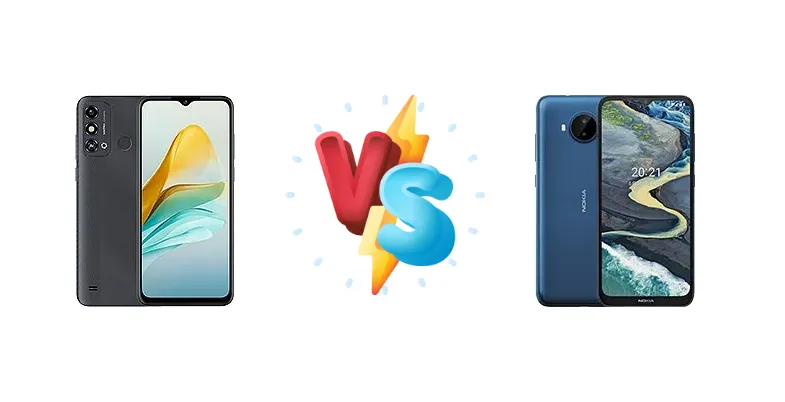
The ZTE Blade A53 and Nokia C20 Plus represent the extreme end of the smartphone price spectrum, targeting users prioritizing affordability above all else. Both devices rely on Unisoc chipsets, but subtle differences in manufacturing process and potentially software optimization create a nuanced comparison for those seeking the most functionality for their money.
🏆 Quick Verdict
For the average user needing a basic smartphone for calls, messaging, and light app usage, the ZTE Blade A53 edges out the Nokia C20 Plus. Its newer Unisoc SC9863A1 chipset, fabricated on a smaller 22nm process, offers a slight performance and efficiency advantage, translating to a smoother user experience.
| Network |
|---|
| 2G bands | GSM 850 / 900 / 1800 / 1900 | GSM 850 / 900 / 1800 / 1900 |
| 3G bands | HSDPA 850 / 900 / 1900 / 2100 | HSDPA 850 / 900 / 1900 / 2100 |
| 4G bands | LTE | 1, 3, 5, 8, 34, 38, 29, 40, 41 |
| Speed | HSPA, LTE | HSPA 42.2/5.76 Mbps, LTE Cat4 150/50 Mbps |
| Technology | GSM / HSPA / LTE | GSM / HSPA / LTE |
| Launch |
|---|
| Announced | 2023, April | 2021, June 11 |
| Status | Available. Released 2023, April | Available. Released 2021, June 16 |
| Body |
|---|
| Dimensions | 165.7 x 76.4 x 9.1 mm (6.52 x 3.01 x 0.36 in) | 165.4 x 75.9 x 9.4 mm (6.51 x 2.99 x 0.37 in) |
| SIM | Nano-SIM + Nano-SIM | · Nano-SIM· Nano-SIM + Nano-SIM |
| Weight | - | 204.7 g (7.23 oz) |
| Display |
|---|
| Resolution | 720 x 1600 pixels, 20:9 ratio (~269 ppi density) | 720 x 1600 pixels, 20:9 ratio (~270 ppi density) |
| Size | 6.52 inches, 102.6 cm2 (~81.1% screen-to-body ratio) | 6.5 inches, 102.0 cm2 (~81.3% screen-to-body ratio) |
| Type | IPS LCD | IPS LCD |
| Platform |
|---|
| CPU | Octa-core (4x1.6 GHz Cortex-A55 & 4x1.2 GHz Cortex-A55) | Octa-core (4x1.6 GHz Cortex-A55 & 4x1.2 GHz Cortex-A55) |
| Chipset | Unisoc SC9863A1 (22 nm) | Unisoc SC9863A (28 nm) |
| GPU | IMG8322 | IMG8322 |
| OS | Android 12 (Go edition) | Android 11 (Go edition) |
| Memory |
|---|
| Card slot | microSDXC (uses shared SIM slot) | microSDXC |
| Internal | 32GB 2GB RAM | 32GB 3GB RAM |
| | - | eMMC 5.1 |
| Main Camera |
|---|
| Dual | - | 8 MP
Auxiliary lens |
| Features | LED flash | LED flash |
| Single | 8 MP, AF | 5 MP |
| Video | 1080p@30fps | 720p@30fps |
| Selfie camera |
|---|
| Single | 5 MP | 5 MP |
| Video | Yes | 720p |
| Sound |
|---|
| 3.5mm jack | - | Yes |
| 35mm jack | Yes | Yes |
| Loudspeaker | Yes | Yes |
| Comms |
|---|
| Bluetooth | 4.2, A2DP | 4.2, A2DP |
| NFC | Yes (market/region dependent) | No |
| Positioning | GPS | GPS |
| Radio | Unspecified | FM radio |
| USB | microUSB | microUSB 2.0 |
| WLAN | Wi-Fi 802.11 b/g/n | Wi-Fi 802.11 b/g/n |
| Features |
|---|
| Sensors | Fingerprint (rear-mounted), accelerometer, proximity | Accelerometer, proximity |
| Battery |
|---|
| Charging | 10W wired | 10W wired |
| Type | 4000 mAh | Li-Ion 4950 mAh, removable |
| Misc |
|---|
| Colors | Gray, Blue, Green | Ocean Blue, Graphite black |
| Models | - | TA-1388, TA-1380 |
| Price | - | About 90 EUR |
ZTE Blade A53
- Slightly more powerful chipset (Unisoc SC9863A1)
- More efficient 22nm fabrication process
- Potentially smoother multitasking experience
- Brand recognition isn't as strong as Nokia
- Software update support may be limited
Nokia C20 Plus
- Nokia's reputation for build quality and durability
- Potential for longer software support
- Established brand trust
- Older, less efficient chipset (Unisoc SC9863A)
- 28nm fabrication process leads to higher power consumption
- Potentially slower performance
Display Comparison
Neither ZTE nor Nokia provide display specifications beyond resolution. However, given the price point, both likely utilize LCD panels. The key difference lies internally: the chipset powering the display. A more efficient chipset, like the one in the A53, can contribute to better perceived brightness and responsiveness, even with similar panel characteristics. Bezels are expected to be substantial on both devices, reflecting their budget nature.
Camera Comparison
Camera details are sparse for both devices. It's safe to assume both feature basic camera setups geared towards casual snapshots. Without sensor size or aperture information, a direct comparison is difficult. However, the slightly improved processing power of the A53’s chipset *could* lead to marginally better image processing, particularly in low-light conditions. Expect limited detail and dynamic range from both cameras.
Performance
The core of the performance difference lies in the chipset fabrication process. The ZTE Blade A53 utilizes the Unisoc SC9863A1, built on a 22nm process, while the Nokia C20 Plus uses the older SC9863A on a 28nm process. A smaller process node generally translates to lower power consumption and higher transistor density, resulting in improved performance. Both feature the same octa-core CPU configuration (4x1.6 GHz Cortex-A55 & 4x1.2 GHz Cortex-A55), but the A53’s chipset will likely sustain higher clock speeds for longer periods due to better thermal management. This impacts app loading times and multitasking.
Battery Life
Both phones feature 10W wired charging, indicating similar charging speeds. The actual battery capacity isn't specified, but given the target market, both likely house batteries in the 3000-4000 mAh range. The 22nm process of the SC9863A1 in the ZTE Blade A53 will contribute to better power efficiency, potentially resulting in slightly longer battery life during typical usage compared to the Nokia C20 Plus’s 28nm chipset.
Buying Guide
Buy the ZTE Blade A53 if you need a marginally faster and more responsive device for everyday tasks, and appreciate a slightly more modern chipset. Buy the Nokia C20 Plus if you prioritize the Nokia brand's reputation for software support and a potentially more durable build quality, and are comfortable with a slightly less performant experience. Both are excellent choices for first-time smartphone users or as reliable backup devices.
Frequently Asked Questions
❓ Will the ZTE Blade A53 struggle with popular social media apps like Facebook and Instagram?
While not designed for intensive gaming, the ZTE Blade A53’s Unisoc SC9863A1 chipset should handle basic social media apps like Facebook and Instagram without significant issues. Expect some loading times and occasional lag when switching between apps, but it’s sufficient for casual use.
❓ Does the Nokia C20 Plus receive regular Android security updates?
Nokia generally provides better software support than many other brands in this price segment. While it may not receive the latest Android versions, the C20 Plus is likely to receive periodic security updates, enhancing its long-term security. However, the frequency and duration of updates are not guaranteed.
❓ Is the 10W charging speed on either phone sufficient for daily use?
10W charging is slow by modern standards. Expect a full charge to take several hours. However, given the likely battery capacity (3000-4000mAh) and typical usage patterns of these phones, overnight charging is a viable solution, mitigating the slow charging speed.