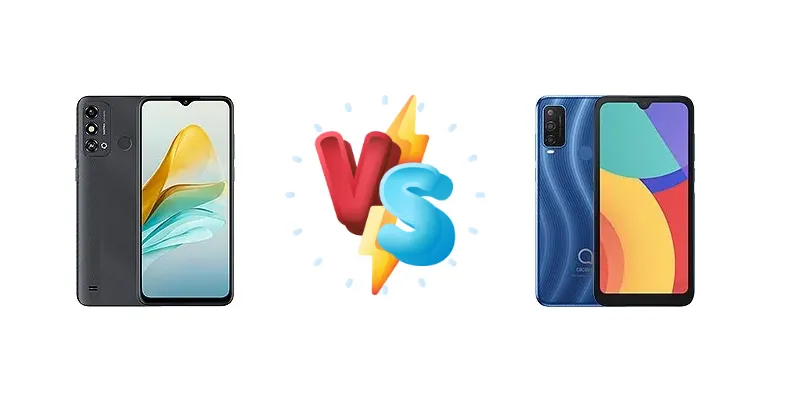
The ZTE Blade A53 and Alcatel 1L Pro (2021) represent the absolute bottom end of the smartphone market, targeting users who prioritize affordability above all else. Both devices rely on Unisoc chipsets, but subtle differences in manufacturing process and potentially software optimization create a surprisingly nuanced comparison for those seeking the most performance for their dollar.
🏆 Quick Verdict
For the average user prioritizing basic functionality, the ZTE Blade A53 emerges as the slightly better choice. Its newer Unisoc SC9863A1 chipset, fabricated on a smaller 22nm process, offers a marginal efficiency advantage over the Alcatel 1L Pro’s 28nm SC9863A, potentially leading to slightly better battery life and sustained performance.
| Network |
|---|
| 2G bands | GSM 850 / 900 / 1800 / 1900 | GSM 850 / 900 / 1800 / 1900 |
| 3G bands | HSDPA 850 / 900 / 1900 / 2100 | HSDPA 850 / 900 / 1700(AWS) / 1900 / 2100 |
| 4G bands | LTE | 2, 3, 4, 5, 7, 8, 12, 17, 28, 66 - USA |
| Speed | HSPA, LTE | HSPA 21.1/5.76 Mbps, LTE Cat4 150/50 Mbps |
| Technology | GSM / HSPA / LTE | GSM / HSPA / LTE |
| Launch |
|---|
| Announced | 2023, April | 2021, June 25 |
| Status | Available. Released 2023, April | Available. Released 2021, Q2 |
| Body |
|---|
| Build | - | Glass front, plastic back, plastic frame |
| Dimensions | 165.7 x 76.4 x 9.1 mm (6.52 x 3.01 x 0.36 in) | 156.4 x 74.8 x 9.7 mm (6.16 x 2.94 x 0.38 in) |
| SIM | Nano-SIM + Nano-SIM | · Nano-SIM· Nano-SIM + Nano-SIM |
| Weight | - | 190 g (6.70 oz) |
| Display |
|---|
| Resolution | 720 x 1600 pixels, 20:9 ratio (~269 ppi density) | 720 x 1560 pixels, 19.5:9 ratio (~282 ppi density) |
| Size | 6.52 inches, 102.6 cm2 (~81.1% screen-to-body ratio) | 6.1 inches, 91.3 cm2 (~78.1% screen-to-body ratio) |
| Type | IPS LCD | IPS LCD |
| Platform |
|---|
| CPU | Octa-core (4x1.6 GHz Cortex-A55 & 4x1.2 GHz Cortex-A55) | Octa-core (4x1.6 GHz Cortex-A55 & 4x1.2 GHz Cortex-A55) |
| Chipset | Unisoc SC9863A1 (22 nm) | Unisoc SC9863A (28 nm) |
| GPU | IMG8322 | IMG8322 |
| OS | Android 12 (Go edition) | Android 11 (Go edition) |
| Memory |
|---|
| Card slot | microSDXC (uses shared SIM slot) | microSDXC (uses shared SIM slot) |
| Internal | 32GB 2GB RAM | 32GB 2GB RAM |
| | - | eMMC 5.1 |
| Main Camera |
|---|
| Dual | - | 13 MP, f/2.2, 26mm (wide), 1/3.06", 1.12µm, AF
Auxiliary lens |
| Features | LED flash | LED flash, HDR, panorama |
| Single | 8 MP, AF | - |
| Video | 1080p@30fps | 1080p@30fps |
| Selfie camera |
|---|
| Features | - | HDR |
| Single | 5 MP | 5 MP, f/2.2, 27mm (wide), 1/5.0", 1.12µm |
| Video | Yes | 1080p@30fps |
| Sound |
|---|
| 3.5mm jack | - | Yes |
| 35mm jack | Yes | Yes |
| Loudspeaker | Yes | Yes |
| Comms |
|---|
| Bluetooth | 4.2, A2DP | 4.2, A2DP |
| NFC | Yes (market/region dependent) | No |
| Positioning | GPS | GPS |
| Radio | Unspecified | FM radio |
| USB | microUSB | microUSB 2.0, OTG |
| WLAN | Wi-Fi 802.11 b/g/n | Wi-Fi 802.11 b/g/n, Wi-Fi Direct |
| Features |
|---|
| Sensors | Fingerprint (rear-mounted), accelerometer, proximity | Fingerprint (rear-mounted), accelerometer, proximity |
| Battery |
|---|
| Charging | 10W wired | - |
| Type | 4000 mAh | Li-Ion 3000 mAh |
| Misc |
|---|
| Colors | Gray, Blue, Green | Power Grey, Twilight Blue |
| Price | - | About 110 EUR |
ZTE Blade A53
- More efficient chipset (22nm process)
- Potentially better sustained performance
- Likely to receive more software updates
- May be slightly more expensive than the Alcatel 1L Pro
- Limited availability in some regions
alcatel 1L Pro (2021)
- Generally the most affordable option
- Widely available in many markets
- Simple and easy-to-use interface
- Less efficient chipset (28nm process)
- Potentially shorter battery life
- May receive fewer software updates
Display Comparison
Neither ZTE nor Alcatel provide detailed display specifications for these models. Given their price point, it’s safe to assume both utilize LCD panels with 720p+ resolutions. The lack of information prevents a detailed comparison of brightness, color accuracy, or viewing angles. However, the focus should be on usability rather than visual fidelity at this price point.
Camera Comparison
Camera performance is expected to be minimal on both devices. Details are scarce, but both likely feature a basic primary sensor paired with low-resolution auxiliary lenses. Without specific sensor size or aperture information, it’s difficult to assess image quality. The focus should be on capturing usable photos in good lighting conditions, as low-light performance will likely be poor. The inclusion of a 2MP macro lens on either device is largely a marketing gimmick and offers limited practical benefit.
Performance
The core of the comparison lies in the chipsets. Both phones employ an octa-core CPU configuration with the same core speeds (4x1.6 GHz Cortex-A55 & 4x1.2 GHz Cortex-A55). However, the ZTE Blade A53 utilizes the Unisoc SC9863A1, built on a 22nm process, while the Alcatel 1L Pro (2021) uses the older SC9863A on a 28nm process. This smaller node size generally translates to improved power efficiency and potentially slightly higher clock speeds under sustained load. While the CPU architecture is identical, the 22nm process gives the A53 a theoretical edge in thermal management and battery life. Both are likely to struggle with demanding applications or multitasking.
Battery Life
Battery capacity details are unavailable for either device. However, the Unisoc SC9863A1’s 22nm process in the ZTE Blade A53 offers a potential advantage in power efficiency. This could translate to slightly longer battery life compared to the Alcatel 1L Pro (2021), despite potentially having a similar battery capacity. Both phones feature 10W wired charging, meaning slow charging speeds – expect several hours to reach a full charge.
Buying Guide
Buy the ZTE Blade A53 if you need a phone for essential tasks like calls, messaging, and light social media browsing, and want the most efficient processor in this price bracket. Buy the Alcatel 1L Pro (2021) if you find it significantly cheaper than the A53 and are willing to accept a potentially shorter battery life and slightly slower performance in exchange for the lowest possible upfront cost.
Frequently Asked Questions
❓ Will either of these phones run popular apps like WhatsApp and Facebook smoothly?
Yes, both the ZTE Blade A53 and Alcatel 1L Pro (2021) should be capable of running basic apps like WhatsApp and Facebook without significant issues. However, expect some lag when switching between apps or loading complex content. These phones are designed for light usage, not intensive multitasking.
❓ How long will it take to fully charge either phone with the included 10W charger?
Given the 10W charging speed and likely battery capacities around 3000-4000mAh, expect a full charge to take approximately 3-4 hours. These phones are not designed for fast charging, so patience is required.
❓ Are these phones suitable for mobile gaming?
Neither the ZTE Blade A53 nor the Alcatel 1L Pro (2021) are suitable for serious mobile gaming. While they can run very basic games, expect significant lag and low frame rates in more demanding titles. The Unisoc chipsets lack the graphical power necessary for a smooth gaming experience.
❓ Do either of these phones support VoLTE or Wi-Fi calling?
Support for VoLTE and Wi-Fi calling varies by carrier and region. It's crucial to check with your mobile carrier to confirm compatibility before purchasing either phone, as these features are essential for modern network connectivity.