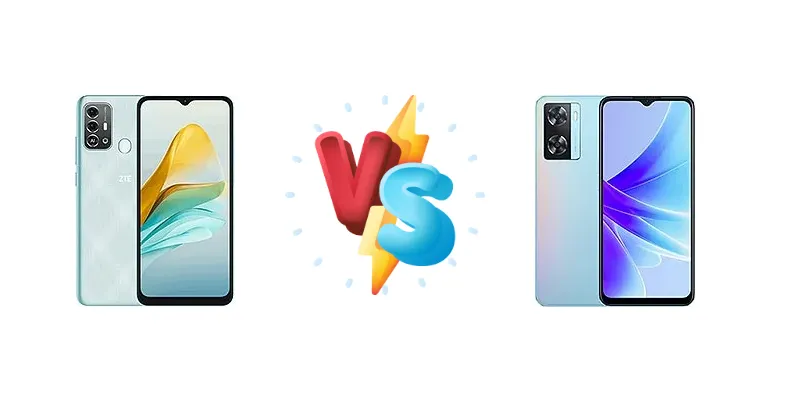
The ZTE Blade A53 Pro and Oppo A57s represent two compelling options in the ultra-budget smartphone segment. Both aim to deliver essential smartphone functionality at a low price point, but they take different approaches to achieving this. The key differentiator lies in their chipsets and charging capabilities, impacting performance and user experience.
🏆 Quick Verdict
For the average user prioritizing quick top-ups and slightly better overall performance, the Oppo A57s is the stronger choice. Its 33W charging significantly reduces downtime compared to the ZTE Blade A53 Pro’s 10W charging, and the Helio G35 offers a modest performance edge. However, the A53 Pro remains a viable option for those on the tightest budgets.
| Network |
|---|
| 2G bands | GSM 850 / 900 / 1800 / 1900 | GSM 850 / 900 / 1800 / 1900 |
| 3G bands | HSDPA 850 / 900 / 1900 / 2100 | HSDPA 850 / 900 / 2100 |
| 4G bands | LTE | 1, 3, 5, 7, 8, 20, 28, 38, 40, 41 |
| Speed | HSPA, LTE | HSPA, LTE |
| Technology | GSM / HSPA / LTE | GSM / HSPA / LTE |
| Launch |
|---|
| Announced | 2023, April | 2022, August 31 |
| Status | Available. Released 2023, April | Available. Released 2022, September 12 |
| Body |
|---|
| Build | - | Glass front (Panda Glass), plastic frame, plastic back |
| Dimensions | 164 x 75.8 x 8.7 mm (6.46 x 2.98 x 0.34 in) | 163.8 x 75 x 8 mm (6.45 x 2.95 x 0.31 in) |
| SIM | Nano-SIM + Nano-SIM | Nano-SIM + Nano-SIM |
| Weight | - | 187 g (6.60 oz) |
| | - | IP5X (dust), IPX4 (water) resistance |
| Display |
|---|
| Protection | - | Panda Glass |
| Resolution | 720 x 1600 pixels, 20:9 ratio (~269 ppi density) | 720 x 1612 pixels, 20:9 ratio (~269 ppi density) |
| Size | 6.52 inches, 102.6 cm2 (~82.6% screen-to-body ratio) | 6.56 inches, 103.4 cm2 (~84.2% screen-to-body ratio) |
| Type | IPS LCD | IPS LCD, 480 nits (typ), 600 nits (HBM) |
| Platform |
|---|
| CPU | Octa-core (4x1.6 GHz Cortex-A55 & 4x1.2 GHz Cortex-A55) | Octa-core (4x2.3 GHz Cortex-A53 & 4x1.8 GHz Cortex-A53) |
| Chipset | Unisoc SC9863A1 (22 nm) | Mediatek MT6765G Helio G35 (12 nm) |
| GPU | IMG8322 | PowerVR GE8320 |
| OS | Android 12 | Android 12, ColorOS 12.1 |
| Memory |
|---|
| Card slot | microSDXC (uses shared SIM slot) | microSDXC |
| Internal | 64GB 4GB RAM | 64GB 4GB RAM, 128GB 4GB RAM |
| | - | eMMC 5.1 |
| Main Camera |
|---|
| Dual | 13 MP, AF
Auxiliary lens | 50 MP, f/1.8, 27mm (wide), PDAF
Auxiliary lens |
| Features | LED flash | LED flash, HDR, panorama |
| Single | - | 8 MP, f/2.0, 26mm (wide) |
| Video | 1080p@30fps | 1080p@30fps |
| Selfie camera |
|---|
| Features | - | Panorama |
| Single | 5 MP | 8 MP, f/2.0, 26mm (wide) |
| Video | Yes | 1080p@30fps |
| Sound |
|---|
| 3.5mm jack | - | Yes |
| 35mm jack | Yes | Yes |
| Loudspeaker | Yes | Yes, with stereo speakers |
| Comms |
|---|
| Bluetooth | 4.2, A2DP | 5.3, A2DP, LE, aptX HD |
| NFC | Yes (market/region dependent) | Yes |
| Positioning | GPS | GPS, GLONASS, BDS, GALILEO, QZSS |
| Radio | Unspecified | No |
| USB | microUSB | USB Type-C 2.0, OTG |
| WLAN | Wi-Fi 802.11 b/g/n | Wi-Fi 802.11 a/b/g/n/ac, dual-band, Wi-Fi Direct |
| Features |
|---|
| Sensors | Fingerprint (rear-mounted), accelerometer, proximity | Fingerprint (side-mounted), accelerometer, proximity, compass |
| Battery |
|---|
| Charging | 10W wired | 33W wired, 100% in 69 min |
| Type | 5000 mAh | Li-Po 5000 mAh |
| Misc |
|---|
| Colors | Dark Blue, Green | Starry Black, Sky Blue |
| Models | - | CPH2385 |
ZTE Blade A53 Pro
- Lowest possible price point
- Functional for basic tasks
- Potentially longer battery life due to less powerful processor
- Slow performance
- Extremely slow charging (10W)
- Likely limited software support
Oppo A57s
- Faster performance with Helio G35
- Significantly faster 33W charging
- More responsive user experience
- Slightly higher price
- May not be ideal for heavy gaming
- Potentially less battery life than A53 Pro
Display Comparison
Neither ZTE nor Oppo provide display specifications beyond the basic screen size. Given the price point, both likely utilize LCD panels with 720p+ resolution. The lack of detailed specs makes a direct comparison impossible, but we can infer that color accuracy and brightness will be limited on both devices. Bezels are expected to be substantial, typical of this market segment.
Camera Comparison
Without detailed camera sensor information, a meaningful comparison is difficult. Both phones likely feature a primary camera alongside depth or macro sensors of limited utility. The focus should be on the main sensor; larger sensors and wider apertures (lower f-number) capture more light, resulting in better image quality, especially in low-light conditions. Given the price bracket, image processing will be basic on both devices, relying heavily on software algorithms to enhance photos. Expect limited dynamic range and detail.
Performance
The Oppo A57s boasts the MediaTek Helio G35, fabricated on a more efficient 12nm process compared to the ZTE Blade A53 Pro’s Unisoc SC9863A1 (22nm). This process node difference translates to better thermal efficiency for the Oppo device. While both are octa-core CPUs, the A57s utilizes Cortex-A53 cores clocked at 2.3 GHz, a significant step up from the A53 Pro’s 1.6 GHz and 1.2 GHz Cortex-A55 cores. This means the A57s will handle multitasking and app launches with noticeably less lag. The Unisoc chip is likely to struggle with demanding applications. The A57s will provide a smoother experience for casual gaming and social media browsing.
Battery Life
While battery capacity isn’t specified, the most significant difference lies in charging speed. The Oppo A57s supports 33W wired charging, achieving a full charge in just 69 minutes. The ZTE Blade A53 Pro is limited to a slow 10W charge, meaning significantly longer charging times. This difference is crucial for users who rely heavily on their phones throughout the day and need quick top-ups. Even with a similar battery capacity, the A57s’ faster charging provides a more convenient user experience.
Buying Guide
Buy the ZTE Blade A53 Pro if you absolutely need the lowest possible price and are willing to accept slower performance and charging. It’s ideal for basic communication and light tasks. Buy the Oppo A57s if you value faster charging, a slightly more responsive user experience, and don’t mind spending a little extra for those benefits. It’s better suited for users who consume media or play casual games.
Frequently Asked Questions
❓ Will the Oppo A57s handle popular games like PUBG Mobile or Call of Duty?
The MediaTek Helio G35 in the Oppo A57s can run PUBG Mobile and Call of Duty, but expect to play at lower graphics settings and frame rates to maintain a stable experience. It’s suitable for casual gaming, but not for demanding, high-performance gaming.
❓ How long will it take to fully charge the ZTE Blade A53 Pro from 0%?
With its 10W charging, the ZTE Blade A53 Pro will take a considerable amount of time to fully charge – likely exceeding 3-4 hours. This is a significant drawback compared to the Oppo A57s’ 33W fast charging.
❓ Is the Unisoc SC9863A1 chipset known for overheating?
The Unisoc SC9863A1 is a low-end chipset and isn't known for extreme overheating, but it can get warm during prolonged use. Its 22nm process is less efficient than the 12nm process used in the Helio G35, meaning it generates more heat for the same level of performance.
❓ Does the Oppo A57s support software updates?
Oppo typically provides software updates for its A-series devices, but the frequency and duration of support can vary. Expect at least one major Android update, but long-term support is not guaranteed given the phone's budget positioning.