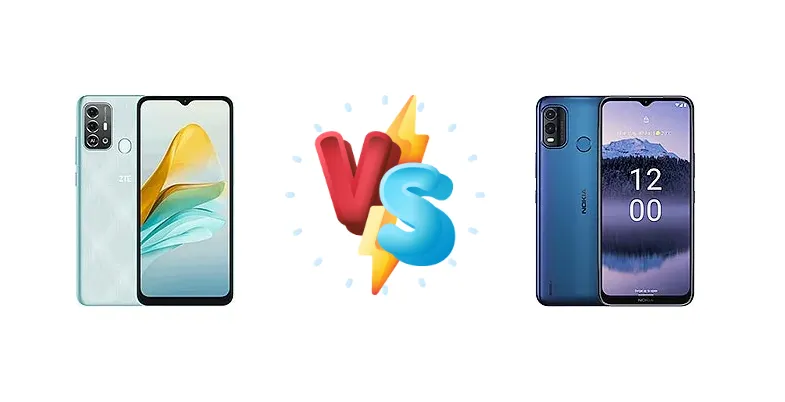
The ZTE Blade A53 Pro and Nokia G11 Plus represent the fiercely competitive sub-$150 smartphone market. Both devices rely on Unisoc chipsets to deliver an affordable Android experience, but significant architectural differences exist. This comparison dissects those differences, revealing which phone offers the best balance of performance, battery life, and overall value for budget-conscious consumers.
🏆 Quick Verdict
For most users, the Nokia G11 Plus emerges as the better choice. Its Unisoc T606 chipset, built on a more efficient 12nm process and featuring Cortex-A75 performance cores, provides a noticeable performance advantage over the ZTE Blade A53 Pro’s SC9863A1. While both offer 10W charging, the G11 Plus’s superior processing power makes it more capable for everyday tasks and light multitasking.
| Network |
|---|
| 2G bands | GSM 850 / 900 / 1800 / 1900 | GSM 850 / 900 / 1800 / 1900 |
| 3G bands | HSDPA 850 / 900 / 1900 / 2100 | HSDPA 850 / 900 / 2100 - International |
| 4G bands | LTE | 1, 3, 5, 7, 8, 20, 28, 38, 40, 41 - International |
| Speed | HSPA, LTE | HSPA 42.2/5.76 Mbps, LTE Cat4 150/50 Mbps |
| Technology | GSM / HSPA / LTE | GSM / HSPA / LTE |
| | - | 1, 3, 5, 8, 40, 41 - India |
| Launch |
|---|
| Announced | 2023, April | 2022, June 29 |
| Status | Available. Released 2023, April | Available. Released 2022, July 20 |
| Body |
|---|
| Build | - | Glass front, plastic frame, plastic back |
| Dimensions | 164 x 75.8 x 8.7 mm (6.46 x 2.98 x 0.34 in) | 164.8 x 75.9 x 8.6 mm (6.49 x 2.99 x 0.34 in) |
| SIM | Nano-SIM + Nano-SIM | · Nano-SIM· Nano-SIM + Nano-SIM |
| Weight | - | 192 g (6.77 oz) |
| | - | Splash protection |
| Display |
|---|
| Resolution | 720 x 1600 pixels, 20:9 ratio (~269 ppi density) | 720 x 1600 pixels, 20:9 ratio (~269 ppi density) |
| Size | 6.52 inches, 102.6 cm2 (~82.6% screen-to-body ratio) | 6.52 inches, 102.6 cm2 (~82.1% screen-to-body ratio) |
| Type | IPS LCD | IPS LCD, 90Hz, 400 nits (typ) |
| Platform |
|---|
| CPU | Octa-core (4x1.6 GHz Cortex-A55 & 4x1.2 GHz Cortex-A55) | Octa-core (2x1.6 GHz Cortex-A75 & 6x1.6 GHz Cortex-A55) |
| Chipset | Unisoc SC9863A1 (22 nm) | Unisoc T606 (12 nm) |
| GPU | IMG8322 | Mali-G57 MP1 |
| OS | Android 12 | Android 12, upgradable to Android 13 |
| Memory |
|---|
| Card slot | microSDXC (uses shared SIM slot) | microSDXC (dedicated slot) |
| Internal | 64GB 4GB RAM | 32GB 3GB RAM, 64GB 3GB RAM, 64GB 4GB RAM, 128GB 3GB RAM |
| | - | eMMC 5.1 |
| Main Camera |
|---|
| Dual | 13 MP, AF
Auxiliary lens | 50 MP, f/1.8, (wide), 1/2.67", PDAF
Auxiliary lens |
| Features | LED flash | LED flash |
| Single | - | 8 MP, f/2.0, (wide), 1/4.0" |
| Video | 1080p@30fps | 1080p@30fps |
| Selfie camera |
|---|
| Single | 5 MP | 8 MP, f/2.0, (wide), 1/4.0" |
| Video | Yes | 1080p@30fps |
| Sound |
|---|
| 3.5mm jack | - | Yes |
| 35mm jack | Yes | Yes |
| Loudspeaker | Yes | Yes |
| Comms |
|---|
| Bluetooth | 4.2, A2DP | 5.0, A2DP, LE |
| NFC | Yes (market/region dependent) | No |
| Positioning | GPS | GPS |
| Radio | Unspecified | FM radio |
| USB | microUSB | USB Type-C 2.0, OTG |
| WLAN | Wi-Fi 802.11 b/g/n | Wi-Fi 802.11 a/b/g/n/ac, dual-band, Wi-Fi Direct |
| Features |
|---|
| Sensors | Fingerprint (rear-mounted), accelerometer, proximity | Fingerprint (rear-mounted), accelerometer, proximity |
| Battery |
|---|
| Charging | 10W wired | 10W wired |
| Type | 5000 mAh | Li-Ion 5000 mAh |
| Misc |
|---|
| Colors | Dark Blue, Green | Lake Blue, Charcoal Grey |
| Price | - | About 130 EUR |
ZTE Blade A53 Pro
- Potentially lower price point
- Simple and straightforward Android experience
- Suitable for basic communication needs
- Less powerful chipset
- Less efficient processor
- Likely slower app launch times
Nokia G11 Plus
- More powerful Unisoc T606 chipset
- More efficient 12nm process
- Improved multitasking capabilities
- Better overall responsiveness
- Slightly higher price
- 10W charging remains slow
- Basic camera system
Display Comparison
Neither ZTE nor Nokia provide display specifications beyond the basic panel size. However, the chipset differences indirectly impact the user experience. The more powerful Unisoc T606 in the Nokia G11 Plus can render UI elements and graphics more smoothly, making scrolling and animations feel more fluid, even on a similarly specified display. The absence of high refresh rate panels on either device means display quality will largely depend on color calibration and brightness, which are not specified.
Camera Comparison
Detailed camera specifications are unavailable for either device. Given their price point, both likely feature basic camera setups. However, the processing capabilities of the Unisoc T606 in the Nokia G11 Plus may offer slightly better image processing, potentially resulting in more detailed and less noisy photos, especially in challenging lighting conditions. The absence of Optical Image Stabilization (OIS) on either device suggests low-light performance will be limited.
Performance
The core difference lies in the chipsets. The ZTE Blade A53 Pro utilizes the Unisoc SC9863A1, fabricated on a 22nm process, with a CPU configuration of four 1.6GHz Cortex-A55 cores and four 1.2GHz Cortex-A55 cores. The Nokia G11 Plus, conversely, employs the Unisoc T606, built on a more efficient 12nm process, and features a more potent CPU arrangement: two 1.6GHz Cortex-A75 cores and six 1.6GHz Cortex-A55 cores. The inclusion of Cortex-A75 cores in the G11 Plus provides a significant boost in single-core performance, crucial for app launch times and general responsiveness. This translates to a snappier user experience, particularly noticeable when switching between applications.
Battery Life
Both devices are equipped with 10W wired charging, indicating similar charging speeds. While battery capacity isn't specified, the more efficient 12nm Unisoc T606 in the Nokia G11 Plus will likely contribute to better battery life. The reduced power consumption of the T606 means the G11 Plus can maintain a functional charge for longer periods, even with moderate usage. Expect both phones to take over 3 hours for a full 0-100% charge.
Buying Guide
Buy the ZTE Blade A53 Pro if your primary need is a very basic smartphone for essential communication – calls, texts, and minimal app usage – and you prioritize absolute lowest cost. Buy the Nokia G11 Plus if you want a more responsive experience for social media, web browsing, and occasional gaming, and are willing to spend a small premium for improved performance and a more modern chipset architecture.
Frequently Asked Questions
❓ Will the Nokia G11 Plus handle popular social media apps like Facebook and Instagram smoothly?
Yes, the Unisoc T606 chipset in the Nokia G11 Plus, with its Cortex-A75 cores, provides sufficient processing power for smooth operation of most social media applications. While it won't offer a flagship-level experience, it will handle scrolling, image loading, and video playback without significant lag.
❓ Is the 10W charging on either phone a significant drawback?
Yes, 10W charging is relatively slow by modern standards. Expect both the ZTE Blade A53 Pro and Nokia G11 Plus to take over three hours to fully charge from 0% to 100%. This is a compromise made to keep the price point low, and users should plan to charge overnight.
❓ Can the Nokia G11 Plus run multiple apps simultaneously without slowing down?
The Nokia G11 Plus is better equipped for multitasking than the ZTE Blade A53 Pro. The Unisoc T606 chipset and its Cortex-A75 cores allow for smoother switching between apps. However, avoid running too many demanding applications concurrently, as the limited RAM may cause performance degradation.
❓ Are either of these phones likely to receive major Android updates?
Given their price point and reliance on Unisoc chipsets, major Android updates are unlikely. Both devices likely ship with Android Go Edition, a lightweight version of Android designed for low-end hardware. Security updates may be provided for a limited time, but long-term software support should not be expected.