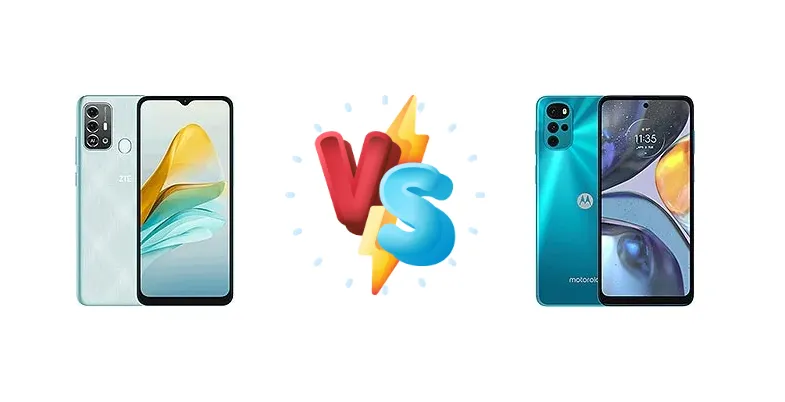
The sub-$150 smartphone market is fiercely competitive. Both the ZTE Blade A53 Pro and Motorola Moto G22 aim to deliver essential smartphone functionality at an accessible price. However, they take different approaches to achieving this, with varying chipset choices and charging capabilities. This comparison dissects these differences to determine which device offers the best value for budget-conscious consumers.
🏆 Quick Verdict
For most users, the Motorola Moto G22 is the better choice. Its Mediatek Helio G37, built on a more efficient 12nm process, provides a noticeable performance advantage over the ZTE Blade A53 Pro’s Unisoc SC9863A1. The faster 20W charging (in some regions) further sweetens the deal, making it a more practical daily driver.
| Network |
|---|
| 2G bands | GSM 850 / 900 / 1800 / 1900 | GSM 850 / 900 / 1800 / 1900 |
| 3G bands | HSDPA 850 / 900 / 1900 / 2100 | HSDPA 850 / 900 / 1900 / 2100 |
| 4G bands | LTE | 1, 3, 5, 7, 8, 20, 38, 40, 41 |
| Speed | HSPA, LTE | HSPA 42.2/5.76 Mbps, LTE Cat4 150/50 Mbps |
| Technology | GSM / HSPA / LTE | GSM / HSPA / LTE |
| Launch |
|---|
| Announced | 2023, April | 2022, March 04 |
| Status | Available. Released 2023, April | Available. Released 2022, March 04 |
| Body |
|---|
| Build | - | Glass front, plastic frame, plastic back |
| Dimensions | 164 x 75.8 x 8.7 mm (6.46 x 2.98 x 0.34 in) | 164 x 75 x 8.5 mm (6.46 x 2.95 x 0.33 in) |
| SIM | Nano-SIM + Nano-SIM | · Nano-SIM· Nano-SIM + Nano-SIM |
| Weight | - | 185 g (6.53 oz) |
| | - | Water-repellent design |
| Display |
|---|
| Resolution | 720 x 1600 pixels, 20:9 ratio (~269 ppi density) | 720 x 1600 pixels, 20:9 ratio (~268 ppi density) |
| Size | 6.52 inches, 102.6 cm2 (~82.6% screen-to-body ratio) | 6.5 inches, 103.5 cm2 (~84.2% screen-to-body ratio) |
| Type | IPS LCD | IPS LCD, 90Hz |
| Platform |
|---|
| CPU | Octa-core (4x1.6 GHz Cortex-A55 & 4x1.2 GHz Cortex-A55) | Octa-core (4x2.3 GHz Cortex-A53 & 4x1.8 GHz Cortex-A53) |
| Chipset | Unisoc SC9863A1 (22 nm) | Mediatek MT6765V/CB Helio G37 (12 nm) |
| GPU | IMG8322 | PowerVR GE8320 |
| OS | Android 12 | Android 12 |
| Memory |
|---|
| Card slot | microSDXC (uses shared SIM slot) | microSDXC (dedicated slot) |
| Internal | 64GB 4GB RAM | 64GB 4GB RAM, 128GB 4GB RAM |
| Main Camera |
|---|
| Dual | 13 MP, AF
Auxiliary lens | - |
| Features | LED flash | LED flash, HDR, panorama |
| Quad | - | 50 MP, f/1.8, (wide), 0.64µm, PDAF
8 MP, f/2.2, 118˚ (ultrawide), 1/4.0", 1.12µm
2 MP (macro)
Auxiliary lens |
| Video | 1080p@30fps | 1080p@30fps |
| Selfie camera |
|---|
| Features | - | HDR |
| Single | 5 MP | 16 MP, f/2.5, (wide), 1.0µm |
| Video | Yes | 1080p@30fps |
| Sound |
|---|
| 3.5mm jack | - | Yes |
| 35mm jack | Yes | Yes |
| Loudspeaker | Yes | Yes |
| Comms |
|---|
| Bluetooth | 4.2, A2DP | 5.0, A2DP, LE |
| NFC | Yes (market/region dependent) | Yes (market/region dependent) |
| Positioning | GPS | GPS, GLONASS, GALILEO |
| Radio | Unspecified | Unspecified |
| USB | microUSB | USB Type-C 2.0 |
| WLAN | Wi-Fi 802.11 b/g/n | Wi-Fi 802.11 a/b/g/n/ac, dual-band, Wi-Fi Direct |
| Features |
|---|
| Sensors | Fingerprint (rear-mounted), accelerometer, proximity | Fingerprint (side-mounted), accelerometer, gyro, proximity, compass |
| Battery |
|---|
| Charging | 10W wired | 20W wired (India)
15W wired (Global) |
| Type | 5000 mAh | Li-Po 5000 mAh |
| Misc |
|---|
| Colors | Dark Blue, Green | Pearl White, Iceberg Blue, Cosmic Black, Mint Green |
| Models | - | XT2231-1, XT2231-2, XT2231-5 |
| Price | - | About 120 EUR |
ZTE Blade A53 Pro
- Potentially lower price point
- Simple and straightforward user experience
- Acceptable for basic communication tasks
- Less powerful processor
- Slow 10W charging
- Likely inferior sustained performance
Motorola Moto G22
- More powerful and efficient processor
- Faster charging (up to 20W)
- Generally better software optimization
- May be slightly more expensive
- 2MP macro camera is largely unnecessary
- Global version limited to 15W charging
Display Comparison
Neither device boasts a standout display. Details regarding panel type (IPS vs. TFT) and resolution are missing, but both likely target a 720p+ resolution typical of this price bracket. The key difference lies elsewhere. The focus here is on processing power, as display quality is often a secondary concern for these models. Bezels are expected to be substantial on both, impacting the overall screen-to-body ratio.
Camera Comparison
Camera performance is likely to be similar, with both devices relying on budget sensors. Without specific sensor size information, it’s difficult to make definitive claims. However, the Moto G22’s image processing pipeline, while still basic, is generally considered more refined than ZTE’s. The inclusion of a 2MP macro camera on both is largely a marketing tactic, offering limited practical benefit due to the low resolution and lack of optical image stabilization (OIS). Expect acceptable results in well-lit conditions, but struggles in low light.
Performance
The Motorola Moto G22’s Mediatek Helio G37, fabricated on a 12nm process, represents a significant architectural advantage over the ZTE Blade A53 Pro’s Unisoc SC9863A1 (22nm). The 12nm node allows for greater transistor density and improved power efficiency, translating to better sustained performance and potentially less thermal throttling. While both CPUs utilize an octa-core configuration, the G37’s Cortex-A53 cores clock higher (2.3 GHz vs 1.6 GHz/1.2 GHz), offering a tangible boost in application launch speeds and overall responsiveness. This benefits users who multitask or play casual games.
Battery Life
Battery capacity is not specified for either device, but both likely house around a 5000mAh cell, standard for this segment. The critical difference is charging speed. The Motorola Moto G22 supports 20W wired charging in India, while globally it’s limited to 15W. The ZTE Blade A53 Pro is capped at a slow 10W. This means the Moto G22 can significantly reduce charging times, offering a more convenient user experience. While a larger battery capacity is desirable, faster charging mitigates the impact of a slightly smaller cell.
Buying Guide
Buy the ZTE Blade A53 Pro if your primary need is a very basic smartphone for minimal tasks like calls, texts, and light social media, and you prioritize absolute lowest cost. Buy the Motorola Moto G22 if you want a more responsive experience for everyday apps, occasional gaming, and appreciate the convenience of faster charging, even if it's not universally available.
Frequently Asked Questions
❓ Does the Unisoc SC9863A1 in the ZTE Blade A53 Pro struggle with multitasking?
Yes, the Unisoc SC9863A1, with its older 22nm process and lower clock speeds, is likely to exhibit noticeable lag when switching between multiple apps or running demanding applications. It's best suited for single-tasking and basic usage.
❓ Is the 20W charging on the Motorola Moto G22 universally available, or is it region-locked?
The 20W charging is currently confirmed for the Motorola Moto G22 in India. Globally, the device is often shipped with a 15W charger. This is a crucial detail to verify before purchasing, as it significantly impacts charging times.
❓ Will either phone be able to run popular games like PUBG Mobile smoothly?
While both phones *can* technically run PUBG Mobile, expect to play at the lowest graphics settings and potentially experience frame drops. The Motorola Moto G22’s Helio G37 will offer a slightly more stable experience, but neither phone is designed for serious gaming.
❓ How does the power efficiency of the Helio G37 compare to the SC9863A1 in real-world usage?
The Helio G37's 12nm process is significantly more power-efficient than the SC9863A1's 22nm process. This translates to longer battery life during typical usage, even with similar battery capacities. You'll likely notice a difference in standby time and overall usage duration.