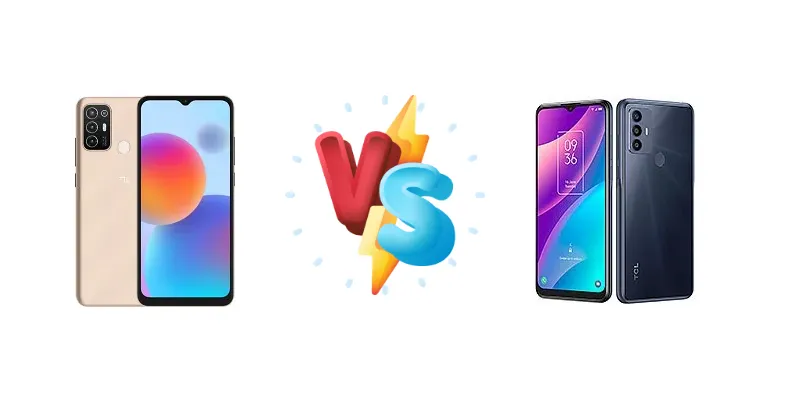
The ZTE Blade A52 and TCL 30 SE represent the fiercely competitive sub-$150 smartphone market. Both aim to deliver essential smartphone functionality at an accessible price point, but they take different approaches to achieving this. The A52 relies on a mature, if less efficient, Unisoc chipset, while the 30 SE opts for MediaTek’s Helio G25. This comparison dissects the key differences to determine which device offers the best value.
🏆 Quick Verdict
For the average user prioritizing responsiveness and faster charging, the TCL 30 SE is the better choice. Its 12nm Helio G25 chipset offers a noticeable performance advantage over the ZTE Blade A52’s 28nm Unisoc SC9863A, and the 15W charging is a welcome improvement over the A52’s sluggish 10W implementation.
| Network |
|---|
| 2G bands | GSM 850 / 900 / 1800 / 1900 | GSM 850 / 900 / 1800 / 1900 |
| 3G bands | HSDPA 850 / 900 / 1900 / 2100 | HSDPA 850 / 900 / 1900 / 2100 - EMEA/APAC |
| 4G bands | 1, 3, 5, 7, 8, 20, 28, 38, 40, 41 | 1, 3, 5, 7, 8, 20, 28, 38, 40, 41 - EMEA |
| Speed | HSPA, LTE | HSPA 42.2/11.5 Mbps, LTE Cat4 150/50 Mbps |
| Technology | GSM / HSPA / LTE | GSM / HSPA / LTE |
| | - | 2, 3, 4, 5, 7, 8, 12, 13, 17, 26, 28, 66 - LATAM |
| Launch |
|---|
| Announced | 2022, June 10 | 2022, February 27 |
| Status | Available. Released 2022, June 10 | Available. Released 2022, April 20 |
| Body |
|---|
| Build | - | Glass front, plastic frame, plastic back |
| Dimensions | 168 x 77.5 x 9.4 mm (6.61 x 3.05 x 0.37 in) | 165.2 x 75.5 x 8.9 mm (6.50 x 2.97 x 0.35 in) |
| SIM | Nano-SIM + Nano-SIM | · Nano-SIM· Nano-SIM + Nano-SIM |
| Weight | 214 g (7.55 oz) | 190 g (6.70 oz) |
| Display |
|---|
| Resolution | 720 x 1600 pixels, 20:9 ratio (~269 ppi density) | 720 x 1600 pixels, 20:9 ratio (~269 ppi density) |
| Size | 6.52 inches, 102.6 cm2 (~78.8% screen-to-body ratio) | 6.52 inches, 102.6 cm2 (~82.3% screen-to-body ratio) |
| Type | IPS LCD | IPS LCD, 450 nits (typ) |
| Platform |
|---|
| CPU | Octa-core (4x1.6 GHz Cortex-A55 & 4x1.2 GHz Cortex-A55) | Octa-core (4x2.0 GHz Cortex-A53 & 4x1.5 GHz Cortex-A53) |
| Chipset | Unisoc SC9863A (28 nm) | Mediatek MT6762G Helio G25 (12 nm) |
| GPU | IMG8322 | PowerVR GE8320 |
| OS | Android 11 | Android 12, TCL UI 4.0 |
| Memory |
|---|
| Card slot | microSDXC | microSDXC (dedicated slot) |
| Internal | 32GB 2GB RAM, 64GB 2GB RAM | 64GB 4GB RAM, 128GB 4GB RAM |
| | - | eMMC 5.1 |
| Main Camera |
|---|
| Features | LED flash, HDR | LED flash, HDR, panorama |
| Single | - | 8 MP, f/2.0, 26mm (wide), 1/4", 1.12µm |
| Triple | 13 MP, AF
2 MP (macro)
Auxiliary lens | 50 MP, f/1.9, 28mm (wide), 1/2.76", 0.64µm, PDAF
2 MP (macro)
Auxiliary lens |
| Video | 1080p@30fps | 1080p@30fps |
| Selfie camera |
|---|
| Features | - | HDR |
| Single | 5 MP | 8 MP, f/2.0, 26mm (wide), 1/4.0", 1.12µm |
| Video | 720p@30fps | 1080p@30fps |
| Sound |
|---|
| 3.5mm jack | Yes | Yes |
| 35mm jack | Yes | Yes |
| Loudspeaker | Yes | Yes |
| Comms |
|---|
| Bluetooth | Yes | 5.0, A2DP, LE |
| NFC | Yes | Yes (6165H/6165H1 only) |
| Positioning | GPS, GLONASS | GPS, GLONASS, GALILEO, BDS |
| Radio | Unspecified | Unspecified |
| USB | USB Type-C 2.0, OTG | USB Type-C 2.0 |
| WLAN | Yes | Wi-Fi 802.11 b/g/n, Wi-Fi Direct |
| Features |
|---|
| Sensors | Fingerprint (rear-mounted), accelerometer, proximity | Fingerprint (rear-mounted), accelerometer, proximity, compass |
| Battery |
|---|
| Charging | 10W wired | 15W wired |
| Type | Li-Ion 5000 mAh | Li-Po 5000 mAh |
| Misc |
|---|
| Colors | Space Gray, Silk Gold, Crystal Blue | Atlantic Blue, Space Gray, Glacial Blue |
| Models | - | 6165H, 6156H1, 6165A, 6165A1, 6165S |
| Price | About 90 EUR | - |
ZTE Blade A52
- Potentially lower price point
- Functional for basic smartphone tasks
- Simple and straightforward user experience
- Less powerful chipset
- Slower charging speed (10W)
- Likely lower performance in demanding apps
TCL 30 SE
- More efficient and powerful chipset
- Faster charging (15W)
- Smoother user experience
- Better potential for gaming
- May be slightly more expensive
- Still an entry-level device with limitations
Display Comparison
Neither device boasts a standout display. Both likely feature LCD panels, typical for this price bracket. However, the lack of detailed display specifications necessitates focusing on the chipset’s ability to drive the UI smoothly. A more powerful chipset, like the TCL 30 SE’s Helio G25, will translate to a more fluid visual experience, even on a similar panel.
Camera Comparison
Without detailed camera sensor information, a direct comparison is difficult. However, it’s safe to assume both devices feature basic camera setups geared towards casual photography. The focus should be on image processing capabilities, which are tied to the chipset. The Helio G25’s ISP (Image Signal Processor) is likely more advanced than the Unisoc SC9863A’s, potentially resulting in better image quality, particularly in challenging lighting conditions. The prevalence of 2MP macro lenses on both devices suggests limited utility; these are often included for marketing purposes rather than genuine photographic benefit.
Performance
The TCL 30 SE’s MediaTek Helio G25, fabricated on a 12nm process, represents a significant architectural advantage over the ZTE Blade A52’s Unisoc SC9863A (28nm). The smaller node generally equates to improved power efficiency and thermal performance. While both CPUs utilize octa-core configurations, the Helio G25’s Cortex-A53 cores clocked at 2.0 GHz offer a performance boost compared to the A52’s 1.6 GHz Cortex-A55 cores. This translates to quicker app loading times and smoother multitasking on the TCL 30 SE. The Unisoc chip's larger process node will likely result in more heat generation under sustained load.
Battery Life
Battery capacity isn’t specified, but the TCL 30 SE’s 15W wired charging is a clear advantage over the ZTE Blade A52’s 10W charging. This faster charging speed will significantly reduce the time spent tethered to a power outlet. While a larger battery capacity on the A52 could partially offset this, the Helio G25’s superior power efficiency means the 30 SE will likely deliver comparable, if not better, real-world battery life despite potentially having a smaller cell.
Buying Guide
Buy the ZTE Blade A52 if your primary need is a basic, functional smartphone for essential tasks like calls, texts, and light social media, and you’re willing to accept slower performance and charging. Buy the TCL 30 SE if you prefer a more responsive user experience, occasionally play mobile games, or value faster charging speeds, even if it means spending slightly more.
Frequently Asked Questions
❓ Will the TCL 30 SE handle popular games like PUBG Mobile or Call of Duty Mobile?
While the Helio G25 isn't a gaming powerhouse, it's capable of running PUBG Mobile and Call of Duty Mobile at lower settings. Expect frame rate dips during intense action, but it's a playable experience, unlike the ZTE Blade A52 which will struggle more significantly.
❓ How long will it take to fully charge each phone from 0%?
With 15W charging, the TCL 30 SE will likely reach 100% in around 2.5 to 3.5 hours, depending on battery capacity. The ZTE Blade A52’s 10W charging will take considerably longer, potentially exceeding 4 hours.
❓ Is the Unisoc SC9863A chipset known to overheat during prolonged use?
The Unisoc SC9863A, due to its 28nm process, is more prone to thermal throttling than the TCL 30 SE’s Helio G25. Expect performance to decrease during extended gaming sessions or heavy multitasking on the ZTE Blade A52.
❓ Are both phones likely to receive software updates?
Software update support is limited on both devices. Expect minimal updates beyond security patches. TCL generally offers slightly better software support than ZTE in this price segment, but don't anticipate major Android version upgrades.