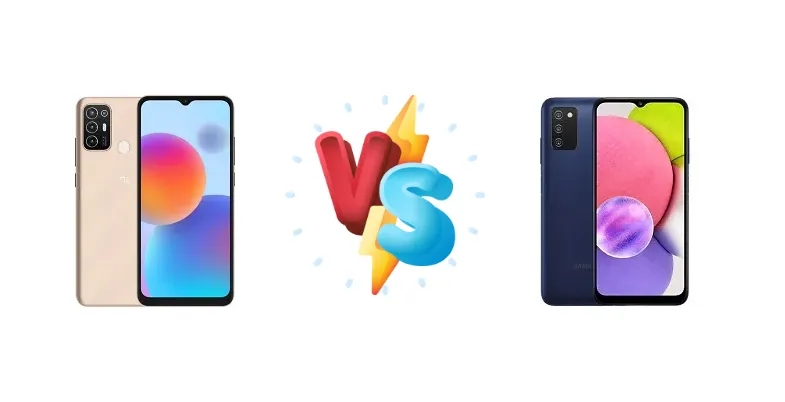
The ZTE Blade A52 and Samsung Galaxy A03s represent the extreme end of the smartphone price spectrum, targeting users who prioritize affordability above all else. Both devices aim to deliver a functional smartphone experience without breaking the bank, but they achieve this through different approaches to chipset selection and feature implementation. This comparison will dissect their key specifications to determine which offers the best value.
🏆 Quick Verdict
For the average user prioritizing basic functionality and slightly better performance, the Samsung Galaxy A03s emerges as the better choice. Its Mediatek Helio P35, built on a more efficient 12nm process, offers a noticeable performance edge over the ZTE Blade A52’s Unisoc SC9863A, despite both utilizing Cortex-A53/A55 cores. Both phones offer similar battery endurance, but the A03s’ 15W charging provides a slight convenience advantage.
| Network |
|---|
| 2G bands | GSM 850 / 900 / 1800 / 1900 | GSM 850 / 900 / 1800 / 1900 |
| 3G bands | HSDPA 850 / 900 / 1900 / 2100 | HSDPA 850 / 900 / 2100 |
| 4G bands | 1, 3, 5, 7, 8, 20, 28, 38, 40, 41 | 1, 3, 5, 7, 8, 20, 28, 38, 40, 41 |
| Speed | HSPA, LTE | HSPA 42.2/5.76 Mbps, LTE Cat4 150/50 Mbps |
| Technology | GSM / HSPA / LTE | GSM / HSPA / LTE |
| | - | 2, 4, 5, 7, 12, 13, 14, 25, 26, 41, 66, 71 - SM-A037U |
| Launch |
|---|
| Announced | 2022, June 10 | 2021, August 18 |
| Status | Available. Released 2022, June 10 | Available. Released 2021, August 18 |
| Body |
|---|
| Build | - | Glass front, plastic frame, plastic back |
| Dimensions | 168 x 77.5 x 9.4 mm (6.61 x 3.05 x 0.37 in) | 164.2 x 75.9 x 9.1 mm (6.46 x 2.99 x 0.36 in) |
| SIM | Nano-SIM + Nano-SIM | Nano-SIM + Nano-SIM |
| Weight | 214 g (7.55 oz) | 196 g (6.91 oz) |
| Display |
|---|
| Resolution | 720 x 1600 pixels, 20:9 ratio (~269 ppi density) | 720 x 1600 pixels, 20:9 ratio (~270 ppi density) |
| Size | 6.52 inches, 102.6 cm2 (~78.8% screen-to-body ratio) | 6.5 inches, 102.0 cm2 (~81.8% screen-to-body ratio) |
| Type | IPS LCD | PLS LCD |
| Platform |
|---|
| CPU | Octa-core (4x1.6 GHz Cortex-A55 & 4x1.2 GHz Cortex-A55) | Octa-core (4x2.35 GHz Cortex-A53 & 4x1.8 GHz Cortex-A53) |
| Chipset | Unisoc SC9863A (28 nm) | Mediatek MT6765 Helio P35 (12 nm) |
| GPU | IMG8322 | PowerVR GE8320 |
| OS | Android 11 | Android 11, upgradable to Android 13, One UI 5.1 Core |
| Memory |
|---|
| Card slot | microSDXC | microSDXC (dedicated slot) |
| Internal | 32GB 2GB RAM, 64GB 2GB RAM | 32GB 2GB RAM, 32GB 3GB RAM, 32GB 4GB RAM, 64GB 3GB RAM, 64GB 4GB RAM |
| | - | eMMC 5.1 |
| Main Camera |
|---|
| Features | LED flash, HDR | LED flash |
| Single | - | 5 MP, f/2.2 |
| Triple | 13 MP, AF
2 MP (macro)
Auxiliary lens | 13 MP, f/2.2, (wide), AF
2 MP (macro)
Auxiliary lens |
| Video | 1080p@30fps | 1080p@30fps |
| Selfie camera |
|---|
| Single | 5 MP | 5 MP, f/2.2 |
| Video | 720p@30fps | 1080p@30fps |
| Sound |
|---|
| 3.5mm jack | Yes | Yes |
| 35mm jack | Yes | Yes |
| Loudspeaker | Yes | Yes |
| Comms |
|---|
| Bluetooth | Yes | 5.0, A2DP |
| NFC | Yes | Yes (market/region dependent) |
| Positioning | GPS, GLONASS | GPS, GLONASS, GALILEO, BDS |
| Radio | Unspecified | No |
| USB | USB Type-C 2.0, OTG | USB Type-C 2.0 |
| WLAN | Yes | Wi-Fi 802.11 b/g/n, Wi-Fi Direct |
| Features |
|---|
| Sensors | Fingerprint (rear-mounted), accelerometer, proximity | Fingerprint (side-mounted), accelerometer, proximity |
| Battery |
|---|
| Charging | 10W wired | 15W wired |
| Type | Li-Ion 5000 mAh | Li-Po 5000 mAh |
| Misc |
|---|
| Colors | Space Gray, Silk Gold, Crystal Blue | Black, Blue, White |
| Models | - | SM-A037F, SM-A037F/DS, SM-A037M, SM-A037G, SM-A037U, SM-S134DL, SM-A037W, SM-A037U1, SM-S135DL |
| Price | About 90 EUR | $ 65.65 / £ 82.99 / ₹ 10,800 |
| SAR EU | - | 0.36 W/kg (head) 1.09 W/kg (body) |
| Tests |
|---|
| Battery life | - |
Endurance rating 122h
|
| Camera | - |
Photo / Video |
| Display | - |
Contrast ratio: 1718:1 (nominal) |
| Loudspeaker | - |
-27.4 LUFS (Good)
|
| Performance | - |
AnTuTu: 103465 (v8), 101299 (v9)
GeekBench: 889 (v5.1)
GFXBench: 5.5fps (ES 3.1 onscreen) |
ZTE Blade A52
- Potentially lower price point
- Functional for basic tasks
- Acceptable battery life
- Less powerful chipset
- Slower charging speed
- Limited display brightness information
Samsung Galaxy A03s
- More powerful and efficient chipset
- Brighter display for outdoor use
- Faster 15W charging
- May be slightly more expensive
- Basic camera system
- 2MP macro camera is largely ineffective
Display Comparison
The Samsung Galaxy A03s boasts a measured peak brightness of 488 nits, significantly improving outdoor visibility compared to the ZTE Blade A52, which lacks published brightness data. Both displays share a 1718:1 contrast ratio, suggesting similar color reproduction quality. However, the A03s’ higher brightness is a tangible benefit for users frequently exposed to sunlight. The lack of detailed display specifications for the A52 makes a comprehensive comparison difficult, but the A03s clearly holds an advantage in usability.
Camera Comparison
Both devices feature basic photo/video capabilities, but detailed camera specifications are limited. Without sensor size or aperture information, a direct comparison is challenging. The presence of a camera is more about functionality than quality at this price point. The ZTE Blade A52 and Samsung Galaxy A03s likely rely heavily on software processing to enhance image quality, and the results will likely be similar in most scenarios. The inclusion of a 2MP macro camera on the A03s is largely a marketing feature with limited practical benefit.
Performance
The Samsung Galaxy A03s’ Mediatek Helio P35 (12nm) offers a clear architectural advantage over the ZTE Blade A52’s Unisoc SC9863A (28nm). While both utilize octa-core configurations, the Helio P35’s faster 2.35 GHz Cortex-A53 cores and more efficient manufacturing process translate to snappier app loading and smoother multitasking. The A52’s 1.6 GHz Cortex-A55 cores, while newer architecture, are hampered by the older, less efficient 28nm node. This difference will be most noticeable when running multiple apps or demanding tasks. The A03s will likely exhibit less thermal throttling under sustained load.
Battery Life
Both the ZTE Blade A52 and Samsung Galaxy A03s achieve an endurance rating of 122 hours, indicating comparable battery life under typical usage. However, the Samsung Galaxy A03s supports 15W wired charging, while the ZTE Blade A52 is limited to 10W. This means the A03s will recharge significantly faster, reducing downtime and offering a more convenient user experience. While both will last a full day for light users, the A03s’ faster charging is a practical advantage.
Buying Guide
Buy the ZTE Blade A52 if you need a phone primarily for very light tasks like calls, texts, and occasional social media browsing, and are extremely budget-constrained. Buy the Samsung Galaxy A03s if you prefer a slightly more responsive experience for everyday tasks, appreciate a brighter display for outdoor visibility, and value the faster 15W charging for quicker top-ups.
Frequently Asked Questions
❓ Does the Unisoc SC9863A in the ZTE Blade A52 struggle with multitasking?
Yes, the Unisoc SC9863A, built on a 28nm process, is less efficient and powerful than the Helio P35 in the A03s. Expect noticeable slowdowns when switching between multiple apps or running demanding applications. It's best suited for single-tasking scenarios.
❓ Is the 15W charging on the Samsung Galaxy A03s a significant improvement over the ZTE Blade A52's 10W charging?
Absolutely. While both phones offer similar battery life, the A03s’ 15W charging will significantly reduce the time it takes to fully recharge the battery. This is a practical benefit for users who don't want to be tethered to a charger for extended periods.
❓ How does the display quality of the Samsung Galaxy A03s compare to other phones in its price range?
The A03s’ 488 nits peak brightness is relatively good for a phone in this price bracket, offering decent visibility outdoors. While the contrast ratio is standard, the brightness is a key advantage over many competitors with dimmer displays.
❓ Is the Samsung Galaxy A03s a good option for playing mobile games?
The Helio P35 can handle casual mobile games, but don't expect high frame rates or smooth performance in graphically demanding titles like PUBG or Call of Duty. Lowering graphics settings is recommended for a playable experience.