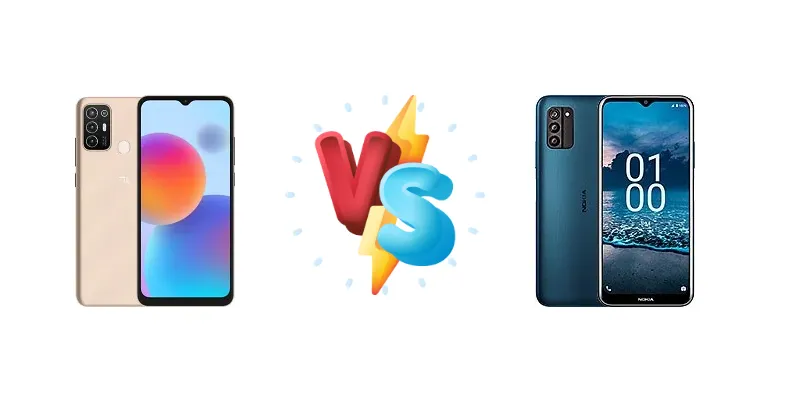
The ZTE Blade A52 and Nokia G100 represent two distinct approaches to the ultra-budget smartphone market. The Blade A52 relies on the efficiency of a Unisoc chipset, while the Nokia G100 opts for Qualcomm's Snapdragon 662. This comparison dives deep into the specifications to determine which device offers the best balance of performance, features, and value for the price-conscious consumer.
🏆 Quick Verdict
For most users, the Nokia G100 emerges as the better choice. Its Snapdragon 662 chipset, fabricated on an 11nm process, provides a noticeable performance advantage over the ZTE Blade A52’s Unisoc SC9863A. While the A52 may offer slightly better efficiency, the G100’s faster processing and 15W charging outweigh this benefit.
| Network |
|---|
| 2G bands | GSM 850 / 900 / 1800 / 1900 | GSM 850 / 900 / 1800 / 1900 |
| 3G bands | HSDPA 850 / 900 / 1900 / 2100 | HSDPA 850 / 1700(AWS) / 1900 |
| 4G bands | 1, 3, 5, 7, 8, 20, 28, 38, 40, 41 | 2, 4, 5, 7, 12, 13, 17, 44, 66, 71 |
| Speed | HSPA, LTE | HSPA, LTE |
| Technology | GSM / HSPA / LTE | GSM / HSPA / LTE |
| Launch |
|---|
| Announced | 2022, June 10 | 2022, September 22 |
| Status | Available. Released 2022, June 10 | Available. Released 2022, October |
| Body |
|---|
| Build | - | Glass front, plastic frame, plastic back |
| Dimensions | 168 x 77.5 x 9.4 mm (6.61 x 3.05 x 0.37 in) | 166.6 x 76.7 x 8.9 mm (6.56 x 3.02 x 0.35 in) |
| SIM | Nano-SIM + Nano-SIM | Nano-SIM |
| Weight | 214 g (7.55 oz) | 195.1 g (6.88 oz) |
| Display |
|---|
| Resolution | 720 x 1600 pixels, 20:9 ratio (~269 ppi density) | 720 x 1600 pixels, 20:9 ratio (~269 ppi density) |
| Size | 6.52 inches, 102.6 cm2 (~78.8% screen-to-body ratio) | 6.52 inches, 102.6 cm2 (~80.3% screen-to-body ratio) |
| Type | IPS LCD | IPS LCD |
| Platform |
|---|
| CPU | Octa-core (4x1.6 GHz Cortex-A55 & 4x1.2 GHz Cortex-A55) | Octa-core (4x2.0 GHz Kryo 260 Gold & 4x1.8 GHz Kryo 260 Silver) |
| Chipset | Unisoc SC9863A (28 nm) | Qualcomm SM6115 Snapdragon 662 (11 nm) |
| GPU | IMG8322 | Adreno 610 |
| OS | Android 11 | Android 12 |
| Memory |
|---|
| Card slot | microSDXC | microSDXC |
| Internal | 32GB 2GB RAM, 64GB 2GB RAM | 32GB 3GB RAM, 128GB 4GB RAM |
| Main Camera |
|---|
| Features | LED flash, HDR | LED flash, HDR, panorama |
| Triple | 13 MP, AF
2 MP (macro)
Auxiliary lens | 13 MP, f/1.8, (wide), AF
5 MP, f/2.2, 115˚ (ultrawide), 1/5.0"
Auxiliary lens |
| Video | 1080p@30fps | 1080p@30fps |
| Selfie camera |
|---|
| Single | 5 MP | 8 MP, f/2.0, (wide), 1/4.0", 1.12µm |
| Video | 720p@30fps | 1080p@30fps |
| Sound |
|---|
| 3.5mm jack | Yes | - |
| 35mm jack | Yes | Yes |
| Loudspeaker | Yes | Yes |
| Comms |
|---|
| Bluetooth | Yes | 5.0, A2DP, LE |
| NFC | Yes | No |
| Positioning | GPS, GLONASS | GPS |
| Radio | Unspecified | FM radio |
| USB | USB Type-C 2.0, OTG | USB Type-C 2.0, OTG |
| WLAN | Yes | Wi-Fi 802.11 b/g/n/ac, dual-band |
| Features |
|---|
| Sensors | Fingerprint (rear-mounted), accelerometer, proximity | Fingerprint (side-mounted), accelerometer, gyro, proximity, barometer |
| Battery |
|---|
| Charging | 10W wired | 15W wired |
| Type | Li-Ion 5000 mAh | Li-Po 5000 mAh |
| Misc |
|---|
| Colors | Space Gray, Silk Gold, Crystal Blue | Nordic Blue |
| Price | About 90 EUR | About 60 EUR |
ZTE Blade A52
- Potentially slightly better standby battery life due to Unisoc's efficiency.
- Lower price point (likely).
- Simple and straightforward user experience.
- Significantly slower performance compared to the Nokia G100.
- Slower 10W charging.
- Likely inferior camera performance.
Nokia G100
- Faster and more responsive performance thanks to the Snapdragon 662.
- Faster 15W charging.
- Better image processing capabilities.
- May be slightly more expensive than the ZTE Blade A52.
- Potentially slightly shorter battery life during heavy use.
- Larger software footprint (potentially).
Display Comparison
Neither device boasts a standout display. Details regarding panel type (IPS, TFT) and resolution are missing, but both likely target a 720p+ resolution common in this price bracket. The key difference lies in processing power impacting UI smoothness. The Nokia G100’s more powerful chipset will contribute to a more fluid experience when scrolling and navigating the interface, even if the panel itself is similar. Bezels are expected to be substantial on both devices, reflecting their budget positioning.
Camera Comparison
Without detailed camera specifications beyond the presence of cameras, a direct comparison is difficult. However, the Nokia G100’s more powerful image signal processor (ISP) within the Snapdragon 662 chipset will likely result in better image processing, particularly in challenging lighting conditions. The ZTE Blade A52’s Unisoc chipset will likely struggle to deliver the same level of detail and dynamic range. It’s safe to assume both phones include a primary camera and potentially depth or macro sensors, but image quality will heavily favor the Nokia G100.
Performance
The Nokia G100’s Qualcomm Snapdragon 662 (11nm) significantly outperforms the ZTE Blade A52’s Unisoc SC9863A (28nm). The 11nm fabrication process allows for higher clock speeds and improved power efficiency compared to the older 28nm node. The Snapdragon 662’s CPU configuration – 4x2.0 GHz Kryo 260 Gold & 4x1.8 GHz Kryo 260 Silver – provides a clear advantage over the Blade A52’s 4x1.6 GHz Cortex-A55 & 4x1.2 GHz Cortex-A55. This translates to faster app loading times, smoother multitasking, and a more responsive user experience. While neither phone is a gaming powerhouse, the G100 will handle casual games with greater ease.
Battery Life
Both phones likely feature battery capacities around 5000mAh, a common size for budget smartphones. However, the Nokia G100’s 15W wired charging is a significant advantage over the ZTE Blade A52’s 10W charging. This means the G100 will recharge noticeably faster, reducing downtime. While the Unisoc chipset in the A52 *may* offer slightly better standby efficiency, the difference will be minimal in real-world usage, and the faster charging of the G100 is more impactful.
Buying Guide
Buy the ZTE Blade A52 if your primary need is a very basic smartphone for essential tasks like calls, texts, and light social media, and you prioritize minimizing cost above all else. Buy the Nokia G100 if you want a more responsive experience for everyday use, including smoother multitasking, slightly better gaming performance, and faster charging, even if it means spending a bit more.
Frequently Asked Questions
❓ Will the Nokia G100 struggle with demanding apps like Facebook or Instagram?
While the Snapdragon 662 isn't a flagship processor, it's more than capable of handling everyday apps like Facebook and Instagram smoothly. The 662’s architecture is designed for efficient multitasking, meaning you’ll experience fewer slowdowns compared to the ZTE Blade A52’s Unisoc chipset when switching between apps.
❓ Is the 10W charging on the ZTE Blade A52 painfully slow?
Yes, 10W charging is relatively slow by today's standards. Expect a full charge to take well over 3 hours. This is a significant drawback compared to the Nokia G100’s 15W charging, which will noticeably reduce recharge times, especially if you're a heavy user.
❓ Can either of these phones handle basic mobile games like Candy Crush or Subway Surfers?
Both phones can handle casual games like Candy Crush or Subway Surfers, but the Nokia G100 will provide a smoother and more consistent experience. The Snapdragon 662’s GPU is more powerful, resulting in fewer frame drops and a more enjoyable gaming experience, even at lower settings.
❓ How does the Unisoc SC9863A chipset compare to older Snapdragon 400 series chips?
The Unisoc SC9863A generally performs similarly to older Snapdragon 400 series chips (like the 439 or 450). It's adequate for basic tasks but struggles with demanding applications. The Snapdragon 662 in the Nokia G100 represents a significant step up in performance.