
ZTE Blade A52 vs. Motorola Moto G Play (2023): A Deep Dive into Budget Smartphone Choices
| Phones Images | |||||
|---|---|---|---|---|---|
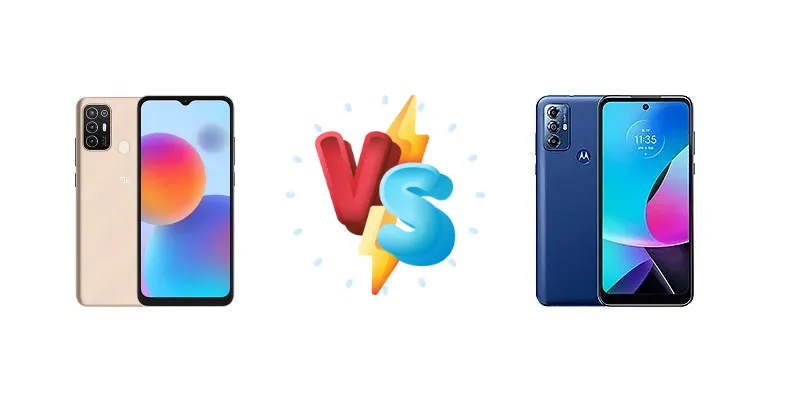
|
🏆 Quick Verdict
For the average user prioritizing responsiveness and future-proofing, the Motorola Moto G Play (2023) is the better choice. Its MediaTek Helio G37, built on a more efficient 12nm process, provides a noticeable performance advantage over the ZTE Blade A52’s older Unisoc SC9863A, despite both phones sharing a 10W charging rate.
| PHONES | ||
|---|---|---|
| Phone Names | ZTE Blade A52 | Motorola Moto G Play (2023) |
| Network | ||
|---|---|---|
| 2G bands | GSM 850 / 900 / 1800 / 1900 | GSM 850 / 900 / 1800 / 1900 |
| 3G bands | HSDPA 850 / 900 / 1900 / 2100 | HSDPA 850 / 900 / 1700(AWS) / 1900 / 2100 |
| 4G bands | 1, 3, 5, 7, 8, 20, 28, 38, 40, 41 | 1, 2, 3, 4, 5, 7, 8, 12, 13, 14, 17, 18, 19, 20, 25, 26, 29, 30, 38, 39, 40, 41, 66, 71 |
| Speed | HSPA, LTE | HSPA, LTE |
| Technology | GSM / HSPA / LTE | GSM / CDMA / HSPA / LTE |
| - | CDMA 800 / 1900 | |
| Launch | ||
|---|---|---|
| Announced | 2022, June 10 | 2022, December 08 |
| Status | Available. Released 2022, June 10 | Available. Released 2022, December 12 |
| Body | ||
|---|---|---|
| Build | - | Plastic frame, plastic back |
| Dimensions | 168 x 77.5 x 9.4 mm (6.61 x 3.05 x 0.37 in) | 167.2 x 76.5 x 9.4 mm (6.58 x 3.01 x 0.37 in) |
| SIM | Nano-SIM + Nano-SIM | Nano-SIM |
| Weight | 214 g (7.55 oz) | 203 g (7.20 oz) |
| - | Water-repellent coating | |
| Display | ||
|---|---|---|
| Resolution | 720 x 1600 pixels, 20:9 ratio (~269 ppi density) | 720 x 1600 pixels, 20:9 ratio (~270 ppi density) |
| Size | 6.52 inches, 102.6 cm2 (~78.8% screen-to-body ratio) | 6.5 inches, 102.0 cm2 (~79.7% screen-to-body ratio) |
| Type | IPS LCD | IPS LCD, 90Hz |
| Platform | ||
|---|---|---|
| CPU | Octa-core (4x1.6 GHz Cortex-A55 & 4x1.2 GHz Cortex-A55) | Octa-core (4x2.3 GHz Cortex-A53 & 4x1.8 GHz Cortex-A53) |
| Chipset | Unisoc SC9863A (28 nm) | Mediatek MT6765 Helio G37 (12 nm) |
| GPU | IMG8322 | PowerVR GE8320 |
| OS | Android 11 | Android 12 |
| Memory | ||
|---|---|---|
| Card slot | microSDXC | microSDXC (dedicated slot) |
| Internal | 32GB 2GB RAM, 64GB 2GB RAM | 32GB 3GB RAM |
| - | eMMC 5.1 | |
| Main Camera | ||
|---|---|---|
| Features | LED flash, HDR | LED flash, HDR, panorama |
| Triple | 13 MP, AF 2 MP (macro) Auxiliary lens | 16 MP, f/2.2, (wide), 1.12µm, PDAF 2 MP (macro) Auxiliary lens |
| Video | 1080p@30fps | 1080p@30/60fps |
| Selfie camera | ||
|---|---|---|
| Features | - | HDR |
| Single | 5 MP | 5 MP, f/2.4, (wide), 1.12µm |
| Video | 720p@30fps | 1080p@30fps |
| Sound | ||
|---|---|---|
| 3.5mm jack | Yes | Yes |
| 35mm jack | Yes | Yes |
| Loudspeaker | Yes | Yes |
| Comms | ||
|---|---|---|
| Bluetooth | Yes | 5.0, A2DP, LE |
| NFC | Yes | No |
| Positioning | GPS, GLONASS | GPS, GLONASS |
| Radio | Unspecified | No |
| USB | USB Type-C 2.0, OTG | USB Type-C 2.0 |
| WLAN | Yes | Wi-Fi 802.11 a/b/g/n/ac, dual-band |
| Features | ||
|---|---|---|
| Sensors | Fingerprint (rear-mounted), accelerometer, proximity | Fingerprint (rear-mounted), accelerometer, proximity, barometer |
| Battery | ||
|---|---|---|
| Charging | 10W wired | 10W wired |
| Type | Li-Ion 5000 mAh | Li-Po 5000 mAh |
| Misc | ||
|---|---|---|
| Colors | Space Gray, Silk Gold, Crystal Blue | Deep Indigo |
| Models | - | XT2271-1, XT2271-3, XT2271-5, XT2271-4 |
| Price | About 90 EUR | $ 54.00 / C$ 129.00 |
ZTE Blade A52
- Potentially lower price point
- Simple and straightforward user experience
- Acceptable for basic communication tasks
- Outdated Unisoc chipset
- Slower performance and responsiveness
- Limited software support lifespan
Motorola Moto G Play (2023)
- More modern and efficient MediaTek Helio G37 chipset
- Improved performance for everyday tasks
- Likely longer software support
- Better gaming capabilities (within limitations)
- Still a budget device with inherent limitations
- 10W charging is slow
- Camera performance is basic
Display Comparison
Neither device boasts a standout display. Both likely utilize LCD panels, a common cost-saving measure in this segment. However, the lack of detailed display specifications (resolution, brightness) makes a direct comparison difficult. We can infer that the Moto G Play, being a newer release, *may* benefit from slightly improved color calibration, but this is speculative. Bezels are expected to be substantial on both devices, reflecting their budget nature.
Camera Comparison
Camera performance is likely to be similar – adequate for basic snapshots in good lighting conditions. Both phones likely feature a primary camera and a depth sensor, with the ZTE potentially including a second, low-resolution camera. Given the context data, focusing on the primary sensor is key. Without sensor size information, it’s difficult to definitively say which is better, but the Helio G37’s image signal processor (ISP) is likely more advanced, potentially leading to slightly better image processing and noise reduction. The inclusion of a 2MP macro camera on either device is largely a marketing gimmick and shouldn’t be a deciding factor.
Performance
The core difference lies in the chipsets. The Motorola Moto G Play (2023) features the MediaTek Helio G37, fabricated on a 12nm process. This translates to improved power efficiency and, crucially, a higher clock speed for its Cortex-A53 cores (2.3 GHz vs 1.6 GHz on the ZTE). While both use Cortex-A55 cores, the A52’s are clocked lower (1.2 GHz vs 1.8 GHz). This means the Moto G Play will handle multitasking and app launches with noticeably less lag. The Unisoc SC9863A in the ZTE Blade A52, built on a 28nm process, is an older design and will struggle with more demanding tasks. The G37’s GPU will also provide a better gaming experience, even if limited to less graphically intensive titles.
Battery Life
Both devices are equipped with 10W wired charging, indicating a similar charging experience – slow by modern standards. Battery capacity isn’t specified, but given the price point, both likely house batteries in the 4000-5000 mAh range. The Helio G37’s 12nm process offers better power efficiency, meaning the Moto G Play (2023) will likely deliver slightly longer battery life despite potentially having a similar capacity. The difference won’t be dramatic, but it’s a factor to consider.
Buying Guide
Buy the ZTE Blade A52 if you need a phone primarily for very basic tasks like calls, texts, and light social media, and are on an extremely tight budget. Its lower price point may be attractive for first-time smartphone users or as a temporary device. Buy the Motorola Moto G Play (2023) if you prefer a more responsive experience for everyday apps, occasional gaming, and a chipset that offers a longer software support lifespan. The G Play provides a better balance of performance and longevity.