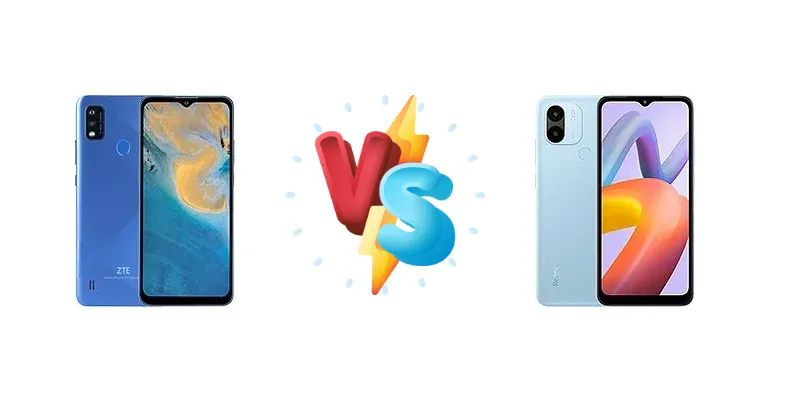
The budget smartphone market is fiercely competitive, offering incredible value for those seeking essential features without breaking the bank. Today, we're pitting two contenders against each other: the ZTE Blade A51 and the Xiaomi Redmi A2+. Let's dive into a detailed comparison to see which phone emerges as the winner.
🏆 Quick Verdict
The Xiaomi Redmi A2+ edges out the ZTE Blade A51 thanks to its more efficient chipset, slightly better performance, and inclusion of 10W charging. While both are budget options, the Redmi A2+ offers a more polished experience overall, making it the recommended choice.
| Network |
|---|
| 2G bands | GSM 850 / 900 / 1800 / 1900 | GSM 850 / 900 / 1800 / 1900 |
| 3G bands | HSDPA 850 / 900 / 1900 / 2100 | HSDPA 850 / 900 / 2100 |
| 4G bands | 1, 3, 5, 7, 8, 20, 28, 38, 40, 41 | 1, 3, 5, 7, 8, 20, 28, 38, 40, 41 - International |
| Speed | HSPA, LTE | HSPA, LTE |
| Technology | GSM / HSPA / LTE | GSM / HSPA / LTE |
| | - | 1, 3, 5, 8, 40, 41 - India |
| Launch |
|---|
| Announced | 2021, May 08 | 2023, March 24 |
| Status | Available. Released 2021, May 08 | Available. Released 2023, March 24 |
| Body |
|---|
| Dimensions | 166.5 x 75.6 x 8.5 mm (6.56 x 2.98 x 0.33 in) | 164.9 x 76.8 x 9.1 mm (6.49 x 3.02 x 0.36 in) |
| SIM | Nano-SIM + Nano-SIM | Nano-SIM + Nano-SIM |
| Weight | 173.7 g (6.14 oz) | 192 g (6.77 oz) |
| Display |
|---|
| Resolution | 720 x 1600 pixels, 20:9 ratio (~269 ppi density) | 720 x 1600 pixels, 20:9 ratio (~269 ppi density) |
| Size | 6.52 inches, 102.6 cm2 (~81.5% screen-to-body ratio) | 6.52 inches, 102.6 cm2 (~81.0% screen-to-body ratio) |
| Type | IPS LCD | IPS LCD, 400 nits (typ) |
| Platform |
|---|
| CPU | Octa-core (4x1.6 GHz Cortex-A55 & 4x1.2 GHz Cortex-A55) | Octa-core (4x2.2 GHz Cortex-A53 & 4x1.7 GHz Cortex-A53) |
| Chipset | Unisoc SC9863A (28 nm) | Mediatek Helio G36 (12 nm) |
| GPU | IMG8322 | PowerVR GE8320 |
| OS | Android 11 (Go edition) | Android 12 or 13 (Go edition), MIUI |
| Memory |
|---|
| Card slot | microSDXC | microSDXC (dedicated slot) |
| Internal | 32GB 2GB RAM, 64GB 2GB RAM | 32GB 2GB RAM, 32GB 3GB RAM, 64GB 3GB RAM, 64GB 4GB RAM, 128GB 4GB RAM |
| | eMMC 5.1 | eMMC 5.1 |
| Main Camera |
|---|
| Dual | 13 MP, AF
2 MP | 8 MP, f/2.0, (wide)
0.08 MP (depth) |
| Features | LED flash, HDR | Dual-LED flash, HDR |
| Single | - | 8 MP, f/2.0, (wide)
Auxiliary lens |
| Video | 1080p@30fps | 1080p@30fps |
| Selfie camera |
|---|
| Single | 5 MP | 5 MP, f/2.2 |
| Video | - | 1080p@30fps |
| Sound |
|---|
| 3.5mm jack | Yes | Yes |
| 35mm jack | Yes | Yes |
| Loudspeaker | Yes | Yes |
| Comms |
|---|
| Bluetooth | 4.2, A2DP, LE | 5.0, A2DP, LE |
| NFC | Yes | No |
| Positioning | GPS, GLONASS | GPS, GLONASS, GALILEO, BDS |
| Radio | FM radio | FM radio |
| USB | USB Type-C 2.0, OTG | microUSB 2.0 |
| WLAN | Wi-Fi 802.11 b/g/n | Wi-Fi 802.11 a/b/g/n |
| Features |
|---|
| Sensors | Fingerprint (rear-mounted), accelerometer, proximity | Fingerprint (rear-mounted), accelerometer |
| Battery |
|---|
| Charging | - | 10W wired |
| Type | Li-Ion 3200 mAh | Li-Po 5000 mAh |
| Misc |
|---|
| Colors | Blue, Gray | Aqua Blue, Classic Black, Sea Green |
| Models | - | 23028RNCAG, 23028RN4DI, 23028RNCAI, 23028RN4DH |
| Price | - | About 100 EUR |
| SAR | - | 1.10 W/kg (head) 1.01 W/kg (body) |
| SAR EU | - | 0.71 W/kg (head) 1.00 W/kg (body) |
ZTE Blade A51
- Potentially lower price
- Larger display (potentially)
- Less powerful chipset
- No specified charging speed
- Older technology
Xiaomi Redmi A2+
- More efficient chipset
- Better performance
- 10W wired charging
- Slightly better display quality
- Potentially slightly higher price
- Modest camera performance
Display Comparison
Both phones feature large displays, typically around 6.5 inches, with HD+ resolution. While the Blade A51 might have a slightly larger display, the Redmi A2+'s display quality is generally considered to be a bit better due to Xiaomi's typically more refined display calibration. Expect similar viewing experiences overall, suitable for basic media consumption.
Camera Comparison
Camera performance on both devices is modest, typical of budget phones. Both likely feature a primary rear camera around 13MP. Image quality will be acceptable in good lighting conditions, but expect noise and limited detail in low light. The Redmi A2+ might have a slight edge in image processing due to Xiaomi's software optimization.
Performance
This is where the Redmi A2+ shines. The Mediatek Helio G36, built on a 12nm process, is significantly more efficient and powerful than the Unisoc SC9863A (28nm) found in the Blade A51. Expect smoother multitasking, faster app loading times, and a generally more responsive user experience on the Redmi A2+. The Cortex-A53 cores in the Redmi A2+ also offer a performance advantage over the Cortex-A55 cores in the Blade A51.
Battery Life
Both phones likely feature batteries around 5000mAh, offering all-day battery life for moderate usage. However, the Redmi A2+'s more efficient chipset contributes to better battery efficiency. The inclusion of 10W wired charging on the Redmi A2+ is a significant advantage over the Blade A51, which lacks specified charging speeds.
Buying Guide
The ZTE Blade A51 is a good option for users prioritizing a larger screen and potentially a slightly lower price point (depending on regional availability). The Xiaomi Redmi A2+ is ideal for those seeking a smoother experience, slightly better performance, and the convenience of wired charging.
Frequently Asked Questions
❓ What is the difference between the Unisoc SC9863A and the Mediatek Helio G36?
The Mediatek Helio G36 is a more modern and efficient chipset built on a 12nm process, offering significantly better performance and battery life compared to the older 28nm Unisoc SC9863A.
❓ Which phone is better for gaming?
The Xiaomi Redmi A2+ is the better choice for gaming due to its more powerful chipset and smoother performance. While neither phone is a gaming powerhouse, the Redmi A2+ will handle basic games more effectively.