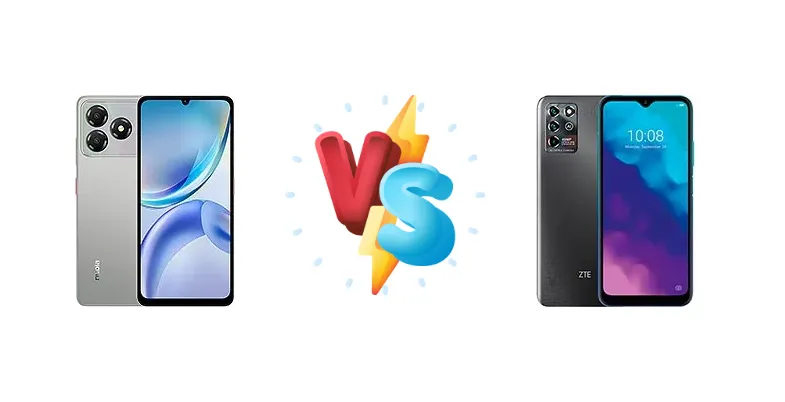
ZTE's Blade series consistently targets the value-conscious consumer, but the A36 and V30 Vita represent slightly different approaches. The A36 emphasizes endurance and a more detailed chipset specification, while the V30 Vita remains more opaque in its hardware details. This comparison aims to dissect the differences and determine which device delivers the best experience for the price.
🏆 Quick Verdict
For the average user prioritizing longevity and a known chipset architecture, the ZTE Blade A36 is the stronger choice. Its Unisoc T7200 provides a more clearly defined performance profile and, crucially, boasts a significantly longer battery endurance rating of 54:13h compared to the V30 Vita's unknown endurance.
| Network |
|---|
| 2G bands | GSM 850 / 900 / 1800 / 1900 | GSM 850 / 900 / 1800 / 1900 |
| 3G bands | HSDPA 850 / 900 / 1900 / 2100 | HSDPA 850 / 1700(AWS) / 1900 - Mexico |
| 4G bands | 1, 3, 5, 7, 8, 20, 28, 38, 40, 41 | 1, 2, 4, 5, 7, 26, 28, 66 - Mexico |
| Speed | HSPA, LTE | HSPA, LTE |
| Technology | GSM / HSPA / LTE | GSM / HSPA / LTE |
| Launch |
|---|
| Announced | 2025, June 18 | 2021, July 16 |
| Status | Available. Released 2025, June | Available. Released 2021, August 16 |
| Body |
|---|
| Build | Glass front, plastic frame, plastic back | - |
| Dimensions | 167.6 x 77.4 x 8.3 mm (6.60 x 3.05 x 0.33 in) | 173 x 78.1 x 8.9 mm (6.81 x 3.07 x 0.35 in) |
| SIM | Nano-SIM + Nano-SIM | Nano-SIM + Nano-SIM |
| Weight | - | 210 g (7.41 oz) |
| Display |
|---|
| Protection | Mohs level 4 | - |
| Resolution | 720 x 1600 pixels, 20:9 ratio (~260 ppi density) | 720 x 1640 pixels, 3:2 ratio (~288 ppi density) |
| Size | 6.75 inches, 110.0 cm2 (~84.8% screen-to-body ratio) | 6.82 inches, 137.8 cm2 (~102.0% screen-to-body ratio) |
| Type | IPS LCD, 90Hz | IPS LCD |
| Platform |
|---|
| CPU | Octa-core (2x1.6 GHz Cortex-A75 & 6x1.6 GHz Cortex-A55) | Octa-core 1.6 GHz |
| Chipset | Unisoc T7200 (12 nm) | - |
| GPU | Mali-G57 MP1 | - |
| OS | Android 15 | Android 11 |
| Memory |
|---|
| Card slot | microSDXC (dedicated slot) | microSDXC |
| Internal | 64GB 4GB RAM | 128GB 3GB RAM |
| Main Camera |
|---|
| Features | LED flash | LED flash, HDR, panorama |
| Single | 13 MP, AF
Auxiliary lens | 8 MP, f/2.0, (wide) |
| Triple | - | 48 MP, f/1.8, 26mm (wide), PDAF
5 MP (macro)
Auxiliary lens |
| Video | 1080p@30fps | 1080p@30fps |
| Selfie camera |
|---|
| Single | 5 MP | 8 MP, f/2.0, (wide) |
| Video | Yes | - |
| Sound |
|---|
| 3.5mm jack | - | Yes |
| 35mm jack | Yes | Yes |
| Loudspeaker | Yes | Yes |
| Comms |
|---|
| Bluetooth | 5.2, A2DP, LE | 4.2, A2DP |
| NFC | No | No |
| Positioning | GPS, GALILEO, GLONASS | GPS |
| Radio | FM radio | Unspecified |
| USB | USB Type-C 2.0 | USB Type-C 2.0 |
| WLAN | Wi-Fi 802.11 a/b/g/n/ac | Wi-Fi 802.11 b/g/n/ac |
| Features |
|---|
| Sensors | Accelerometer, proximity, compass | Fingerprint (side-mounted), accelerometer, proximity |
| Battery |
|---|
| Charging | 10W wired | - |
| Type | 5000 mAh | Li-Po 5000 mAh |
| Misc |
|---|
| Colors | Black, Green, Silver | Black, Blue, Green |
| Models | Z2472 | 8030 |
| Price | About 60 EUR | - |
| EU LABEL |
|---|
| Battery | 54:13h endurance, 800 cycles | - |
| Energy | Class A | - |
| Free fall | Class D (80 falls) | - |
| Repairability | Class B | - |
ZTE Blade A36
- Exceptional battery life (54:13h endurance)
- Detailed chipset specification (Unisoc T7200)
- More powerful CPU architecture (Cortex-A75 cores)
- Slow 10W charging
- Likely basic display quality
ZTE Blade V30 Vita
- Potentially more refined design (based on Vita branding)
- May be slightly more affordable
- Compact form factor (likely)
- Opaque hardware specifications
- Unknown battery life
- Potentially weaker CPU performance
Display Comparison
Display specifications are absent for both devices, making a direct comparison impossible. However, given the price point, it's reasonable to expect both utilize LCD panels with 720p+ resolution. The V30 Vita, historically, has featured slightly more refined designs, suggesting a potentially smaller bezel size, but this is speculative. Color accuracy and peak brightness are likely similar, leaning towards the basic side for cost optimization.
Camera Comparison
Camera details are sparse for both devices. It’s safe to assume both will feature a primary camera and potentially depth/macro sensors. However, without knowing sensor sizes, apertures, or image processing capabilities, a meaningful comparison is impossible. The inclusion of a 2MP macro camera on either device is unlikely to provide significant photographic value. The A36’s chipset *may* offer slightly better image signal processing (ISP) capabilities due to its more modern architecture, but this is purely speculative.
Performance
The ZTE Blade A36’s Unisoc T7200 (12nm) chipset is the clear performance leader here. Its octa-core configuration, split between 2x1.6 GHz Cortex-A75 and 6x1.6 GHz Cortex-A55 cores, provides a more robust architecture than the V30 Vita’s unspecified octa-core 1.6 GHz CPU. The A75 cores in the A36 offer significantly higher single-core performance, crucial for responsive app launching and smoother multitasking. The V30 Vita’s lack of architectural detail raises concerns about the efficiency and overall capability of its processor. Without knowing the GPU, it's difficult to assess gaming performance, but the A36’s chipset is likely to offer a more playable experience.
Battery Life
The ZTE Blade A36’s 54:13h endurance rating is its standout feature. This translates to exceptional battery life, capable of lasting well over a day for most users. The 800 charge cycles suggest a focus on long-term battery health. The V30 Vita’s battery capacity and endurance are unknown, making it difficult to assess its real-world performance. The A36’s 10W charging is slow by modern standards, but the long endurance mitigates this drawback. The V30 Vita’s charging speed is also unknown, but likely similar.
Buying Guide
Buy the ZTE Blade A36 if you need exceptional battery life for all-day use, appreciate a detailed understanding of the processor architecture, and value a phone that will reliably last through extended periods without needing a charge. Buy the ZTE Blade V30 Vita if you prioritize a potentially sleeker design (based on typical Vita branding) and are comfortable with a less transparent specification sheet, accepting a trade-off in known battery performance.
Frequently Asked Questions
❓ How does the Unisoc T7200 in the ZTE Blade A36 compare to other chipsets in this price range?
The Unisoc T7200 offers a competitive performance profile for its price point, particularly excelling in single-core tasks thanks to its Cortex-A75 cores. While it doesn't match the raw power of some MediaTek Helio G-series chips, it provides a more balanced experience with better efficiency and a known architecture, making it a reliable choice for everyday use.
❓ Is the 10W charging on the ZTE Blade A36 a significant drawback?
While 10W charging is slow compared to modern fast-charging standards, the A36’s exceptional battery endurance (54:13h) mitigates this issue. You’ll likely only need to charge the phone every other day, or even less frequently with moderate usage, reducing the impact of the slow charging speed.
❓ What kind of gaming performance can I expect from the ZTE Blade A36?
The ZTE Blade A36 can handle casual gaming reasonably well. More demanding titles will require lower graphics settings to maintain a playable frame rate. The Unisoc T7200’s GPU is adequate for basic gaming, but don’t expect flagship-level performance.