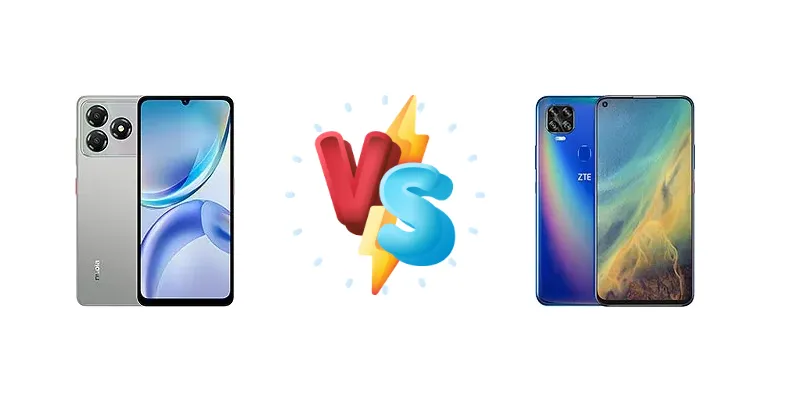
ZTE's Blade series consistently targets the value-conscious consumer. The A36 and V2020 5G represent two distinct approaches within that segment: the A36 prioritizes longevity and efficiency, while the V2020 5G aims for a more substantial performance uplift with 5G connectivity. This comparison dissects the key differences to determine which device best suits your needs.
🏆 Quick Verdict
For the average user prioritizing responsiveness and future-proofing, the ZTE Blade V2020 5G is the clear winner. Its Mediatek Dimensity 800 chipset delivers significantly better performance than the Unisoc T7200 in the A36, justifying the potential price difference. However, the A36’s exceptional battery endurance is a compelling factor for those prioritizing long-term use.
| Network |
|---|
| 2G bands | GSM 850 / 900 / 1800 / 1900 | GSM 850 / 900 / 1800 / 1900 |
| 3G bands | HSDPA 850 / 900 / 1900 / 2100 | HSDPA 850 / 900 / 1900 / 2100 |
| 4G bands | 1, 3, 5, 7, 8, 20, 28, 38, 40, 41 | 1, 3, 4, 5, 7, 8, 12, 17, 20, 34, 38, 39, 40, 41 |
| 5G bands | - | 1, 3, 28, 41, 78, 79 SA/NSA |
| Speed | HSPA, LTE | HSPA, LTE, 5G |
| Technology | GSM / HSPA / LTE | GSM / CDMA / HSPA / LTE / 5G |
| | - | CDMA 800 |
| Launch |
|---|
| Announced | 2025, June 18 | 2020, October 22. Released 2020, October 22 |
| Status | Available. Released 2025, June | Discontinued |
| Body |
|---|
| Build | Glass front, plastic frame, plastic back | - |
| Dimensions | 167.6 x 77.4 x 8.3 mm (6.60 x 3.05 x 0.33 in) | 162.7 x 76.3 x 8.8 mm (6.41 x 3.00 x 0.35 in) |
| SIM | Nano-SIM + Nano-SIM | Nano-SIM + Nano-SIM |
| Weight | - | 184 g (6.49 oz) |
| Display |
|---|
| Protection | Mohs level 4 | - |
| Resolution | 720 x 1600 pixels, 20:9 ratio (~260 ppi density) | 1080 x 2340 pixels, 19.5:9 ratio (~395 ppi density) |
| Size | 6.75 inches, 110.0 cm2 (~84.8% screen-to-body ratio) | 6.53 inches, 104.7 cm2 (~84.3% screen-to-body ratio) |
| Type | IPS LCD, 90Hz | IPS LCD |
| Platform |
|---|
| CPU | Octa-core (2x1.6 GHz Cortex-A75 & 6x1.6 GHz Cortex-A55) | Octa-core (4x2.0 GHz Cortex-A76 & 4x2.0 GHz Cortex-A55) |
| Chipset | Unisoc T7200 (12 nm) | Mediatek Dimensity 800 (7 nm) |
| GPU | Mali-G57 MP1 | Mali-G57MP4 |
| OS | Android 15 | Android 10, MiFavor 10.1 |
| Memory |
|---|
| Card slot | microSDXC (dedicated slot) | microSDXC |
| Internal | 64GB 4GB RAM | 128GB 6GB RAM |
| | - | UFS 2.1 |
| Main Camera |
|---|
| Features | LED flash | LED flash, panorama, HDR |
| Quad | - | 48 MP, f/1.8, (wide), 1/2.0", 0.8µm, PDAF
8 MP, f/2.2, 120˚ (ultrawide)
2 MP (macro)
Auxiliary lens |
| Single | 13 MP, AF
Auxiliary lens | - |
| Video | 1080p@30fps | 4K@30fps, 1080p@30fps |
| Selfie camera |
|---|
| Features | - | HDR |
| Single | 5 MP | 16 MP, f/2.0, (wide) |
| Video | Yes | 1080p@30fps |
| Sound |
|---|
| 3.5mm jack | - | Yes |
| 35mm jack | Yes | Yes |
| Loudspeaker | Yes | Yes |
| Comms |
|---|
| Bluetooth | 5.2, A2DP, LE | 5.0, A2DP, LE |
| NFC | No | No |
| Positioning | GPS, GALILEO, GLONASS | GPS |
| Radio | FM radio | No |
| USB | USB Type-C 2.0 | USB Type-C 2.0, OTG |
| WLAN | Wi-Fi 802.11 a/b/g/n/ac | Wi-Fi 802.11 a/b/g/n/ac, dual-band, Wi-Fi Direct |
| Features |
|---|
| Sensors | Accelerometer, proximity, compass | Fingerprint (rear-mounted), accelerometer, proximity |
| Battery |
|---|
| Charging | 10W wired | 18W wired |
| Type | 5000 mAh | Li-Ion 4000 mAh |
| Misc |
|---|
| Colors | Black, Green, Silver | Aurora Glamour |
| Models | Z2472 | - |
| Price | About 60 EUR | About 180 EUR |
| EU LABEL |
|---|
| Battery | 54:13h endurance, 800 cycles | - |
| Energy | Class A | - |
| Free fall | Class D (80 falls) | - |
| Repairability | Class B | - |
ZTE Blade A36
- Exceptional battery endurance (54:13h)
- Long battery lifespan (800 charge cycles)
- More affordable price point (likely)
- Less powerful processor (Unisoc T7200)
- Slower charging speed (10W)
- Limited performance for demanding tasks
ZTE Blade V2020 5G
- Significantly faster processor (Dimensity 800)
- Faster charging speed (18W)
- 5G connectivity for faster data speeds
- Shorter battery life compared to A36
- Potentially higher price
- May experience more thermal throttling under heavy load
Display Comparison
Display specifications are not provided, so a direct comparison is limited. However, given the price points, both devices likely utilize LCD panels. The V2020 5G, being positioned as a slightly more premium option, *may* feature a higher resolution or slightly improved color accuracy. The A36’s focus on battery life suggests a potentially more conservative display configuration to minimize power draw.
Camera Comparison
Camera details are absent, making a detailed comparison impossible. However, it’s reasonable to assume both phones feature modest camera setups geared towards casual photography. Given the V2020 5G’s more powerful processor, it likely benefits from more sophisticated image processing algorithms, potentially leading to better dynamic range and low-light performance. The absence of information prevents speculation on sensor sizes or optical image stabilization.
Performance
The core difference lies in the chipsets. The ZTE Blade V2020 5G’s Mediatek Dimensity 800 (7nm) is a substantial upgrade over the Unisoc T7200 (12nm) in the A36. The Dimensity 800 features a more powerful CPU configuration – 4x2.0 GHz Cortex-A76 cores versus the A36’s 2x1.6 GHz Cortex-A75 cores – resulting in significantly faster application loading and smoother multitasking. The 7nm process node also contributes to better thermal efficiency, meaning the V2020 5G is less likely to throttle under sustained load. The A36’s Unisoc T7200 is adequate for basic tasks, but will struggle with demanding applications.
Battery Life
The ZTE Blade A36 boasts an impressive 54:13h endurance rating, coupled with a claimed 800 charge cycles, indicating a focus on long-term battery health. While the A36 charges at a slower 10W, its efficiency allows it to maximize usage from its battery capacity. The V2020 5G, with its 18W charging, offers faster top-ups, but the more power-hungry Dimensity 800 chipset will likely result in shorter overall battery life. The faster charging is beneficial for users who frequently need to quickly replenish their battery.
Buying Guide
Buy the ZTE Blade A36 if you need a phone that will reliably last through a full day (and then some) on a single charge, and your usage primarily involves basic tasks like calling, texting, and light social media. Buy the ZTE Blade V2020 5G if you prefer a smoother, more responsive experience for multitasking, gaming, and utilizing 5G networks, even if it means slightly less battery life and potentially needing to charge more frequently.
Frequently Asked Questions
❓ Will the Unisoc T7200 in the A36 struggle with modern mobile games?
Yes, the Unisoc T7200 is a budget-oriented chipset. While it can handle less demanding games, you'll likely experience noticeable frame drops and lag in graphically intensive titles. The V2020 5G’s Dimensity 800 is far better suited for gaming.
❓ How much faster is the 18W charging on the V2020 5G compared to the A36’s 10W charging?
While a precise time difference depends on battery level and usage, the 18W charging on the V2020 5G will significantly reduce charging times. Expect a noticeably quicker top-up, especially from 0-50%, compared to the A36’s slower 10W charging.
❓ Is the 5G connectivity on the V2020 5G worth the extra cost if I don't have 5G coverage in my area?
If 5G isn't available, the benefit is minimal. However, the Dimensity 800 also offers improvements in 4G LTE performance, providing faster and more reliable connectivity even on older networks. The processor upgrade alone may justify the cost.