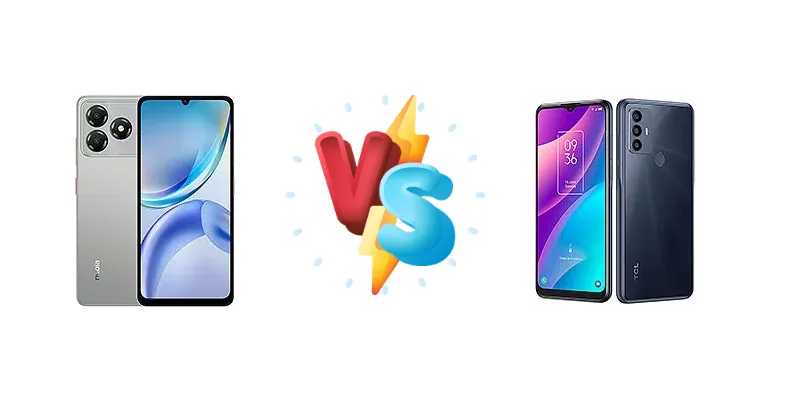
The ZTE Blade A36 and TCL 30 SE represent the fiercely competitive sub-$150 smartphone market. Both aim to deliver essential functionality at an accessible price, but they take different approaches to achieving this. The A36 prioritizes sustained performance with a newer Unisoc chipset, while the 30 SE focuses on a slightly faster clock speed and quicker charging, creating a clear trade-off for potential buyers.
🏆 Quick Verdict
For the average user prioritizing all-day battery life and consistent performance, the ZTE Blade A36 emerges as the stronger choice. Its Unisoc T7200 chipset, coupled with exceptional 54:13h endurance, outweighs the TCL 30 SE’s marginally faster CPU clock speeds and 15W charging.
| Network |
|---|
| 2G bands | GSM 850 / 900 / 1800 / 1900 | GSM 850 / 900 / 1800 / 1900 |
| 3G bands | HSDPA 850 / 900 / 1900 / 2100 | HSDPA 850 / 900 / 1900 / 2100 - EMEA/APAC |
| 4G bands | 1, 3, 5, 7, 8, 20, 28, 38, 40, 41 | 1, 3, 5, 7, 8, 20, 28, 38, 40, 41 - EMEA |
| Speed | HSPA, LTE | HSPA 42.2/11.5 Mbps, LTE Cat4 150/50 Mbps |
| Technology | GSM / HSPA / LTE | GSM / HSPA / LTE |
| | - | 2, 3, 4, 5, 7, 8, 12, 13, 17, 26, 28, 66 - LATAM |
| Launch |
|---|
| Announced | 2025, June 18 | 2022, February 27 |
| Status | Available. Released 2025, June | Available. Released 2022, April 20 |
| Body |
|---|
| Build | Glass front, plastic frame, plastic back | Glass front, plastic frame, plastic back |
| Dimensions | 167.6 x 77.4 x 8.3 mm (6.60 x 3.05 x 0.33 in) | 165.2 x 75.5 x 8.9 mm (6.50 x 2.97 x 0.35 in) |
| SIM | Nano-SIM + Nano-SIM | · Nano-SIM· Nano-SIM + Nano-SIM |
| Weight | - | 190 g (6.70 oz) |
| Display |
|---|
| Protection | Mohs level 4 | - |
| Resolution | 720 x 1600 pixels, 20:9 ratio (~260 ppi density) | 720 x 1600 pixels, 20:9 ratio (~269 ppi density) |
| Size | 6.75 inches, 110.0 cm2 (~84.8% screen-to-body ratio) | 6.52 inches, 102.6 cm2 (~82.3% screen-to-body ratio) |
| Type | IPS LCD, 90Hz | IPS LCD, 450 nits (typ) |
| Platform |
|---|
| CPU | Octa-core (2x1.6 GHz Cortex-A75 & 6x1.6 GHz Cortex-A55) | Octa-core (4x2.0 GHz Cortex-A53 & 4x1.5 GHz Cortex-A53) |
| Chipset | Unisoc T7200 (12 nm) | Mediatek MT6762G Helio G25 (12 nm) |
| GPU | Mali-G57 MP1 | PowerVR GE8320 |
| OS | Android 15 | Android 12, TCL UI 4.0 |
| Memory |
|---|
| Card slot | microSDXC (dedicated slot) | microSDXC (dedicated slot) |
| Internal | 64GB 4GB RAM | 64GB 4GB RAM, 128GB 4GB RAM |
| | - | eMMC 5.1 |
| Main Camera |
|---|
| Features | LED flash | LED flash, HDR, panorama |
| Single | 13 MP, AF
Auxiliary lens | 8 MP, f/2.0, 26mm (wide), 1/4", 1.12µm |
| Triple | - | 50 MP, f/1.9, 28mm (wide), 1/2.76", 0.64µm, PDAF
2 MP (macro)
Auxiliary lens |
| Video | 1080p@30fps | 1080p@30fps |
| Selfie camera |
|---|
| Features | - | HDR |
| Single | 5 MP | 8 MP, f/2.0, 26mm (wide), 1/4.0", 1.12µm |
| Video | Yes | 1080p@30fps |
| Sound |
|---|
| 3.5mm jack | - | Yes |
| 35mm jack | Yes | Yes |
| Loudspeaker | Yes | Yes |
| Comms |
|---|
| Bluetooth | 5.2, A2DP, LE | 5.0, A2DP, LE |
| NFC | No | Yes (6165H/6165H1 only) |
| Positioning | GPS, GALILEO, GLONASS | GPS, GLONASS, GALILEO, BDS |
| Radio | FM radio | Unspecified |
| USB | USB Type-C 2.0 | USB Type-C 2.0 |
| WLAN | Wi-Fi 802.11 a/b/g/n/ac | Wi-Fi 802.11 b/g/n, Wi-Fi Direct |
| Features |
|---|
| Sensors | Accelerometer, proximity, compass | Fingerprint (rear-mounted), accelerometer, proximity, compass |
| Battery |
|---|
| Charging | 10W wired | 15W wired |
| Type | 5000 mAh | Li-Po 5000 mAh |
| Misc |
|---|
| Colors | Black, Green, Silver | Atlantic Blue, Space Gray, Glacial Blue |
| Models | Z2472 | 6165H, 6156H1, 6165A, 6165A1, 6165S |
| Price | About 60 EUR | - |
| EU LABEL |
|---|
| Battery | 54:13h endurance, 800 cycles | - |
| Energy | Class A | - |
| Free fall | Class D (80 falls) | - |
| Repairability | Class B | - |
ZTE Blade A36
- Exceptional battery life (54:13h endurance)
- More efficient processor architecture (Unisoc T7200)
- Longer battery lifespan (800 charge cycles)
- Slower charging speed (10W)
- Potentially less responsive peak CPU speed
TCL 30 SE
- Faster charging (15W)
- Higher peak CPU clock speed
- Potentially lower initial price
- Less efficient processor architecture (Helio G25)
- Shorter battery life (implied)
- Likely struggles with demanding apps
Display Comparison
Neither device boasts a standout display. Given the price point, details like panel type and resolution are not provided. However, the focus should be on usability. The absence of high refresh rates is expected. The real-world impact will likely be similar, with both displays prioritizing power efficiency over visual fidelity.
Camera Comparison
Without detailed camera specifications, a direct comparison is difficult. Both phones likely feature basic camera setups geared towards casual photography. The absence of information suggests neither device will excel in low-light conditions or offer advanced features like optical image stabilization. The focus will be on adequate image quality in good lighting, and any included 'macro' lenses are likely to be of limited utility.
Performance
The core difference lies in the chipsets. The ZTE Blade A36 utilizes the Unisoc T7200 (12nm), an octa-core processor with a heterogeneous architecture – 2x1.6 GHz Cortex-A75 cores for performance and 6x1.6 GHz Cortex-A55 cores for efficiency. This contrasts with the TCL 30 SE’s MediaTek Helio G25 (12nm), featuring a less sophisticated octa-core setup of 4x2.0 GHz Cortex-A53 and 4x1.5 GHz Cortex-A53 cores. While the G25 has a higher peak clock speed, the A75 cores in the T7200 offer significantly better single-core performance, translating to snappier app launches and smoother multitasking. The Unisoc chipset’s architecture is better suited for handling modern Android workloads. The G25’s all-A53 configuration will likely struggle more with demanding tasks.
Battery Life
The ZTE Blade A36 truly shines in battery endurance, achieving an impressive 54:13h of usage. This is a significant advantage over what we’d expect from a phone in this price bracket. While the TCL 30 SE offers 15W wired charging – a slight improvement over the A36’s 10W – the A36’s superior battery capacity and efficiency will likely offset the slower charging speed for most users. The 800 charge cycles rating for the A36 also suggests a longer lifespan for the battery itself.
Buying Guide
Buy the ZTE Blade A36 if you need a phone that will reliably last through a full day of moderate to heavy use, and you value a chipset designed for sustained performance over short bursts of speed. Buy the TCL 30 SE if you prioritize faster charging times and are a light user who doesn't heavily tax the processor with demanding applications or games.
Frequently Asked Questions
❓ Will the Unisoc T7200 in the ZTE Blade A36 struggle with popular games like PUBG Mobile?
While the Unisoc T7200 isn't a gaming powerhouse, its Cortex-A75 cores provide a noticeable performance boost over the Helio G25. You'll likely be able to play PUBG Mobile at medium settings with reasonable frame rates, but don't expect a flagship-level gaming experience. The TCL 30 SE’s Helio G25 will likely require even lower settings.
❓ How long will it take to fully charge the ZTE Blade A36 with its 10W charger?
With a 10W charger, a full charge from 0% will likely take around 3-4 hours. While slower than the TCL 30 SE’s 15W charging, the A36’s exceptional battery life means you won’t need to top it up as frequently.
❓ Is the TCL 30 SE a good option for someone who primarily uses their phone for calls, texts, and social media?
Yes, the TCL 30 SE is a viable option for basic usage. Its Helio G25 chipset is sufficient for everyday tasks like calls, texts, and browsing social media. However, be aware that it may struggle with more demanding applications or multitasking.