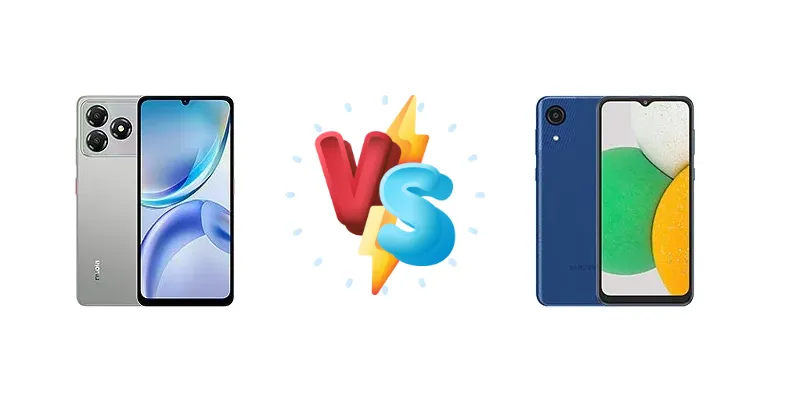
The ZTE Blade A36 and Samsung Galaxy A03 Core represent the absolute entry point into smartphone ownership. Both target users prioritizing affordability, but diverge significantly in their internal hardware. This comparison dissects those differences, focusing on how the chipset and battery performance impact the daily user experience.
🏆 Quick Verdict
For the average user, the ZTE Blade A36 emerges as the stronger choice. Its Unisoc T7200 chipset, built on a more efficient 12nm process, delivers noticeably better performance than the A03 Core’s SC9863A, and its exceptional 54-hour battery endurance provides peace of mind.
| Network |
|---|
| 2G bands | GSM 850 / 900 / 1800 / 1900 | GSM 850 / 900 / 1800 / 1900 |
| 3G bands | HSDPA 850 / 900 / 1900 / 2100 | HSDPA 850 / 900 / 2100 |
| 4G bands | 1, 3, 5, 7, 8, 20, 28, 38, 40, 41 | 1, 3, 5, 7, 8, 20, 28, 38, 40, 41 |
| Speed | HSPA, LTE | HSPA 21.1/5.76 Mbps, LTE |
| Technology | GSM / HSPA / LTE | GSM / HSPA / LTE |
| Launch |
|---|
| Announced | 2025, June 18 | 2021, November 15 |
| Status | Available. Released 2025, June | Available. Released 2021, December 06 |
| Body |
|---|
| Build | Glass front, plastic frame, plastic back | Plastic back, plastic frame |
| Dimensions | 167.6 x 77.4 x 8.3 mm (6.60 x 3.05 x 0.33 in) | 164.2 x 75.9 x 9.1 mm (6.46 x 2.99 x 0.36 in) |
| SIM | Nano-SIM + Nano-SIM | · Nano-SIM· Nano-SIM + Nano-SIM |
| Weight | - | 211 g (7.44 oz) |
| Display |
|---|
| Protection | Mohs level 4 | - |
| Resolution | 720 x 1600 pixels, 20:9 ratio (~260 ppi density) | 720 x 1600 pixels, 20:9 ratio (~270 ppi density) |
| Size | 6.75 inches, 110.0 cm2 (~84.8% screen-to-body ratio) | 6.5 inches, 102.0 cm2 (~81.8% screen-to-body ratio) |
| Type | IPS LCD, 90Hz | PLS LCD |
| Platform |
|---|
| CPU | Octa-core (2x1.6 GHz Cortex-A75 & 6x1.6 GHz Cortex-A55) | Octa-core (4x1.6 GHz Cortex-A55 & 4x1.2 GHz Cortex-A55) |
| Chipset | Unisoc T7200 (12 nm) | Unisoc SC9863A (28 nm) |
| GPU | Mali-G57 MP1 | IMG8322 |
| OS | Android 15 | Android 11 (Go edition) |
| Memory |
|---|
| Card slot | microSDXC (dedicated slot) | microSDXC (dedicated slot) |
| Internal | 64GB 4GB RAM | 32GB 2GB RAM |
| | - | eMMC 5.1 |
| Main Camera |
|---|
| Features | LED flash | LED flash |
| Single | 13 MP, AF
Auxiliary lens | 8 MP, f/2.0, AF |
| Video | 1080p@30fps | 1080p@30fps |
| Selfie camera |
|---|
| Single | 5 MP | 5 MP, f/2.2 |
| Video | Yes | - |
| Sound |
|---|
| 3.5mm jack | - | Yes |
| 35mm jack | Yes | Yes |
| Loudspeaker | Yes | Yes |
| Comms |
|---|
| Bluetooth | 5.2, A2DP, LE | 4.2, A2DP |
| NFC | No | No |
| Positioning | GPS, GALILEO, GLONASS | GPS, GLONASS |
| Radio | FM radio | Unspecified |
| USB | USB Type-C 2.0 | microUSB 2.0, OTG |
| WLAN | Wi-Fi 802.11 a/b/g/n/ac | Wi-Fi 802.11 b/g/n, Wi-Fi Direct |
| Features |
|---|
| Sensors | Accelerometer, proximity, compass | Accelerometer, proximity |
| Battery |
|---|
| Charging | 10W wired | - |
| Type | 5000 mAh | Li-Ion 5000 mAh |
| Misc |
|---|
| Colors | Black, Green, Silver | Black, Blue |
| Models | Z2472 | SM-A032F, SM-A032F/DS, SM-A032M |
| Price | About 60 EUR | £ 74.99 |
| SAR | - | 0.30 W/kg (head) |
| SAR EU | - | 0.24 W/kg (head) 1.39 W/kg (body) |
| EU LABEL |
|---|
| Battery | 54:13h endurance, 800 cycles | - |
| Energy | Class A | - |
| Free fall | Class D (80 falls) | - |
| Repairability | Class B | - |
ZTE Blade A36
- Significantly better processor performance
- Exceptional battery life (54h+ endurance)
- More efficient chipset (12nm process)
- Slow 10W charging
- Likely basic camera performance
Samsung Galaxy A03 Core
- Brand recognition (Samsung)
- Potentially lower price point
- Functional for basic tasks
- Outdated and inefficient chipset (28nm)
- Inferior processor performance
- Likely shorter battery life
Display Comparison
Neither device boasts a standout display. Given the context of these phones, display specs are likely similar (720p+ resolution, LCD panels). However, the focus should be on the chipset's ability to drive the display smoothly. The A36's more powerful processor will likely result in fewer stutters during scrolling and animations.
Camera Comparison
Both phones likely feature basic camera setups. Without specific sensor details, it’s safe to assume both rely on low-resolution primary sensors. The A36’s more capable processor *could* offer slightly better image processing, but the difference will be minimal. Any 2MP macro or depth sensors on either device should be considered marketing filler rather than genuine photographic tools.
Performance
The core difference lies in the chipsets. The ZTE Blade A36’s Unisoc T7200 (12nm) features an octa-core configuration with two Cortex-A75 cores clocked at 1.6GHz, paired with six Cortex-A55 cores. This architecture provides a significant performance boost over the Samsung Galaxy A03 Core’s Unisoc SC9863A (28nm), which uses four Cortex-A55 cores at 1.6GHz and four at 1.2GHz. The 12nm fabrication process of the T7200 is far more efficient than the 28nm process of the SC9863A, translating to better thermal management and sustained performance. The A75 cores in the A36 are also architecturally superior, offering a substantial uplift in single-core performance, crucial for app launch times and responsiveness.
Battery Life
The ZTE Blade A36 truly shines in battery endurance, achieving a remarkable 54 hours and 13 minutes of usage. This is likely due to the efficient Unisoc T7200 chipset and optimized software. While the A03 Core’s battery capacity is unknown, the less efficient SC9863A chipset will undoubtedly result in shorter runtimes. The A36’s 10W charging is slow, but the exceptional battery life mitigates this drawback. Users prioritizing all-day (and multi-day) battery life will strongly favor the A36.
Buying Guide
Buy the ZTE Blade A36 if you need a phone capable of handling more than basic tasks, such as moderate multitasking or occasional gaming. The superior processor and longer battery life make it ideal for users who rely on their phone throughout the day. Buy the Samsung Galaxy A03 Core if your primary needs are extremely limited – basic calling, texting, and light app usage – and you prioritize brand recognition above all else. It’s a functional device, but heavily constrained by its older chipset.
Frequently Asked Questions
❓ Will the Unisoc T7200 in the ZTE Blade A36 handle popular apps like WhatsApp and Facebook smoothly?
Yes, the Unisoc T7200 is more than capable of running common social media apps like WhatsApp and Facebook without significant lag. The Cortex-A75 cores provide a performance boost that the A03 Core’s chipset lacks, ensuring a smoother user experience even with multiple apps open.
❓ How does the 28nm process of the Unisoc SC9863A in the Samsung Galaxy A03 Core affect battery life?
The 28nm fabrication process is significantly less efficient than the 12nm process used in the ZTE Blade A36’s Unisoc T7200. This means the SC9863A consumes more power to perform the same tasks, resulting in shorter battery life and potentially more heat generation.
❓ Is the ZTE Blade A36 a good option for someone upgrading from a feature phone?
Absolutely. The ZTE Blade A36 offers a substantial upgrade in functionality and performance compared to a feature phone. Its larger display, access to Android apps, and improved processing power make it a compelling choice for first-time smartphone users.
❓ Does the Samsung Galaxy A03 Core support software updates beyond the initial Android version?
Samsung's update commitment for the A03 Core is limited. Expect minimal software updates, potentially only security patches for a short period. The ZTE Blade A36's update schedule is also likely limited, but Unisoc chipsets are increasingly receiving more support.