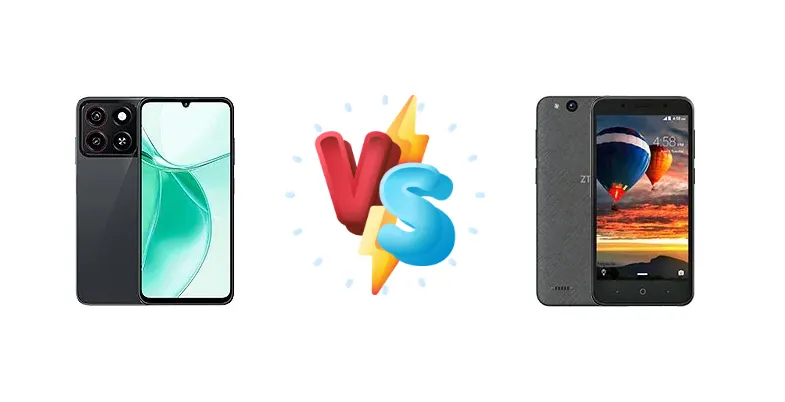
Both the ZTE Blade A35 and ZTE Tempo Go occupy the ultra-budget smartphone segment, aiming to deliver essential functionality at the lowest possible price. However, significant differences in their underlying hardware – specifically the chipset – dictate vastly different user experiences. This comparison dissects those differences to determine which device offers the best value for money.
🏆 Quick Verdict
For the vast majority of users, the ZTE Blade A35 is the superior choice. Its Unisoc SC9863A1 chipset, featuring an octa-core CPU, provides a noticeably smoother and more responsive experience compared to the quad-core Snapdragon 210 in the Tempo Go. While both phones are limited, the A35 offers a more future-proofed platform.
| Network |
|---|
| 2G bands | GSM 850 / 900 / 1800 / 1900 | GSM 850 / 1900 |
| 3G bands | HSDPA 850 / 900 / 1900 / 2100 | HSDPA 850 / 1700(AWS) / 1900 |
| 4G bands | 1, 3, 5, 7, 8, 20, 28, 38, 40, 41 | 2, 4, 5, 12, 13, 25, 26, 41 |
| Speed | HSPA, LTE | HSPA 42.2/5.76 Mbps, LTE Cat4 150/50 Mbps |
| Technology | GSM / HSPA / LTE | GSM / CDMA / HSPA / LTE |
| | - | CDMA 800 / 1900 |
| Launch |
|---|
| Announced | 2024, October 09 | 2018, February. Released 2018, March |
| Status | Available. Released 2024, October | Discontinued |
| Body |
|---|
| Dimensions | 167.7 x 77.4 x 8.5 mm (6.60 x 3.05 x 0.33 in) | 145.5 x 71.9 x 9.1 mm (5.73 x 2.83 x 0.36 in) |
| SIM | Nano-SIM + Nano-SIM | Micro-SIM |
| Weight | - | - |
| Display |
|---|
| Resolution | 720 x 1600 pixels, 20:9 ratio (~262 ppi density) | 480 x 854 pixels, 16:9 ratio (~196 ppi density) |
| Size | 6.75 inches, 108.3 cm2 (~83.5% screen-to-body ratio) | 5.0 inches, 68.9 cm2 (~65.9% screen-to-body ratio) |
| Type | IPS LCD, 90Hz | TFT |
| Platform |
|---|
| CPU | Octa-core (4x1.6 GHz Cortex-A55 & 4x1.2 GHz Cortex-A55) | Quad-core 1.1 GHz Cortex-A7 |
| Chipset | Unisoc SC9863A1 (22 nm) | Qualcomm MSM8909 Snapdragon 210 (28 nm) |
| GPU | IMG8322 | Adreno 304 |
| OS | Android 14 (Go edition) | Android 8.1 Oreo (Go edition) |
| Memory |
|---|
| Card slot | microSDXC (dedicated slot) | microSDHC |
| Internal | 64GB 2GB RAM, 64GB 4GB RAM | 8GB 1GB RAM |
| | - | eMMC 4.5 |
| Main Camera |
|---|
| Features | LED flash | LED flash, HDR, panorama |
| Single | 8 MP, AF | 5 MP |
| Video | 1080p@30fps | 720p |
| Selfie camera |
|---|
| Single | 2 MP (interpolated to 5 MP) | 2 MP |
| Video | Yes | - |
| Sound |
|---|
| 3.5mm jack | - | Yes |
| 35mm jack | Yes | Yes |
| Loudspeaker | Yes | Yes |
| Comms |
|---|
| Bluetooth | 5.2, A2DP, LE | 4.2, A2DP, LE |
| NFC | No | No |
| Positioning | GPS, GALILEO, GLONASS | GPS |
| Radio | FM radio | No |
| USB | USB Type-C 2.0 | microUSB 2.0 |
| WLAN | Wi-Fi 802.11 b/g/n | Wi-Fi 802.11 b/g/n |
| Features |
|---|
| Sensors | Accelerometer | Accelerometer |
| Battery |
|---|
| Charging | 10W wired | - |
| Type | Li-Po 5000 mAh | Li-Ion 2200 mAh battery |
| Misc |
|---|
| Colors | Starry Black, Clover Green | Gray |
| Models | Z2453 | N9137GO |
| Price | About 80 EUR | About 80 EUR |
ZTE Blade A35
- Significantly faster processor for smoother performance
- More efficient chipset for potentially longer battery life
- Likely better software support due to newer hardware
- Still a budget device with limitations
- Camera quality likely remains basic
ZTE Tempo Go
- Extremely affordable price point
- Simple and easy-to-use interface
- Acceptable for basic calling and texting
- Very slow processor leading to a sluggish experience
- Inefficient chipset resulting in shorter battery life
- Limited software support and potential security vulnerabilities
Display Comparison
Neither ZTE provides display specifications beyond size, so a detailed comparison is limited. However, given the price points, both likely utilize LCD panels with modest resolutions (likely 720p+). The Tempo Go's older chipset suggests a less sophisticated display driver, potentially resulting in lower color accuracy and contrast. The A35, benefiting from a newer chipset, may offer slightly improved display characteristics, though neither is expected to compete with higher-end displays.
Camera Comparison
Detailed camera specifications are unavailable for either device. However, given their market segment, it’s safe to assume both feature basic camera setups. The focus should not be on image quality, but rather on functionality. The A35’s more powerful processor may allow for slightly faster image processing and potentially better low-light performance, but expectations should remain low. Any claims of advanced features on either device should be viewed with skepticism.
Performance
The core difference lies in the chipsets. The ZTE Blade A35’s Unisoc SC9863A1 is an octa-core processor built on a 22nm process, featuring four Cortex-A55 cores clocked at 1.6GHz and four at 1.2GHz. This contrasts sharply with the ZTE Tempo Go’s Qualcomm MSM8909 Snapdragon 210, a quad-core 1.1GHz Cortex-A7 processor fabricated on a less efficient 28nm node. The A55 cores in the A35 represent a significant architectural improvement over the A7 cores in the Tempo Go, offering better performance per clock cycle. The 22nm process also contributes to better power efficiency. This translates to faster app loading times, smoother scrolling, and a more responsive overall experience on the A35. The Tempo Go will struggle with even moderately demanding tasks.
Battery Life
Battery capacity is not specified for either device. However, the A35’s more efficient Unisoc SC9863A1 chipset, built on a smaller 22nm process, will likely result in longer battery life compared to the Tempo Go’s Snapdragon 210 on its 28nm process. Both phones feature 10W wired charging, meaning charging times will be relatively slow – expect several hours to fully charge from 0%.
Buying Guide
Buy the ZTE Blade A35 if you prioritize a more responsive user interface, smoother multitasking, and a generally less frustrating experience with modern apps. It's ideal for users who occasionally browse the web, use social media, or engage in light gaming. Buy the ZTE Tempo Go if your needs are extremely basic – primarily making calls and sending texts – and you are on the absolute tightest budget. The Tempo Go represents a minimal viable smartphone experience.
Frequently Asked Questions
❓ Will the ZTE Tempo Go struggle with popular apps like Facebook or WhatsApp?
Yes, the Snapdragon 210 in the Tempo Go is a very low-end processor. Expect significant lag and slow loading times when using apps like Facebook, WhatsApp, or even the Google Chrome browser. These apps are increasingly demanding, and the Tempo Go simply lacks the processing power to handle them smoothly.
❓ Is the Unisoc SC9863A1 in the ZTE Blade A35 a reliable chipset?
Unisoc chipsets have improved significantly in recent years. While not as well-known as Qualcomm's Snapdragon series, the SC9863A1 is a capable processor for basic smartphone tasks. It offers a noticeable performance boost over the Snapdragon 210 and provides a more stable and responsive user experience.
❓ Can either of these phones handle basic mobile games?
The ZTE Blade A35 can handle *very* basic mobile games with reduced settings. The Tempo Go will struggle even with the simplest games, experiencing significant frame rate drops and lag. Don't expect to play graphically intensive titles on either device.
❓ What kind of software updates can I expect on the ZTE Tempo Go?
Given its ultra-budget nature and the age of the Snapdragon 210, the ZTE Tempo Go is unlikely to receive many, if any, software updates. This poses a potential security risk, as vulnerabilities may not be patched. The Blade A35, with its newer chipset, has a higher chance of receiving at least some security updates.