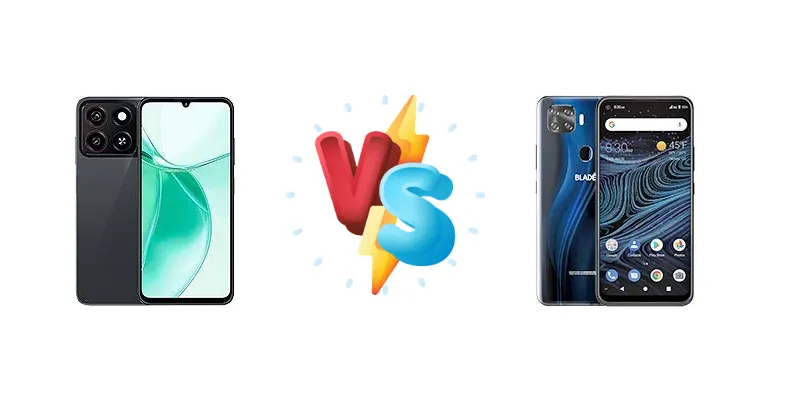
ZTE's Blade series consistently targets the value-conscious consumer. The Blade A35 represents a basic, affordable option, while the Blade X1 5G aims to deliver 5G connectivity and a performance boost. This comparison dissects the core differences between these two devices, focusing on how their internal components translate to real-world user experience.
🏆 Quick Verdict
For most users, the ZTE Blade X1 5G is the clear winner. Its Snapdragon 765G chipset provides a substantial performance advantage over the A35’s Unisoc SC9863A1, and the inclusion of 5G connectivity future-proofs the device. While the A35 is cheaper, the X1 5G’s extra cost is justified by its significantly improved capabilities.
| Network |
|---|
| 2G bands | GSM 850 / 900 / 1800 / 1900 | GSM 850 / 900 / 1800 / 1900 |
| 3G bands | HSDPA 850 / 900 / 1900 / 2100 | HSDPA 850 / 900 / 1700(AWS) / 1900 / 2100 |
| 4G bands | 1, 3, 5, 7, 8, 20, 28, 38, 40, 41 | 2, 4, 5, 12, 13, 66 |
| 5G bands | - | 2, 5, 66 Sub6 |
| Speed | HSPA, LTE | HSPA, LTE, 5G |
| Technology | GSM / HSPA / LTE | GSM / HSPA / LTE / 5G |
| Launch |
|---|
| Announced | 2024, October 09 | 2021, January 26 |
| Status | Available. Released 2024, October | Available. Released 2021, January 26 |
| Body |
|---|
| Build | - | Glass front, plastic back, plastic frame |
| Dimensions | 167.7 x 77.4 x 8.5 mm (6.60 x 3.05 x 0.33 in) | 164 x 76 x 9.2 mm (6.46 x 2.99 x 0.36 in) |
| SIM | Nano-SIM + Nano-SIM | Nano-SIM |
| Weight | - | 190 g (6.70 oz) |
| Display |
|---|
| Resolution | 720 x 1600 pixels, 20:9 ratio (~262 ppi density) | 1080 x 2340 pixels, 19.5:9 ratio (~396 ppi density) |
| Size | 6.75 inches, 108.3 cm2 (~83.5% screen-to-body ratio) | 6.5 inches, 103.7 cm2 (~83.2% screen-to-body ratio) |
| Type | IPS LCD, 90Hz | IPS LCD |
| Platform |
|---|
| CPU | Octa-core (4x1.6 GHz Cortex-A55 & 4x1.2 GHz Cortex-A55) | Octa-core (1x2.4 GHz Kryo 475 Prime & 1x2.2 GHz Kryo 475 Gold & 6x1.8 GHz Kryo 475 Silver) |
| Chipset | Unisoc SC9863A1 (22 nm) | Qualcomm SM7250 Snapdragon 765G 5G (7 nm) |
| GPU | IMG8322 | Adreno 620 |
| OS | Android 14 (Go edition) | Android 10 |
| Memory |
|---|
| Card slot | microSDXC (dedicated slot) | microSDXC |
| Internal | 64GB 2GB RAM, 64GB 4GB RAM | 128GB 6GB RAM |
| Main Camera |
|---|
| Features | LED flash | LED flash, panorama, HDR |
| Quad | - | 48 MP, f/1.8, (wide), 1/2.0", 0.8µm, PDAF
8 MP, f/2.2, 120˚ (ultrawide)
2 MP (macro)
Auxiliary lens |
| Single | 8 MP, AF | - |
| Video | 1080p@30fps | 4K@30fps, 1080p@30fps |
| Selfie camera |
|---|
| Features | - | HDR |
| Single | 2 MP (interpolated to 5 MP) | 16 MP, f/2.0, (wide) |
| Video | Yes | 1080p@30fps |
| Sound |
|---|
| 3.5mm jack | - | Yes |
| 35mm jack | Yes | Yes |
| Loudspeaker | Yes | Yes |
| Comms |
|---|
| Bluetooth | 5.2, A2DP, LE | 5.0, A2DP, LE |
| NFC | No | Yes |
| Positioning | GPS, GALILEO, GLONASS | GPS |
| Radio | FM radio | No |
| USB | USB Type-C 2.0 | USB Type-C 2.0 |
| WLAN | Wi-Fi 802.11 b/g/n | Wi-Fi 802.11 a/b/g/n/ac, dual-band |
| Features |
|---|
| Sensors | Accelerometer | Fingerprint (rear-mounted), accelerometer, gyro, proximity |
| Battery |
|---|
| Charging | 10W wired | 18W wired |
| Type | Li-Po 5000 mAh | Li-Ion 4000 mAh |
| Misc |
|---|
| Colors | Starry Black, Clover Green | Dark Blue |
| Models | Z2453 | - |
| Price | About 80 EUR | About 320 EUR |
ZTE Blade A35
- Most affordable option
- Simple and easy to use
- Acceptable for basic tasks
- Slow performance
- No 5G connectivity
- Slow charging
ZTE Blade X1 5G
- Significantly faster performance
- 5G connectivity
- Faster charging (18W)
- Higher price point
- May still struggle with demanding games
- Battery capacity not specified
Display Comparison
Neither ZTE provides detailed display specifications. However, given the price points, both likely utilize LCD panels. The key difference lies in the processing power driving them. The Blade X1 5G’s Snapdragon 765G will offer smoother scrolling and faster app loading, improving the perceived visual experience even on a similar panel. Bezels are likely comparable, reflecting the budget nature of both devices. Color accuracy is expected to be standard for this segment.
Camera Comparison
Detailed camera specs are unavailable. However, given the market segment, both phones likely feature basic camera setups. The Blade X1 5G’s more powerful ISP (Image Signal Processor) within the Snapdragon 765G will likely result in better image processing, particularly in low-light conditions. While both may include a standard resolution main sensor, the X1 5G’s chipset will provide superior noise reduction and dynamic range. The presence of a dedicated ISP is more important than megapixel count at this price point.
Performance
The performance gap is the most significant differentiator. The ZTE Blade X1 5G’s Qualcomm Snapdragon 765G (7nm) is a vastly superior chipset compared to the Unisoc SC9863A1 (22nm) in the A35. The Snapdragon 765G features a Kryo 475 CPU with a prime core clocked at 2.4GHz, alongside a more powerful Adreno 620 GPU. This translates to significantly faster app launch times, smoother multitasking, and a much better gaming experience. The A35’s Cortex-A55 based CPU, while octa-core, is limited by its older architecture and larger manufacturing process. The 7nm process of the Snapdragon 765G also contributes to better thermal efficiency, reducing throttling during sustained workloads.
Battery Life
Battery capacity is not specified for either device. However, the Blade X1 5G’s 18W wired charging is a clear advantage over the A35’s 10W charging. This means the X1 5G will charge significantly faster, reducing downtime. While a larger battery capacity on the A35 could partially offset this, the faster charging speed of the X1 5G is a more impactful benefit for most users, allowing for quicker top-ups throughout the day.
Buying Guide
Buy the ZTE Blade A35 if you prioritize extreme affordability and only need a phone for basic tasks like calls, texts, and light social media browsing. You're willing to accept slower performance and lack of 5G. Buy the ZTE Blade X1 5G if you want a more responsive experience, the ability to connect to 5G networks, and a phone that can handle moderate gaming and multitasking without significant lag. The X1 5G is the better choice for users who want a phone that will remain usable for longer.
Frequently Asked Questions
❓ Will the Snapdragon 765G in the Blade X1 5G handle demanding games like PUBG or Call of Duty?
While the Snapdragon 765G isn't a flagship chipset, it's capable of running PUBG and Call of Duty at medium settings with acceptable frame rates. Expect some occasional frame drops during intense action. The Unisoc SC9863A1 in the A35 will struggle significantly with these titles.
❓ Does the ZTE Blade X1 5G support all 5G bands?
ZTE does not explicitly list all supported 5G bands. However, the Snapdragon 765G supports a wide range of 5G frequencies. Compatibility will depend on your carrier and region. Check with your carrier to confirm 5G support before purchasing.
❓ Is the lack of detailed camera specs a concern for the Blade X1 5G?
While detailed specs are missing, the Snapdragon 765G’s image signal processor (ISP) is a significant advantage. It will handle image processing more effectively than the A35’s chipset, resulting in better photos, especially in challenging lighting conditions. Don't focus solely on megapixel counts at this price point.
❓ How much faster is the 18W charging on the Blade X1 5G compared to the 10W charging on the A35?
The 18W charging on the X1 5G will significantly reduce charging times. While exact 0-100% times are unavailable, expect the X1 5G to charge at least 40-50% faster than the A35, making it more convenient for users who need to quickly top up their battery.