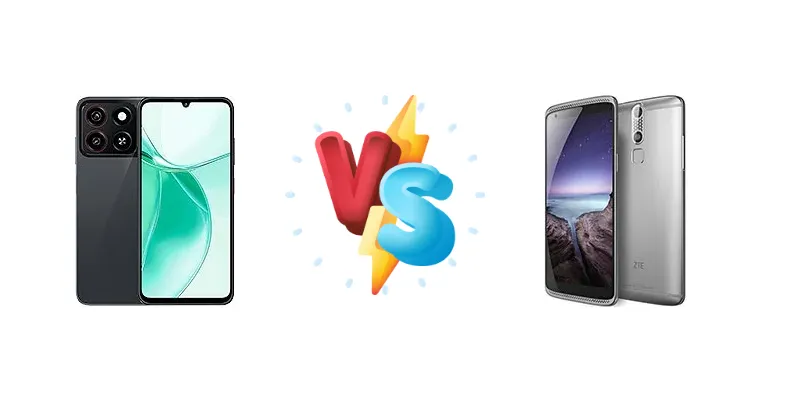
Both the ZTE Blade A35 and ZTE Axon mini represent ZTE’s attempts to capture the ultra-budget smartphone market. However, they approach this segment with different silicon – the A35 utilizing a newer Unisoc chipset, while the Axon mini relies on an older Qualcomm Snapdragon. This comparison dissects these key differences to determine which device offers the best value for users prioritizing performance and efficiency.
🏆 Quick Verdict
For the average user seeking a functional, everyday smartphone, the ZTE Blade A35 emerges as the slightly better choice. While both phones are entry-level, the Unisoc SC9863A1’s more modern Cortex-A55 architecture provides a small but noticeable performance edge, and its 22nm process offers potentially better power efficiency compared to the Axon mini’s older 28nm Snapdragon 616.
| Network |
|---|
| 2G bands | GSM 850 / 900 / 1800 / 1900 | GSM 850 / 900 / 1800 / 1900 - SIM 1 & SIM 2 |
| 3G bands | HSDPA 850 / 900 / 1900 / 2100 | HSDPA 850 / 900 / 1900 / 2100 |
| 4G bands | 1, 3, 5, 7, 8, 20, 28, 38, 40, 41 | 1, 3, 7, 38, 39, 40, 41 |
| Speed | HSPA, LTE | HSPA 42.2/11.5 Mbps, LTE Cat4 150/50 Mbps |
| Technology | GSM / HSPA / LTE | GSM / HSPA / LTE |
| | - | TD-SCDMA |
| Launch |
|---|
| Announced | 2024, October 09 | 2015, October. Released 2015, November |
| Status | Available. Released 2024, October | Discontinued |
| Body |
|---|
| Dimensions | 167.7 x 77.4 x 8.5 mm (6.60 x 3.05 x 0.33 in) | 143.5 x 70 x 7.9 mm (5.65 x 2.76 x 0.31 in) |
| SIM | Nano-SIM + Nano-SIM | Nano-SIM + Nano-SIM |
| Weight | - | 140 g (4.94 oz) |
| Display |
|---|
| Resolution | 720 x 1600 pixels, 20:9 ratio (~262 ppi density) | 1080 x 1920 pixels, 16:9 ratio (~424 ppi density) |
| Size | 6.75 inches, 108.3 cm2 (~83.5% screen-to-body ratio) | 5.2 inches, 74.5 cm2 (~74.2% screen-to-body ratio) |
| Type | IPS LCD, 90Hz | Super AMOLED |
| | - | 3D Touch display (only ZTE Axon mini Premium)
MiFavor 3.2 |
| Platform |
|---|
| CPU | Octa-core (4x1.6 GHz Cortex-A55 & 4x1.2 GHz Cortex-A55) | Octa-core (4x1.5 GHz Cortex-A53 & 4x1.2 GHz Cortex-A53) |
| Chipset | Unisoc SC9863A1 (22 nm) | Qualcomm MSM8939v2 Snapdragon 616 (28 nm) |
| GPU | IMG8322 | Adreno 405 |
| OS | Android 14 (Go edition) | Android 5.1.1 (Lollipop) |
| Memory |
|---|
| Card slot | microSDXC (dedicated slot) | microSDXC (uses shared SIM slot) |
| Internal | 64GB 2GB RAM, 64GB 4GB RAM | 32GB 3GB RAM |
| | - | eMMC 4.5 |
| Main Camera |
|---|
| Features | LED flash | LED flash, panorama, HDR |
| Single | 8 MP, AF | 13 MP, PDAF |
| Video | 1080p@30fps | Yes |
| Selfie camera |
|---|
| Single | 2 MP (interpolated to 5 MP) | 8 MP |
| Video | Yes | - |
| Sound |
|---|
| 3.5mm jack | - | Yes |
| 35mm jack | Yes | Yes |
| Loudspeaker | Yes | Yes |
| | - | 32-bit/192kHz audio
|
| Comms |
|---|
| Bluetooth | 5.2, A2DP, LE | 4.0, A2DP, LE |
| NFC | No | No |
| Positioning | GPS, GALILEO, GLONASS | GPS |
| Radio | FM radio | No |
| USB | USB Type-C 2.0 | microUSB 2.0, OTG |
| WLAN | Wi-Fi 802.11 b/g/n | Wi-Fi 802.11 b/g/n, hotspot |
| Features |
|---|
| Sensors | Accelerometer | Fingerprint (rear-mounted), accelerometer, gyro, proximity, compass |
| Battery |
|---|
| Charging | 10W wired | - |
| Stand-by | - | Up to 450 h |
| Talk time | - | Up to 20 h |
| Type | Li-Po 5000 mAh | Li-Ion 2800 mAh, non-removable |
| Misc |
|---|
| Colors | Starry Black, Clover Green | Gold, Chromium Silver, Rose Gold |
| Models | Z2453 | B2016, 7646 |
| Price | About 80 EUR | About 300 EUR |
| SAR | - | 0.68 W/kg (head) |
ZTE Blade A35
- More modern CPU architecture (Cortex-A55)
- Potentially better power efficiency (22nm process)
- Likely smoother performance for basic tasks
- Unisoc chipset may have less software support
- Limited information available on display quality
ZTE Axon mini
- Qualcomm Snapdragon chipset with established software support
- Familiar Android experience
- Potentially wider compatibility with apps
- Older CPU architecture (Cortex-A53)
- Less efficient 28nm fabrication process
- May exhibit more thermal throttling under load
Display Comparison
Neither ZTE provides display specifications beyond size, so a direct comparison is limited. However, given their price points, both likely utilize IPS LCD panels. The absence of details like peak brightness or color gamut suggests neither phone will excel in outdoor visibility or color accuracy. Bezels are expected to be substantial on both devices, typical of this market segment.
Camera Comparison
Camera details are sparse for both devices. It’s safe to assume both feature basic camera setups geared towards casual photography. Without sensor size or aperture information, a meaningful comparison is impossible. The presence of a 2MP macro camera on either device is largely a marketing tactic, offering limited practical benefit due to the small sensor size and lack of optical image stabilization (OIS). Image processing will likely be basic on both, relying heavily on software algorithms to enhance image quality.
Performance
The core difference lies in the chipsets. The ZTE Blade A35’s Unisoc SC9863A1 features an octa-core configuration with four Cortex-A55 cores clocked at 1.6 GHz and four at 1.2 GHz. The Axon mini’s Snapdragon 616 also has an octa-core setup, but utilizes older Cortex-A53 cores clocked at 1.5 GHz and 1.2 GHz. While core count is identical, the Cortex-A55 architecture in the A35 offers improved instructions per clock (IPC) compared to the A53, translating to better single-core performance. The 22nm fabrication process of the Unisoc chip is also more efficient than the Snapdragon 616’s 28nm process, potentially leading to lower heat generation and improved battery life. However, the Snapdragon 616 benefits from Qualcomm’s mature software optimization.
Battery Life
Battery capacity isn’t specified for either device, but given their market positioning, both likely house batteries in the 2500-3500 mAh range. The ZTE Blade A35’s more efficient Unisoc chipset *could* translate to slightly longer battery life, despite potentially having a smaller capacity. However, both phones are limited to 10W wired charging, meaning a full charge will take a considerable amount of time – likely exceeding 3 hours.
Buying Guide
Buy the ZTE Blade A35 if you need a phone for basic tasks like calling, texting, and light social media browsing, and value a slightly more modern chipset for potentially smoother operation. Buy the ZTE Axon mini if you prioritize Qualcomm’s established software support and are comfortable with a slightly older, but still capable, processor. Both are best suited for users on a very tight budget who don't require demanding applications or gaming.
Frequently Asked Questions
❓ Will the Unisoc SC9863A1 in the Blade A35 struggle with popular apps like Facebook or WhatsApp?
While not a powerhouse, the Unisoc SC9863A1 is generally sufficient for running common social media apps like Facebook and WhatsApp. The Cortex-A55 cores provide enough processing power for these tasks, though multitasking with several apps open simultaneously may result in some slowdown.
❓ Is the Snapdragon 616 in the Axon mini still capable of playing basic mobile games?
The Snapdragon 616 can handle less demanding mobile games, but don't expect high frame rates or detailed graphics. Games like Candy Crush or older titles should run adequately, but newer, more graphically intensive games will likely experience significant lag and may be unplayable.
❓ How long will it take to fully charge either phone with the 10W charger?
Expect a full charge to take approximately 3 to 4 hours with the included 10W charger. The slow charging speed is a common limitation of budget smartphones, so patience is required.
❓ Does either phone support software updates beyond the initial Android version?
Software update support is limited on both devices. ZTE typically provides minimal updates for its ultra-budget models. Expect at best one major Android version update, and security patches may be infrequent.