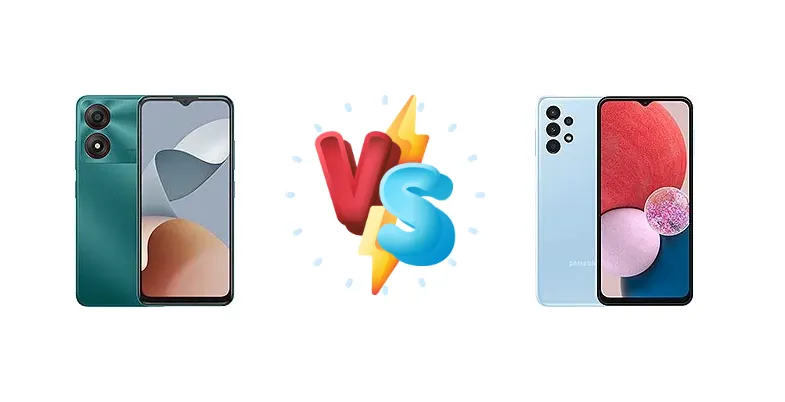
The ZTE Blade A34 and Samsung Galaxy A13 (SM-A137) represent the lower end of the smartphone market, targeting users prioritizing affordability. However, beneath the similar price points lie significant differences in processing power and overall user experience. This comparison dissects these differences to determine which device offers the best value.
🏆 Quick Verdict
For the average user, the Samsung Galaxy A13 emerges as the better choice. While both phones aim for affordability, the A13’s Mediatek Helio G80 chipset provides a noticeable performance advantage over the ZTE Blade A34’s Unisoc SC9863A, making it more suitable for everyday tasks and light gaming.
| Network |
|---|
| 2G bands | GSM 850 / 900 / 1800 / 1900 | GSM 850 / 900 / 1800 / 1900 |
| 3G bands | HSDPA 850 / 900 / 1900 / 2100 | HSDPA 850 / 900 / 2100 |
| 4G bands | LTE | 1, 3, 5, 7, 8, 20, 28, 38, 40, 41 |
| Speed | HSPA, LTE | HSPA, LTE |
| Technology | GSM / HSPA / LTE | GSM / HSPA / LTE |
| Launch |
|---|
| Announced | 2024, February | 2022, June |
| Status | Available. Released 2024, March | Available. Released 2022, July |
| Body |
|---|
| Build | - | Glass front (Gorilla Glass 5), plastic frame, plastic back |
| Dimensions | 164 x 75.8 x 8.8 mm (6.46 x 2.98 x 0.35 in) | 165.1 x 76.4 x 8.8 mm (6.5 x 3.01 x 0.35 in) |
| SIM | Nano-SIM + Nano-SIM | · Nano-SIM· Nano-SIM + Nano-SIM |
| Weight | - | 195 g (6.88 oz) |
| Display |
|---|
| Protection | - | Corning Gorilla Glass 5 |
| Resolution | 720 x 1612 pixels, 20:9 ratio (~267 ppi density) | 1080 x 2408 pixels, 20:9 ratio (~400 ppi density) |
| Size | 6.6 inches, 104.6 cm2 (~84.2% screen-to-body ratio) | 6.6 inches, 104.9 cm2 (~83.2% screen-to-body ratio) |
| Type | IPS LCD | PLS LCD |
| Platform |
|---|
| CPU | Octa-core (4x1.6 GHz Cortex-A55 & 4x1.2 GHz Cortex-A55) | Octa-core (2x2.0 GHz Cortex-A75 & 6x1.8 GHz Cortex-A55) |
| Chipset | Unisoc SC9863A (28 nm) | Mediatek MT6769V/CU Helio G80 (12 nm) |
| GPU | IMG8322 | Mali-G52 MC2 |
| OS | Android 13 (Go edition) | Android 12, upgradable to Android 14, One UI 6.1 |
| Memory |
|---|
| Card slot | microSDXC (dedicated slot) | microSDXC (dedicated slot) |
| Internal | 64GB 2GB RAM, 64GB 4GB RAM | 32GB 3GB RAM, 32GB 4GB RAM, 64GB 4GB RAM, 128GB 4GB RAM |
| | - | eMMC 5.1 |
| Main Camera |
|---|
| Features | LED flash | LED flash, panorama, HDR |
| Quad | - | 50 MP, f/1.8, (wide), PDAF
5 MP, f/2.2, 123˚ (ultrawide), 1/5.0", 1.12µm
2 MP (macro)
Auxiliary lens |
| Single | 8 MP, AF | 8 MP, f/2.2, (wide) |
| Video | 1080p@30fps | 1080p@30fps |
| Selfie camera |
|---|
| Single | 5 MP | 8 MP, f/2.2, (wide) |
| Video | Yes | 1080p@30fps |
| Sound |
|---|
| 3.5mm jack | - | Yes |
| 35mm jack | Yes | Yes |
| Loudspeaker | Yes | Yes |
| Comms |
|---|
| Bluetooth | 5.2, A2DP, LE | 5.2, A2DP, LE |
| NFC | No | Yes |
| Positioning | GPS | GPS, GLONASS, GALILEO, BDS |
| Radio | Unspecified | No |
| USB | USB Type-C 2.0 | USB Type-C 2.0, OTG |
| WLAN | Wi-Fi 802.11 b/g/n | Wi-Fi 802.11 a/b/g/n/ac, dual-band, Wi-Fi Direct |
| Features |
|---|
| Sensors | Accelerometer | Fingerprint (side-mounted), accelerometer, compass |
| | - | Virtual proximity sensing |
| Battery |
|---|
| Charging | - | 15W wired |
| Type | 5000 mAh | Li-Po 5000 mAh |
| Misc |
|---|
| Colors | Green, Gray | Black, White, Blue |
| Models | - | SM-A137F, SM-A137F/DSN, SM-A137F/DS |
| Price | - | About 180 EUR |
| SAR EU | - | 0.35 W/kg (head) 1.22 W/kg (body) |
ZTE Blade A34
- Potentially lower price point
- May offer slightly longer battery life during very light use
- Simple and straightforward user experience
- Significantly weaker processor performance
- Likely lower quality display
- Limited software support
Samsung Galaxy A13 (SM-A137)
- More powerful Mediatek Helio G80 chipset
- Larger display for better media consumption
- Samsung’s established software and support
- 15W charging is relatively slow
- May be slightly more expensive than the ZTE Blade A34
- LCD panel lacks vibrancy compared to AMOLED
Display Comparison
Neither device boasts a standout display. Specifications are unavailable for the ZTE Blade A34’s display, but given its price point, it likely features a 720p LCD panel. The Samsung Galaxy A13 also utilizes an LCD panel, but its larger 6.6-inch size offers more screen real estate. Both will likely suffer from limited viewing angles and color accuracy, but the A13’s larger size is a practical benefit for media consumption. Expect similar levels of brightness, adequate for indoor use but struggling in direct sunlight.
Camera Comparison
Camera performance is likely to be similar, with both phones relying on budget sensors. Details on the ZTE Blade A34’s camera are scarce, but it likely features a basic main sensor paired with auxiliary lenses of limited utility. The Samsung Galaxy A13 typically features a 50MP main sensor, which, while not exceptional, will capture more detail than the A34’s likely lower-resolution sensor. Image processing will be a key differentiator, and Samsung’s software generally offers more refined results, particularly in challenging lighting conditions. Avoid placing too much emphasis on the auxiliary 2MP macro or depth sensors on either device; their image quality is typically subpar.
Performance
The core difference lies in the chipsets. The Samsung Galaxy A13’s Mediatek Helio G80, fabricated on a 12nm process, significantly outperforms the ZTE Blade A34’s Unisoc SC9863A (28nm). The Helio G80’s CPU configuration – 2x2.0 GHz Cortex-A75 and 6x1.8 GHz Cortex-A55 – provides a substantial boost in single-core and multi-core performance compared to the A34’s 4x1.6 GHz Cortex-A55 & 4x1.2 GHz Cortex-A55. This translates to faster app loading times, smoother multitasking, and a more responsive user interface on the A13. The 12nm process also contributes to better thermal efficiency, reducing the likelihood of performance throttling under sustained load. While neither phone is a gaming powerhouse, the A13 will handle less demanding titles with greater ease.
Battery Life
Battery life will depend heavily on usage patterns. The Samsung Galaxy A13 includes 15W wired charging, a modest rate that will take several hours for a full charge. While the A34’s battery capacity is unknown, the less powerful Unisoc chipset may result in slightly better battery endurance during light use. However, the A13’s more efficient chipset will likely offset any capacity difference during more demanding tasks. The 15W charging on the A13 is a practical advantage, providing a quicker top-up when needed.
Buying Guide
Buy the ZTE Blade A34 if your primary needs are basic communication – calls, texts, and light social media – and you prioritize a potentially lower upfront cost. Buy the Samsung Galaxy A13 (SM-A137) if you want a smoother, more responsive experience for multitasking, streaming, and occasional gaming, and value Samsung’s established software ecosystem.
Frequently Asked Questions
❓ Does the Mediatek Helio G80 in the Samsung Galaxy A13 get hot during extended gaming sessions?
While the Helio G80 isn't a flagship processor, its 12nm fabrication process and Samsung’s thermal management are generally adequate for casual gaming. You may experience some throttling after prolonged, demanding gameplay, but it shouldn't lead to overheating or significant performance drops for less intensive titles.
❓ Is the 2MP macro camera on either phone worth using?
Generally, no. 2MP macro cameras on budget phones produce images with limited detail and sharpness. They are often included for marketing purposes but rarely deliver satisfying results. The main sensor on either phone will provide far superior image quality for most scenarios.
❓ Can the Samsung Galaxy A13 handle popular games like PUBG Mobile?
The Samsung Galaxy A13 can run PUBG Mobile, but you’ll likely need to lower the graphics settings to medium or low to achieve a playable frame rate. Don't expect a consistently smooth experience at the highest settings. The ZTE Blade A34 will struggle even more with PUBG Mobile.
❓ How long will software updates be supported on the ZTE Blade A34?
ZTE typically offers limited software support for its budget devices. Expect only one major Android update, if any, and security patches may be infrequent. Samsung, on the other hand, generally provides longer software support for its A-series phones, offering a more secure and up-to-date experience.