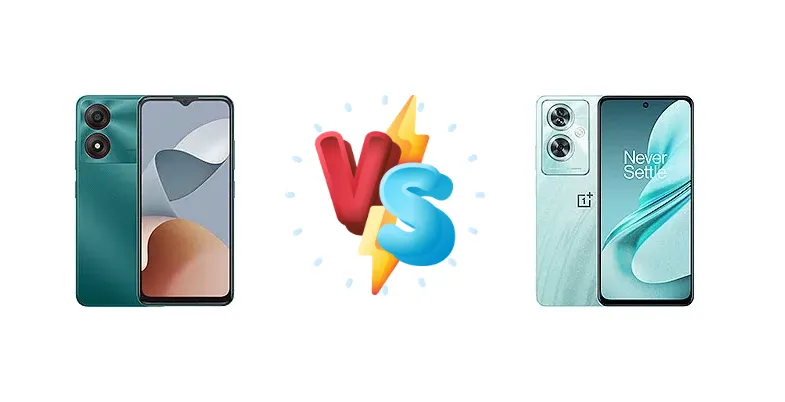
The sub-$200 smartphone market is fiercely competitive. The ZTE Blade A34 and OnePlus Nord N30 SE both aim to deliver a compelling experience without breaking the bank, but they take drastically different approaches to achieving that goal. The Blade A34 relies on a more economical Unisoc chipset, while the Nord N30 SE leverages the more modern and efficient Mediatek Dimensity 6020. This comparison will dissect the key differences to help you choose the right device.
🏆 Quick Verdict
For most users, the OnePlus Nord N30 SE is the superior choice. Its Mediatek Dimensity 6020 chipset, built on a 7nm process, provides a significant performance advantage over the ZTE Blade A34’s 28nm Unisoc SC9863A, translating to smoother multitasking and a more responsive user experience. The 33W charging is a welcome addition, offsetting the slightly smaller battery capacity.
| Network |
|---|
| 2G bands | GSM 850 / 900 / 1800 / 1900 | GSM 850 / 900 / 1800 / 1900 |
| 3G bands | HSDPA 850 / 900 / 1900 / 2100 | HSDPA 850 / 900 / 1700(AWS) / 1900 / 2100 |
| 4G bands | LTE | 1, 2, 3, 4, 5, 7, 8, 12, 13, 17, 18, 19, 20, 26, 28, 38, 39, 40, 41, 66 |
| 5G bands | - | 1, 3, 5, 7, 8, 20, 28, 38, 40, 41, 66, 77, 78 SA/NSA |
| Speed | HSPA, LTE | HSPA, LTE, 5G |
| Technology | GSM / HSPA / LTE | GSM / HSPA / LTE / 5G |
| Launch |
|---|
| Announced | 2024, February | 2024, January 29 |
| Status | Available. Released 2024, March | Available. Released 2024, January 31 |
| Body |
|---|
| Build | - | Glass front, plastic frame, plastic back |
| Dimensions | 164 x 75.8 x 8.8 mm (6.46 x 2.98 x 0.35 in) | 165.6 x 76 x 8 mm (6.52 x 2.99 x 0.31 in) |
| SIM | Nano-SIM + Nano-SIM | Nano-SIM + Nano-SIM |
| Weight | - | 193 g (6.81 oz) |
| Display |
|---|
| Resolution | 720 x 1612 pixels, 20:9 ratio (~267 ppi density) | 1080 x 2400 pixels, 20:9 ratio (~392 ppi density) |
| Size | 6.6 inches, 104.6 cm2 (~84.2% screen-to-body ratio) | 6.72 inches, 109.0 cm2 (~86.6% screen-to-body ratio) |
| Type | IPS LCD | IPS LCD |
| Platform |
|---|
| CPU | Octa-core (4x1.6 GHz Cortex-A55 & 4x1.2 GHz Cortex-A55) | Octa-core (2x2.2 GHz Cortex-A76 & 6x2.0 GHz Cortex-A55) |
| Chipset | Unisoc SC9863A (28 nm) | Mediatek Dimensity 6020 (7 nm) |
| GPU | IMG8322 | Mali-G57 MC2 |
| OS | Android 13 (Go edition) | Android 13, OxygenOS 13.1 |
| Memory |
|---|
| Card slot | microSDXC (dedicated slot) | No |
| Internal | 64GB 2GB RAM, 64GB 4GB RAM | 128GB 4GB RAM |
| Main Camera |
|---|
| Dual | - | 50 MP, f/1.8, (wide), 1/2.76", 0.64µm, PDAF
Auxiliary lens |
| Features | LED flash | LED flash, HDR, panorama |
| Single | 8 MP, AF | - |
| Video | 1080p@30fps | 1080p@30fps |
| Selfie camera |
|---|
| Single | 5 MP | 8 MP, f/2.0, (wide), 1/4.0", 1.12µm |
| Video | Yes | 1080p@30fps |
| Sound |
|---|
| 35mm jack | Yes | Yes |
| Loudspeaker | Yes | Yes, with stereo speakers |
| Comms |
|---|
| Bluetooth | 5.2, A2DP, LE | 5.3, A2DP, LE |
| NFC | No | Yes |
| Positioning | GPS | GPS, GALILEO, GLONASS, BDS |
| Radio | Unspecified | No |
| USB | USB Type-C 2.0 | USB Type-C 2.0, OTG |
| WLAN | Wi-Fi 802.11 b/g/n | Wi-Fi 802.11 a/b/g/n/ac, dual-band |
| Features |
|---|
| Sensors | Accelerometer | Fingerprint (side-mounted), accelerometer, gyro, proximity, compass |
| Battery |
|---|
| Charging | - | 33W wired, 51% in 30 min |
| Type | 5000 mAh | 5000 mAh |
| Misc |
|---|
| Colors | Green, Gray | Black Satin, Cyan |
| Models | - | CPH2605 |
| Price | - | About 510 EUR |
ZTE Blade A34
- Potentially lower price point
- May offer slightly longer battery life due to potentially larger capacity (speculation)
- Simple and straightforward user experience
- Significantly weaker performance
- Slower charging speeds
- Less efficient chipset leading to potential overheating
OnePlus Nord N30 SE
- Superior performance with the Dimensity 6020
- Faster 33W charging
- More efficient chipset for better battery life and thermal management
- Likely a slightly higher price
- May have a smaller battery capacity compared to the Blade A34 (speculation)
- OnePlus's software can be divisive
Display Comparison
Neither device boasts a standout display. While specific panel details (like peak brightness or color gamut coverage) are absent, the core difference lies in the underlying processing power needed to drive them. The more capable Dimensity 6020 in the Nord N30 SE will likely handle display rendering and animations more fluidly. Bezels are expected to be similar on both, given their price points. Color accuracy will likely be standard for this segment, prioritizing vibrancy over absolute fidelity.
Camera Comparison
Without detailed camera specs, a direct comparison is difficult. However, it’s reasonable to assume both phones will feature a primary camera and potentially depth/macro sensors. The image signal processor (ISP) within the Dimensity 6020 is significantly more advanced than the one in the Unisoc SC9863A, enabling better noise reduction, dynamic range, and overall image quality. Expect the Nord N30 SE to produce more detailed and vibrant photos, especially in challenging lighting conditions. The presence of a more powerful ISP also aids in video recording capabilities.
Performance
The performance gap is the most significant differentiator. The Mediatek Dimensity 6020 (7nm) in the Nord N30 SE features two high-performance Cortex-A76 cores clocked at 2.2 GHz, paired with six efficiency cores. This contrasts sharply with the Unisoc SC9863A (28nm) in the Blade A34, which uses four Cortex-A55 cores at 1.6 GHz and another four at 1.2 GHz. The 7nm fabrication process of the Dimensity 6020 is far more efficient, resulting in better performance per watt and reduced thermal throttling. The A76 cores provide a substantial uplift in single-core performance, crucial for app launch times and general responsiveness. The Blade A34 will struggle with demanding tasks and multitasking.
Battery Life
Battery capacity isn't specified for either device, but the Nord N30 SE’s 33W wired charging is a clear advantage. The Blade A34 likely relies on a slower charging standard. The 33W charging on the Nord N30 SE can deliver a 51% charge in just 30 minutes, minimizing downtime. While a larger battery capacity on the Blade A34 might partially offset the slower charging, the efficiency gains of the Dimensity 6020 will likely result in comparable, if not better, real-world battery life on the Nord N30 SE.
Buying Guide
Buy the ZTE Blade A34 if your primary need is basic smartphone functionality – calls, texts, and light social media – and you prioritize absolute affordability above all else. You're willing to accept slower performance and longer loading times to save money. Buy the OnePlus Nord N30 SE if you value a smoother, more responsive experience, faster charging, and a chipset capable of handling more demanding apps and occasional gaming. You're willing to spend a bit more for a noticeable improvement in overall usability.
Frequently Asked Questions
❓ Is the Unisoc SC9863A chipset in the ZTE Blade A34 sufficient for playing games like PUBG Mobile?
While PUBG Mobile may be playable on the ZTE Blade A34, expect significant compromises. The Unisoc SC9863A lacks the graphical horsepower for smooth frame rates at higher settings. You'll likely need to play at the lowest settings with reduced graphics to achieve a playable experience, and even then, expect occasional stuttering and lag.
❓ How does the Dimensity 6020 handle multitasking compared to the Unisoc SC9863A?
The Dimensity 6020 excels at multitasking due to its more powerful cores and efficient architecture. It can handle multiple apps running in the background without significant slowdowns. The Unisoc SC9863A, on the other hand, will struggle with heavy multitasking, leading to app reloading and a sluggish user experience.
❓ Does the OnePlus Nord N30 SE support VoLTE and VoWiFi on all carriers?
Carrier compatibility can vary. It's crucial to check with your specific carrier to confirm VoLTE and VoWiFi support for the OnePlus Nord N30 SE before purchasing. OnePlus typically provides a compatibility list on their website, but it's always best to verify directly with your provider.
❓ What type of storage does the ZTE Blade A34 use, and is it expandable?
While not explicitly stated, budget smartphones like the ZTE Blade A34 typically use eMMC storage. It's highly likely to include a microSD card slot for expandable storage, but the maximum supported capacity should be confirmed before purchase.