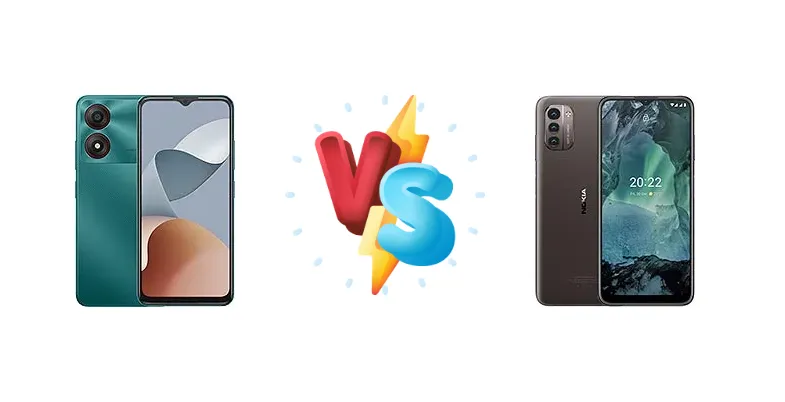
The sub-$200 smartphone market is fiercely competitive. Both the ZTE Blade A34 and Nokia G21 aim to deliver essential smartphone functionality at an accessible price point. However, they take different approaches – the ZTE prioritizing a newer, albeit less powerful, chipset, while the Nokia focuses on maximizing battery endurance. This comparison will break down the key differences to help you choose the right device.
🏆 Quick Verdict
For most users, the Nokia G21 emerges as the better choice. While the ZTE Blade A34 benefits from a slightly newer chipset, the Nokia G21’s more efficient Unisoc T606, coupled with its proven 126-hour endurance rating, provides a more consistently reliable experience, especially for power users and those prioritizing longevity.
| Network |
|---|
| 2G bands | GSM 850 / 900 / 1800 / 1900 | GSM 850 / 900 / 1800 / 1900 |
| 3G bands | HSDPA 850 / 900 / 1900 / 2100 | HSDPA 850 / 900 / 2100 - International |
| 4G bands | LTE | 1, 3, 5, 7, 8, 20, 28, 38, 40, 41 - International |
| Speed | HSPA, LTE | HSPA 42.2/5.76 Mbps, LTE Cat4 150/50 Mbps |
| Technology | GSM / HSPA / LTE | GSM / HSPA / LTE |
| | - | 1, 2, 3, 4, 5, 7, 8, 12, 17, 28, 40, 66 - LATAM |
| Launch |
|---|
| Announced | 2024, February | 2022, February 14 |
| Status | Available. Released 2024, March | Available. Released 2022, February 15 |
| Body |
|---|
| Build | - | Glass front, plastic frame, plastic back |
| Dimensions | 164 x 75.8 x 8.8 mm (6.46 x 2.98 x 0.35 in) | 164.6 x 75.9 x 8.5 mm (6.48 x 2.99 x 0.33 in) |
| SIM | Nano-SIM + Nano-SIM | · Nano-SIM· Nano-SIM + Nano-SIM |
| Weight | - | 190 g (6.70 oz) |
| Display |
|---|
| Resolution | 720 x 1612 pixels, 20:9 ratio (~267 ppi density) | 720 x 1600 pixels, 20:9 ratio (~270 ppi density) |
| Size | 6.6 inches, 104.6 cm2 (~84.2% screen-to-body ratio) | 6.5 inches, 102.0 cm2 (~81.6% screen-to-body ratio) |
| Type | IPS LCD | IPS LCD, 90Hz, 400 nits (typ) |
| Platform |
|---|
| CPU | Octa-core (4x1.6 GHz Cortex-A55 & 4x1.2 GHz Cortex-A55) | Octa-core (2x1.6 GHz Cortex-A75 & 6x1.6 GHz Cortex-A55) |
| Chipset | Unisoc SC9863A (28 nm) | Unisoc T606 (12 nm) |
| GPU | IMG8322 | Mali-G57 MP1 |
| OS | Android 13 (Go edition) | Android 11, upgradable to Android 13 |
| Memory |
|---|
| Card slot | microSDXC (dedicated slot) | microSDXC (dedicated slot) |
| Internal | 64GB 2GB RAM, 64GB 4GB RAM | 64GB 3GB RAM, 64GB 4GB RAM, 128GB 4GB RAM, 128GB 6GB RAM |
| | - | eMMC 5.1 |
| Main Camera |
|---|
| Features | LED flash | LED flash, HDR, panorama |
| Single | 8 MP, AF | 8 MP, f/2.0, (wide) |
| Triple | - | 50 MP, f/1.8, 28mm (wide), 1/2.76", 0.64µm, PDAF
2 MP (macro)
Auxiliary lens |
| Video | 1080p@30fps | 1080p@30fps |
| Selfie camera |
|---|
| Single | 5 MP | 8 MP, f/2.0, (wide) |
| Video | Yes | 1080p@30fps |
| Sound |
|---|
| 3.5mm jack | - | Yes |
| 35mm jack | Yes | Yes |
| Loudspeaker | Yes | Yes |
| Comms |
|---|
| Bluetooth | 5.2, A2DP, LE | 5.0, A2DP, LE |
| NFC | No | Yes (market/region dependent) |
| Positioning | GPS | GPS, GLONASS, GALILEO |
| Radio | Unspecified | FM radio, RDS |
| USB | USB Type-C 2.0 | USB Type-C 2.0, OTG |
| WLAN | Wi-Fi 802.11 b/g/n | Wi-Fi 802.11 a/b/g/n/ac, dual-band, Wi-Fi Direct |
| Features |
|---|
| Sensors | Accelerometer | Fingerprint (side-mounted), accelerometer, proximity |
| Battery |
|---|
| Charging | - | 18W wired, PD3.0 |
| Type | 5000 mAh | Li-Po 5050 mAh |
| Misc |
|---|
| Colors | Green, Gray | Nordic Blue, Dusk |
| Models | - | TA-1418, TA-1477, TA-1415, TA-1405, TA-1404, TA-1412 |
| Price | - | About 90 EUR |
| SAR | - | 1.00 W/kg (head) 1.10 W/kg (body) |
| SAR EU | - | 0.34 W/kg (head) 1.05 W/kg (body) |
| Tests |
|---|
| Battery life | - |
Endurance rating 126h
|
| Camera | - |
Photo / Video |
| Display | - |
Contrast ratio: 1631:1 (nominal) |
| Loudspeaker | - |
-30.7 LUFS (Below average)
|
| Performance | - |
AnTuTu: 171299 (v9)
GeekBench: 1193 (v5.1)
GFXBench: 8.9fps (ES 3.1 onscreen) |
ZTE Blade A34
- Potentially lower price point
- Slightly newer chipset (though less performant)
- Compact form factor (likely, based on brand history)
- Less efficient chipset (28nm)
- Likely shorter battery life
- Limited display brightness information
Nokia G21
- Superior battery life (126h endurance)
- More powerful chipset (Unisoc T606)
- Brighter display (500 nits)
- May be slightly more expensive
- Larger form factor (potentially)
- Basic camera system
Display Comparison
The Nokia G21 boasts a measured peak brightness of 500 nits, a significant advantage over the ZTE Blade A34, which lacks published brightness data. Both share a 1631:1 contrast ratio, suggesting similar color reproduction quality. However, the Nokia’s higher brightness translates to better visibility outdoors and in brightly lit environments. The absence of detailed display specifications for the ZTE Blade A34, such as panel type (IPS vs. VA) and color gamut coverage, makes a comprehensive comparison difficult, but the Nokia clearly has the edge in usability.
Camera Comparison
Both devices list 'Photo / Video' capabilities, but lack specific details regarding sensor size, aperture, or image processing algorithms. This suggests both are equipped with entry-level camera systems. Without further information, it’s difficult to assess image quality. The lack of detail makes it unlikely either phone will excel in low-light photography or offer advanced features like optical image stabilization (OIS). The presence of a 2MP macro lens on either device is largely inconsequential, offering minimal practical benefit to most users.
Performance
The Nokia G21’s Unisoc T606 chipset, built on a 12nm process, represents a clear architectural advantage over the ZTE Blade A34’s Unisoc SC9863A (28nm). The T606 features two Cortex-A75 cores alongside six A55 cores, providing a noticeable boost in single-core performance compared to the A34’s all-A55 configuration. While both are octa-core, the A75 cores in the Nokia G21 will handle demanding tasks like app switching and light gaming more smoothly. The 12nm process also contributes to better power efficiency, further bolstering the Nokia’s battery life. The ZTE’s older 28nm node will likely result in more heat generation and potential throttling under sustained load.
Battery Life
The Nokia G21’s standout feature is its impressive 126-hour endurance rating. This suggests a highly optimized power management system and efficient chipset. While the ZTE Blade A34’s battery capacity is not specified, the less efficient Unisoc SC9863A chipset will likely result in significantly shorter battery life. The Nokia G21 also supports 18W wired charging with PD3.0, offering faster and more versatile charging options compared to the ZTE, which lacks charging specifications. This means the Nokia G21 can replenish its battery more quickly and potentially utilize existing USB-PD chargers.
Buying Guide
Buy the ZTE Blade A34 if you prioritize a slightly newer processor and are comfortable with potentially shorter battery life. It’s a reasonable option for very light users who primarily need a phone for basic communication. Buy the Nokia G21 if you value long-lasting battery life, a brighter display, and a more balanced overall experience. It’s ideal for users who frequently travel, stream media, or simply don’t want to worry about daily charging.
Frequently Asked Questions
❓ Will the Nokia G21’s battery last a full day with moderate use (social media, calls, some video streaming)?
Yes, the Nokia G21’s 126-hour endurance rating suggests it can easily handle a full day of moderate use. Users report consistently achieving all-day battery life, even with several hours of streaming or gaming. The efficient Unisoc T606 chipset plays a key role in maximizing battery longevity.
❓ Is the Unisoc T606 in the Nokia G21 powerful enough for casual gaming like PUBG Mobile or Call of Duty Mobile?
The Unisoc T606 can handle casual gaming, but don’t expect high frame rates or ultra settings. PUBG Mobile and Call of Duty Mobile are playable at medium settings with reasonable frame rates. However, demanding titles or extended gaming sessions may result in some frame drops and noticeable heat. It's suitable for short bursts of gaming, but not a dedicated gaming device.
❓ Does the ZTE Blade A34 support fast charging, and how long does it take to fully charge?
Unfortunately, the ZTE Blade A34’s charging specifications are not publicly available. This suggests it likely supports standard 5W or 10W charging, resulting in a significantly longer charging time compared to the Nokia G21’s 18W PD3.0 support. Expect a full charge to take several hours.