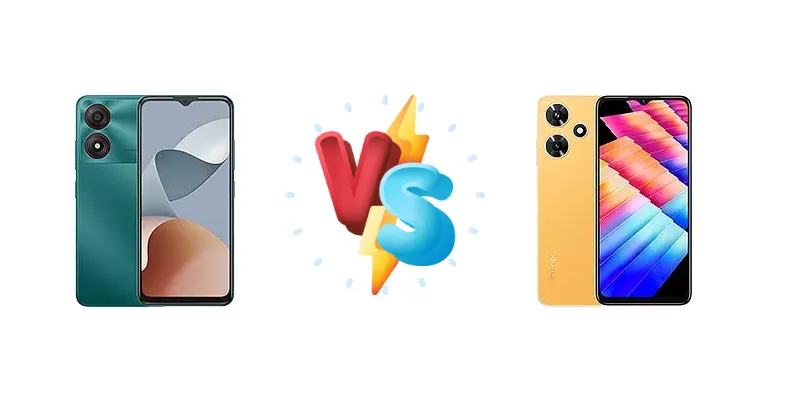
The ZTE Blade A34 and Infinix Hot 30i represent the fiercely competitive sub-$150 smartphone market. Both devices aim to deliver essential functionality at an accessible price point, but they take different approaches to achieving this. The Blade A34 relies on an older, more power-efficient chipset, while the Hot 30i opts for a newer, slightly more powerful processor with faster charging capabilities. This comparison will dissect their key differences to help you choose the right phone for your needs.
🏆 Quick Verdict
For the average user prioritizing sustained performance and faster charging, the Infinix Hot 30i is the better choice. Its Unisoc T606 chipset, built on a 12nm process, offers a noticeable advantage over the ZTE Blade A34’s SC9863A, despite the latter’s lower power consumption. The 18W charging further sweetens the deal, making the Hot 30i a more practical daily driver.
| Network |
|---|
| 2G bands | GSM 850 / 900 / 1800 / 1900 | GSM 850 / 900 / 1800 / 1900 |
| 3G bands | HSDPA 850 / 900 / 1900 / 2100 | HSDPA 850 / 900 / 1700(AWS) / 1900 / 2100 |
| 4G bands | LTE | 1, 2, 3, 4, 5, 7, 8, 20, 28, 38, 40, 41 |
| Speed | HSPA, LTE | HSPA, LTE |
| Technology | GSM / HSPA / LTE | GSM / HSPA / LTE |
| Launch |
|---|
| Announced | 2024, February | 2023, March 31 |
| Status | Available. Released 2024, March | Available. Released 2023, March 31 |
| Body |
|---|
| Build | - | Glass front, plastic frame, plastic back |
| Dimensions | 164 x 75.8 x 8.8 mm (6.46 x 2.98 x 0.35 in) | 164 x 75.8 x 8.4 mm (6.46 x 2.98 x 0.33 in) |
| SIM | Nano-SIM + Nano-SIM | Nano-SIM + Nano-SIM |
| Weight | - | 191 g (6.74 oz) |
| Display |
|---|
| Resolution | 720 x 1612 pixels, 20:9 ratio (~267 ppi density) | 720 x 1612 pixels, 20:9 ratio (~269 ppi density) |
| Size | 6.6 inches, 104.6 cm2 (~84.2% screen-to-body ratio) | 6.56 inches, 103.4 cm2 (~83.2% screen-to-body ratio) |
| Type | IPS LCD | IPS LCD, 90Hz, 500 nits (peak) |
| Platform |
|---|
| CPU | Octa-core (4x1.6 GHz Cortex-A55 & 4x1.2 GHz Cortex-A55) | Octa-core (2x1.6 GHz Cortex-A75 & 6x1.6 GHz Cortex-A55) |
| Chipset | Unisoc SC9863A (28 nm) | Unisoc T606 (12 nm) |
| GPU | IMG8322 | Mali-G57 MP1 |
| OS | Android 13 (Go edition) | Android 12, XOS 10.6 |
| Memory |
|---|
| Card slot | microSDXC (dedicated slot) | microSDXC (dedicated slot) |
| Internal | 64GB 2GB RAM, 64GB 4GB RAM | 64GB 4GB RAM, 128GB 4GB RAM, 128GB 8GB RAM |
| | - | UFS 2.2 |
| Main Camera |
|---|
| Dual | - | 13 MP, f/1.9, (wide), AF
0.08 MP, (depth) |
| Features | LED flash | Dual-LED flash, HDR, panorama |
| Single | 8 MP, AF | 13 MP, f/1.9, (wide), 1/3.07", AF
Auxiliary lens |
| Video | 1080p@30fps | 1080p@30fps |
| Selfie camera |
|---|
| Features | - | Dual-LED flash |
| Single | 5 MP | 8 MP, f/2.0, (wide), 1/3.94" |
| Video | Yes | 1080p@30fps |
| Sound |
|---|
| 3.5mm jack | - | Yes |
| 35mm jack | Yes | Yes |
| Loudspeaker | Yes | Yes |
| Comms |
|---|
| Bluetooth | 5.2, A2DP, LE | Yes |
| NFC | No | Yes (Hot 30i NFC only) |
| Positioning | GPS | GPS |
| Radio | Unspecified | FM radio |
| USB | USB Type-C 2.0 | USB Type-C 2.0, OTG |
| WLAN | Wi-Fi 802.11 b/g/n | Wi-Fi 802.11 a/b/g/n/ac, dual-band |
| Features |
|---|
| Sensors | Accelerometer | Fingerprint (side-mounted), accelerometer, proximity, compass |
| Battery |
|---|
| Charging | - | 18W wired |
| Type | 5000 mAh | 5000 mAh |
| Misc |
|---|
| Colors | Green, Gray | Mirror Black, Glacier Blue, Diamond White, Marigold |
| Models | - | X669, X669D |
ZTE Blade A34
- Potentially longer battery life due to the power-efficient chipset.
- Lower cost of production may translate to a lower retail price.
- Simpler chipset may result in fewer software bugs.
- Noticeably slower performance compared to the Infinix Hot 30i.
- Likely slower charging speeds.
- Older chipset may receive fewer software updates.
Infinix Hot 30i
- Faster and more responsive performance thanks to the Cortex-A75 cores.
- 18W fast charging for quicker top-ups.
- More modern chipset with potentially better camera processing.
- Potentially shorter battery life compared to the ZTE Blade A34.
- May be slightly more expensive.
- 12nm process, while more efficient than 28nm, still consumes more power than the A34's chipset.
Display Comparison
Neither device boasts a standout display. Both are likely to feature LCD panels, common in this price bracket. However, details like resolution and peak brightness are missing. The focus here is on the internal hardware. The absence of high refresh rates is expected, and color accuracy will likely be standard for budget phones. The real difference lies in the chipset's ability to efficiently drive the display, which favors the newer T606 in the Infinix Hot 30i.
Camera Comparison
Without detailed camera specifications, a direct comparison is difficult. Both phones likely feature a primary camera and potentially a depth or macro sensor. However, the image signal processor (ISP) within the Unisoc T606 of the Infinix Hot 30i is likely more advanced, potentially leading to better image processing and noise reduction. The larger sensor size, if present, would also benefit the Hot 30i. The ZTE Blade A34’s older chipset may struggle with complex image processing algorithms.
Performance
The core difference lies in the chipsets. The ZTE Blade A34’s Unisoc SC9863A, fabricated on a 28nm node, features a split core configuration: four Cortex-A55 cores clocked at 1.6GHz and four at 1.2GHz. The Infinix Hot 30i’s Unisoc T606, built on a more efficient 12nm process, utilizes a more potent configuration with two Cortex-A75 cores at 1.6GHz and six Cortex-A55 cores at the same speed. The A75 cores represent a significant architectural upgrade, offering substantially better single-core performance, crucial for app responsiveness. While the A34 prioritizes power efficiency, the T606 delivers a more fluid and capable experience for demanding tasks.
Battery Life
Battery capacity is not specified for either device. However, the Unisoc SC9863A in the ZTE Blade A34, being built on a larger 28nm node, is inherently more power-efficient. This could translate to longer battery life with similar capacity batteries. However, the Infinix Hot 30i compensates with 18W wired charging, a significant advantage over the likely 10W or 15W charging on the Blade A34. This faster charging reduces downtime and makes the Hot 30i more convenient for users who frequently need to top up their battery.
Buying Guide
Buy the ZTE Blade A34 if you prioritize maximum battery life and are primarily using the phone for basic tasks like calls, texts, and light social media. Its older, less demanding chipset will translate to longer periods between charges. Buy the Infinix Hot 30i if you prefer a snappier user experience, enjoy occasional gaming, and value the convenience of faster 18W charging. The T606 chipset provides a more responsive experience for multitasking and app loading.
Frequently Asked Questions
❓ Will the Infinix Hot 30i struggle with demanding games like PUBG Mobile?
While the Unisoc T606 isn't a gaming powerhouse, it should be capable of running PUBG Mobile at medium settings with reasonable frame rates. Expect some occasional stuttering, but the A75 cores provide a noticeable improvement over the ZTE Blade A34's chipset for gaming.
❓ How long will it take to fully charge the Infinix Hot 30i with the 18W charger?
Assuming a typical 5000mAh battery (a common capacity in this segment), the Infinix Hot 30i should fully charge from 0% to 100% in approximately 2.5 to 3 hours with the included 18W charger. This is significantly faster than the ZTE Blade A34, which likely supports slower charging speeds.
❓ Is the difference in chipset architecture (Cortex-A75 vs A55) noticeable in everyday use?
Yes, the Cortex-A75 cores in the Infinix Hot 30i provide a significant boost in single-core performance. This translates to snappier app launches, smoother multitasking, and a more responsive user interface compared to the ZTE Blade A34, which relies solely on Cortex-A55 cores.