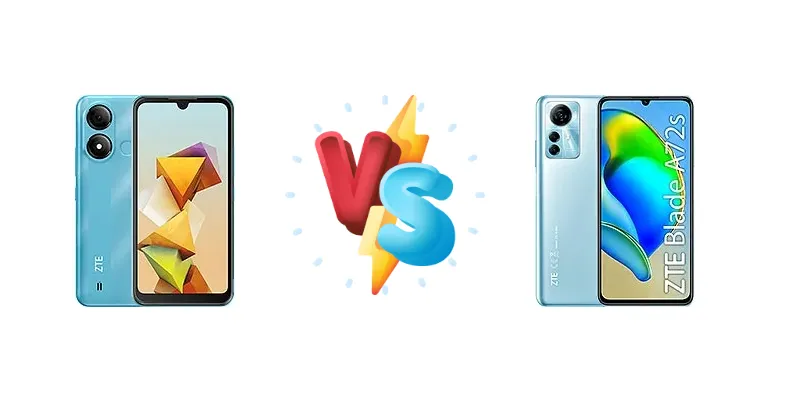
The ZTE Blade A33s and A72s represent ZTE’s commitment to the ultra-budget smartphone market. While both aim to deliver essential smartphone functionality at a low price point, they differ significantly in their internal hardware, particularly in the chipset department. This comparison will dissect those differences to determine which device offers the best value for your money.
🏆 Quick Verdict
For most users, the ZTE Blade A72s is the superior choice. Its Unisoc T606 chipset, built on a more efficient 12nm process and featuring Cortex-A75 performance cores, delivers a noticeably smoother experience than the A33s’ older Unisoc SC9863A. The addition of 22.5W charging further solidifies its position as the better all-around device.
| Network |
|---|
| 2G bands | GSM 850 / 900 / 1800 / 1900 | GSM 850 / 900 / 1800 / 1900 |
| 3G bands | HSDPA 850 / 900 / 1900 / 2100 | HSDPA 850 / 900 / 1900 / 2100 |
| 4G bands | LTE | LTE |
| Speed | HSPA, LTE | HSPA, LTE |
| Technology | GSM / HSPA / LTE | GSM / HSPA / LTE |
| Launch |
|---|
| Announced | 2023, November | 2022, June 19 |
| Status | Available. Released 2023, November | Available. Released 2023, July |
| Body |
|---|
| Dimensions | 160 x 78 x 10.3 mm (6.30 x 3.07 x 0.41 in) | 168 x 77.5 x 8.6 mm (6.61 x 3.05 x 0.34 in) |
| SIM | Nano-SIM + Nano-SIM | Nano-SIM + Nano-SIM |
| Weight | - | 198 g (6.98 oz) |
| Display |
|---|
| Resolution | 480 x 1014 pixels, 19:9 ratio (~178 ppi density) | 720 x 1600 pixels, 20:9 ratio (~260 ppi density) |
| Size | 6.3 inches, 99.0 cm2 (~79.3% screen-to-body ratio) | 6.75 inches, 110.0 cm2 (~84.5% screen-to-body ratio) |
| Type | IPS LCD | IPS LCD, 90Hz |
| Platform |
|---|
| CPU | Octa-core (4x1.6 GHz Cortex-A55 & 4x1.2 GHz Cortex-A55) | Octa-core (2x1.6 GHz Cortex-A75 & 6x1.6 GHz Cortex-A55) |
| Chipset | Unisoc SC9863A (28 nm) | Unisoc T606 (12 nm) |
| GPU | IMG8322 | Mali-G57 MP1 |
| OS | Android 12 (Go edition) | Android 12 |
| Memory |
|---|
| Card slot | microSDXC (dedicated slot) | microSDXC |
| Internal | 32GB 2GB RAM | 128GB 3GB RAM |
| Main Camera |
|---|
| Features | LED flash | LED flash |
| Single | 5 MP (interpolated to 8 MP), AF | - |
| Triple | - | 50 MP, (wideo), AF
2 MP (macro)
Auxiliary lens |
| Video | 1080p@30fps | 1080p@30fps |
| Selfie camera |
|---|
| Single | 2 MP (interpolated to 5 MP) | 5 MP |
| Video | Yes | 720p@30fps |
| Sound |
|---|
| 35mm jack | Yes | Yes |
| Loudspeaker | Yes | Yes |
| Comms |
|---|
| Bluetooth | 5.2, A2DP, LE | 5.0, A2DP, LE |
| NFC | No | No |
| Positioning | GPS | GPS, GLONASS |
| Radio | Unspecified | Unspecified |
| USB | microUSB | microUSB 2.0, OTG |
| WLAN | Wi-Fi 802.11 b/g/n | Wi-Fi 802.11 b/g/n/ac |
| Features |
|---|
| Sensors | Fingerprint (rear-mounted, optional), accelerometer | Fingerprint (side-mounted), accelerometer, proximity |
| Battery |
|---|
| Charging | - | 22.5W wired |
| Type | 4000 mAh | Li-Ion 5000 mAh |
| Misc |
|---|
| Colors | Silver, Blue, Green | Space Gray, Sky Blue |
| Models | - | A7050 |
| Price | - | About 120 EUR |
ZTE Blade A33s
- Potentially lower price point
- Functional for basic tasks
- Simple and straightforward user experience
- Outdated chipset
- Slower performance
- Likely slower charging speeds
ZTE Blade A72s
- More powerful Unisoc T606 chipset
- Faster 22.5W charging
- Improved responsiveness and multitasking
- May be slightly more expensive
- Still a budget device with limitations
- Camera quality likely remains basic
Display Comparison
Neither ZTE provides detailed display specifications beyond resolution. However, given the price point, both likely utilize IPS LCD panels. The key difference lies in the underlying processing power driving the display, which the A72s benefits from. Without knowing the peak brightness or color gamut coverage, it’s difficult to assess visual quality, but the A72s’ more powerful GPU will contribute to smoother animations and transitions.
Camera Comparison
Detailed camera specifications are unavailable. Given the market segment, both devices likely feature basic camera setups. It’s reasonable to assume the A72s benefits from slightly better image signal processing (ISP) capabilities integrated within the T606 chipset, potentially leading to marginally improved image quality, particularly in low-light conditions. However, without knowing sensor sizes or lens apertures, a definitive assessment is impossible. The presence of a 2MP macro camera on either device is unlikely to significantly impact the overall photography experience.
Performance
The core distinction between these two devices is the chipset. The ZTE Blade A33s utilizes the Unisoc SC9863A, a 28nm chipset with an octa-core configuration split between 1.6GHz and 1.2GHz Cortex-A55 cores. This is an older, efficiency-focused design. Conversely, the A72s boasts the Unisoc T606, fabricated on a more modern 12nm process. Crucially, the T606 incorporates two 1.6GHz Cortex-A75 cores alongside six Cortex-A55 cores. The A75 cores represent a significant architectural leap, offering substantially higher single-core performance, which directly translates to snappier app launches and improved responsiveness. This difference will be most noticeable when multitasking or running slightly more demanding apps.
Battery Life
Battery capacity is not specified for either device. However, the A72s’ 22.5W wired charging is a significant advantage. While battery life will depend on usage patterns, the faster charging speed will reduce downtime and provide a more convenient user experience. The A33s likely supports standard 10W or 15W charging, resulting in considerably longer charge times. The more efficient 12nm process of the T606 in the A72s may also contribute to slightly better battery life under similar usage conditions.
Buying Guide
Buy the ZTE Blade A33s if your primary need is a basic, functional smartphone for essential tasks like calls, texts, and light social media browsing, and you prioritize minimizing upfront cost. Buy the ZTE Blade A72s if you want a more responsive user experience, faster charging, and a device capable of handling slightly more demanding applications without significant lag. The A72s is ideal for users who want a bit more future-proofing.
Frequently Asked Questions
❓ Will the ZTE Blade A72s handle popular games like PUBG Mobile or Call of Duty Mobile?
While the Unisoc T606 isn't a gaming powerhouse, the A72s will be able to run PUBG Mobile and Call of Duty Mobile at lower graphics settings and frame rates. Expect playable performance, but don't anticipate a high-end gaming experience. The A33s will struggle significantly with these titles.
❓ Is the 22.5W charging on the A72s compatible with any standard USB-PD charger?
ZTE doesn't explicitly state USB-PD compatibility. However, most modern USB-C chargers supporting Quick Charge or similar fast charging protocols should work with the A72s and deliver faster-than-standard charging speeds. Using the included charger is recommended for optimal performance.
❓ How much RAM does each phone have, and will that impact multitasking?
RAM specifications are not provided. However, both phones likely feature 3GB or 4GB of RAM. The A72s’ more efficient chipset and faster processing will mitigate the impact of limited RAM, resulting in smoother multitasking compared to the A33s.