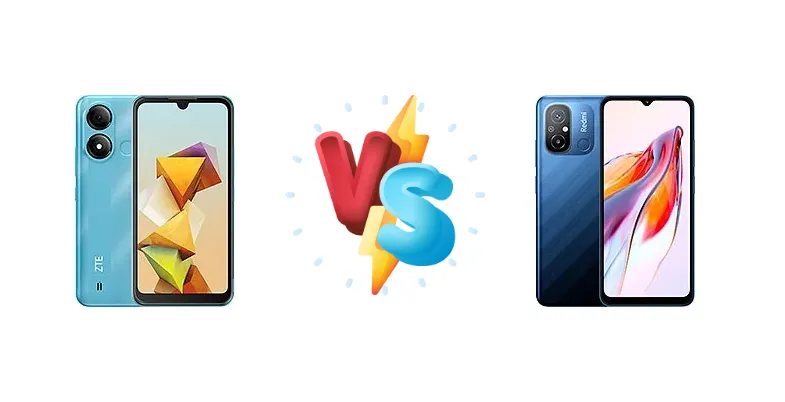
The sub-$150 smartphone market is fiercely competitive. Both the Xiaomi Redmi 12C and ZTE Blade A33s aim to deliver essential smartphone functionality at an accessible price. However, they take different approaches, primarily through their chipset choices: MediaTek’s Helio G85 in the Redmi 12C versus Unisoc’s SC9863A in the Blade A33s. This comparison will dissect the implications of these choices for everyday users.
🏆 Quick Verdict
For most users, the Xiaomi Redmi 12C is the better choice. Its Helio G85 chipset, built on a more efficient 12nm process, delivers noticeably improved CPU and GPU performance compared to the ZTE Blade A33s’ Unisoc SC9863A. While the Blade A33s may offer slightly better battery life due to the less powerful chip, the Redmi 12C’s performance advantage outweighs this.
| Network |
|---|
| 2G bands | GSM 850 / 900 / 1800 / 1900 | GSM 850 / 900 / 1800 / 1900 |
| 3G bands | HSDPA 850 / 900 / 1900 / 2100 | HSDPA 850 / 900 / 2100 |
| 4G bands | LTE | 1, 3, 5, 7, 8, 20, 28, 38, 40, 41 - International |
| Speed | HSPA, LTE | HSPA, LTE |
| Technology | GSM / HSPA / LTE | GSM / CDMA / HSPA / EVDO / LTE |
| | - | CDMA2000 1xEV-DO |
| Launch |
|---|
| Announced | 2023, November | 2022, December 31 |
| Status | Available. Released 2023, November | Available. Released 2023, January 01 |
| Body |
|---|
| Dimensions | 160 x 78 x 10.3 mm (6.30 x 3.07 x 0.41 in) | 168.8 x 76.4 x 8.8 mm (6.65 x 3.01 x 0.35 in) |
| SIM | Nano-SIM + Nano-SIM | Nano-SIM + Nano-SIM |
| Weight | - | 192 g (6.77 oz) |
| Display |
|---|
| Resolution | 480 x 1014 pixels, 19:9 ratio (~178 ppi density) | 720 x 1650 pixels (~268 ppi density) |
| Size | 6.3 inches, 99.0 cm2 (~79.3% screen-to-body ratio) | 6.71 inches, 106.5 cm2 (~82.6% screen-to-body ratio) |
| Type | IPS LCD | IPS LCD, 500 nits (typ) |
| Platform |
|---|
| CPU | Octa-core (4x1.6 GHz Cortex-A55 & 4x1.2 GHz Cortex-A55) | Octa-core (2x2.0 GHz Cortex-A75 & 6x1.8 GHz Cortex-A55) |
| Chipset | Unisoc SC9863A (28 nm) | Mediatek MT6769Z Helio G85 (12 nm) |
| GPU | IMG8322 | Mali-G52 MC2 |
| OS | Android 12 (Go edition) | Android 12, MIUI 13 |
| Memory |
|---|
| Card slot | microSDXC (dedicated slot) | microSDXC (dedicated slot) |
| Internal | 32GB 2GB RAM | 32GB 2GB RAM, 32GB 3GB RAM, 32GB 4GB RAM, 64GB 3GB RAM, 64GB 4GB RAM, 128GB 3GB RAM, 128GB 4GB RAM, 128GB 6GB RAM |
| | - | eMMC 5.1 |
| Main Camera |
|---|
| Dual | - | 50 MP, (wide), PDAF
0.08 MP (depth) |
| Features | LED flash | LED flash, HDR |
| Single | 5 MP (interpolated to 8 MP), AF | 50 MP, f/1.8, (wide), 1/2.76", PDAF
Auxiliary lens |
| Video | 1080p@30fps | 1080p@30fps |
| Selfie camera |
|---|
| Single | 2 MP (interpolated to 5 MP) | 5 MP, f/2.2, (wide) |
| Video | Yes | 1080p@30fps |
| Sound |
|---|
| 3.5mm jack | - | Yes |
| 35mm jack | Yes | Yes |
| Loudspeaker | Yes | Yes |
| Comms |
|---|
| Bluetooth | 5.2, A2DP, LE | 5.1, A2DP, LE |
| NFC | No | Yes (market/region dependent) |
| Positioning | GPS | GPS, GLONASS, BDS, GALILEO |
| Radio | Unspecified | FM radio |
| USB | microUSB | microUSB 2.0 |
| WLAN | Wi-Fi 802.11 b/g/n | Wi-Fi 802.11 a/b/g/n/ac, dual-band, Wi-Fi Direct |
| Features |
|---|
| Sensors | Fingerprint (rear-mounted, optional), accelerometer | Fingerprint (rear-mounted), accelerometer |
| | - | Virtual proximity sensing |
| Battery |
|---|
| Charging | - | 10W wired |
| Type | 4000 mAh | Li-Po 5000 mAh |
| Misc |
|---|
| Colors | Silver, Blue, Green | Graphite Gray, Ocean Blue, Mint Green, Lavender Purple |
| Models | - | 22120RN86G, 22120RN86I, 22126RN91Y, 2212ARNC4L |
| Price | - | £ 132.99 / € 107.41 |
| SAR | - | 1.08 W/kg (head) 0.64 W/kg (body) |
| SAR EU | - | 0.98 W/kg (head) 0.99 W/kg (body) |
ZTE Blade A33s
- Potentially longer battery life due to less powerful chipset
- Lower price point (likely)
- Simple and straightforward user experience
- Significantly slower performance
- Less responsive user interface
- Poor gaming performance
Xiaomi Redmi 12C
- Faster and more responsive performance
- Better gaming capabilities
- More advanced image processing
- Slower charging speed (10W)
- Potentially shorter battery life under heavy load
- May be slightly more expensive
Display Comparison
Neither device is expected to excel in display quality, given their price point. Specifics like panel type (IPS is likely for both) and resolution are not provided, but the focus here is on the underlying processing power needed to drive the display. The more capable GPU in the Redmi 12C will likely handle scrolling and animations more smoothly, even if the displays themselves are similar. Bezels are likely to be substantial on both devices, and color accuracy will be standard for this segment.
Camera Comparison
Without detailed camera specs, it’s difficult to make a definitive judgment. However, the chipset plays a crucial role in image processing. The Helio G85’s ISP (Image Signal Processor) is likely more advanced than the one in the SC9863A, resulting in better image quality, especially in low-light conditions. Both phones likely feature a primary camera and depth sensor, but the Redmi 12C’s processing power will likely allow for more effective noise reduction and dynamic range optimization. The presence of a 2MP macro camera on either device is largely a marketing gimmick and shouldn't be a deciding factor.
Performance
The core difference lies in the chipsets. The Xiaomi Redmi 12C’s MediaTek Helio G85 (12nm) features a more modern CPU architecture with 2x2.0 GHz Cortex-A75 cores and 6x1.8 GHz Cortex-A55 cores, compared to the ZTE Blade A33s’ Unisoc SC9863A (28nm) with 4x1.6 GHz Cortex-A55 and 4x1.2 GHz Cortex-A55 cores. This translates to a significant performance advantage for the Redmi 12C in CPU-intensive tasks. The Helio G85 also boasts a more capable GPU, making it better suited for light gaming. The 28nm process of the Unisoc chip is older and less efficient, meaning it will generate more heat and consume more power for the same level of performance.
Battery Life
The Unisoc SC9863A’s lower performance demands *could* translate to slightly better battery life on the ZTE Blade A33s, all else being equal. However, the Redmi 12C’s 10W charging is a significant drawback. While neither phone will charge quickly, the slower charging speed on the Redmi 12C means longer periods tethered to a power outlet. The actual battery life will depend heavily on usage patterns, but the Redmi 12C’s more powerful processor will consume more power during intensive tasks.
Buying Guide
Buy the ZTE Blade A33s if your primary need is absolute minimal cost and you only intend to use the phone for basic tasks like calls, texts, and light social media. Buy the Xiaomi Redmi 12C if you want a more responsive experience for everyday apps, occasional gaming, and a generally smoother user interface. The Redmi 12C offers a better balance of performance and features for the price.
Frequently Asked Questions
❓ Will the Redmi 12C struggle with popular apps like Facebook and WhatsApp?
No, the Helio G85 is more than capable of handling everyday apps like Facebook, WhatsApp, and web browsing. While it won't offer a flagship-level experience, it will provide a smooth and responsive user interface for these common tasks.
❓ Is the 10W charging on the Redmi 12C a major inconvenience?
Yes, 10W charging is relatively slow by today's standards. Expect a full charge to take several hours. This is a trade-off for the lower price point, and users who frequently need to top up their battery may find it frustrating.
❓ Can I play games like PUBG Mobile on the ZTE Blade A33s?
While technically possible, PUBG Mobile will likely be unplayable at acceptable frame rates on the ZTE Blade A33s. The Unisoc SC9863A lacks the graphical horsepower to handle demanding games like PUBG, even at the lowest settings.
❓ Does the Redmi 12C support software updates?
Xiaomi generally provides software updates for their Redmi series, but the frequency and duration of support can vary. Expect at least one major Android version update, but long-term support is not guaranteed for this budget device.