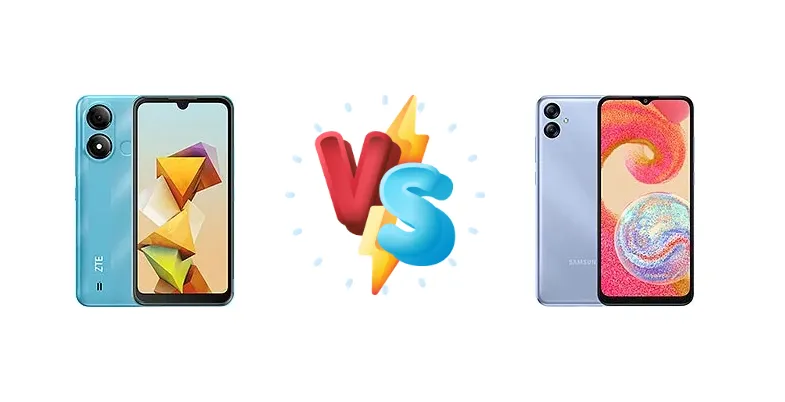
The ZTE Blade A33s and Samsung Galaxy A04e represent the extreme end of the smartphone price spectrum. Both aim to deliver essential smartphone functionality at a minimal cost, but they achieve this through different approaches to chipset design and overall hardware. This comparison dissects their key specifications to determine which device offers the best experience for the budget-conscious user.
🏆 Quick Verdict
For the average user prioritizing responsiveness and slightly better multitasking, the Samsung Galaxy A04e emerges as the winner. Its Mediatek Helio P35, built on a smaller 12nm process, delivers a noticeable performance edge over the ZTE Blade A33s’ Unisoc SC9863A, despite the latter’s octa-core configuration. However, the A33s may offer slightly better efficiency.
| Network |
|---|
| 2G bands | GSM 850 / 900 / 1800 / 1900 | GSM 850 / 900 / 1800 / 1900 |
| 3G bands | HSDPA 850 / 900 / 1900 / 2100 | HSDPA 850 / 900 / 2100 |
| 4G bands | LTE | 1, 3, 5, 7, 8, 20, 28, 38, 40, 41 |
| Speed | HSPA, LTE | HSPA, LTE |
| Technology | GSM / HSPA / LTE | GSM / HSPA / LTE |
| Launch |
|---|
| Announced | 2023, November | 2022, October 21 |
| Status | Available. Released 2023, November | Available. Released 2022, November 07 |
| Body |
|---|
| Build | - | Glass front, plastic back, plastic frame |
| Dimensions | 160 x 78 x 10.3 mm (6.30 x 3.07 x 0.41 in) | 164.2 x 75.9 x 9.1 mm (6.46 x 2.99 x 0.36 in) |
| SIM | Nano-SIM + Nano-SIM | · Nano-SIM· Nano-SIM + Nano-SIM |
| Weight | - | 188 g (6.63 oz) |
| Display |
|---|
| Resolution | 480 x 1014 pixels, 19:9 ratio (~178 ppi density) | 720 x 1600 pixels, 20:9 ratio (~270 ppi density) |
| Size | 6.3 inches, 99.0 cm2 (~79.3% screen-to-body ratio) | 6.5 inches, 102.0 cm2 (~81.8% screen-to-body ratio) |
| Type | IPS LCD | PLS LCD |
| Platform |
|---|
| CPU | Octa-core (4x1.6 GHz Cortex-A55 & 4x1.2 GHz Cortex-A55) | Octa-core (4x2.3 GHz Cortex-A53 & 4x1.8 GHz Cortex-A53) |
| Chipset | Unisoc SC9863A (28 nm) | Mediatek MT6765 Helio P35 (12 nm) |
| GPU | IMG8322 | PowerVR GE8320 |
| OS | Android 12 (Go edition) | Android 12, One UI Core 4.1 |
| Memory |
|---|
| Card slot | microSDXC (dedicated slot) | microSDXC (dedicated slot) |
| Internal | 32GB 2GB RAM | 32GB 2GB RAM, 32GB 3GB RAM, 32GB 4GB RAM, 64GB 2GB RAM, 64GB 3GB RAM, 64GB 4GB RAM, 128GB 4GB RAM |
| Main Camera |
|---|
| Dual | - | 13 MP, f/2.2, (wide), AF
Auxiliary lens |
| Features | LED flash | LED flash |
| Single | 5 MP (interpolated to 8 MP), AF | 5 MP, f/2.2 |
| Video | 1080p@30fps | 1080p@30fps |
| Selfie camera |
|---|
| Single | 2 MP (interpolated to 5 MP) | 5 MP, f/2.2 |
| Video | Yes | Yes |
| Sound |
|---|
| 3.5mm jack | - | Yes |
| 35mm jack | Yes | Yes |
| Loudspeaker | Yes | Yes |
| Comms |
|---|
| Bluetooth | 5.2, A2DP, LE | 5.0, A2DP, LE |
| NFC | No | No |
| Positioning | GPS | GPS, GLONASS, GALILEO, BDS |
| Radio | Unspecified | Unspecified |
| USB | microUSB | USB Type-C 2.0, OTG |
| WLAN | Wi-Fi 802.11 b/g/n | Wi-Fi 802.11 b/g/n, Wi-Fi Direct |
| Features |
|---|
| Sensors | Fingerprint (rear-mounted, optional), accelerometer | Accelerometer, proximity |
| Battery |
|---|
| Type | 4000 mAh | Li-Po 5000 mAh |
| Misc |
|---|
| Colors | Silver, Blue, Green | Black, Copper, Light Blue |
| Models | - | SM-A042F, SM-A042F/DS, SM-A042M, SM-A042M/DS |
| Price | - | ₹ 7,999 |
| SAR EU | - | 0.29 W/kg (head) 1.11 W/kg (body) |
ZTE Blade A33s
- Potentially better battery life due to larger node (depending on battery capacity)
- Lower price point (likely)
- Simple and straightforward Android experience
- Significantly slower CPU performance
- Less responsive user interface
- Less efficient chipset overall
Samsung Galaxy A04e
- Faster CPU performance for smoother multitasking
- More responsive user experience
- More efficient chipset (12nm process)
- Potentially shorter battery life (depending on battery capacity)
- May be slightly more expensive
- Samsung’s software can include bloatware
Display Comparison
Neither device boasts a standout display. Both are likely to feature LCD panels, typical for this price point. The key difference lies under the hood. Without specific display specs, we can infer that the A04e’s slightly more powerful chipset may allow for smoother scrolling and animations. The A33s’ larger 28nm node may lead to slightly more heat during sustained display use, potentially impacting brightness over extended periods.
Camera Comparison
Camera performance is likely to be similar, with both devices likely featuring basic sensors. Without detailed sensor information, it’s safe to assume both will struggle in low-light conditions. The A04e’s slightly more powerful ISP (Image Signal Processor) within the Helio P35 chipset *may* offer marginally better image processing, but the difference will be minimal. The inclusion of a 2MP macro camera on either device is largely a marketing gimmick and offers limited practical benefit.
Performance
The performance gap is the most significant differentiator. The Samsung Galaxy A04e’s Mediatek Helio P35 (12nm) utilizes Cortex-A53 cores clocked at up to 2.3 GHz. This contrasts with the ZTE Blade A33s’ Unisoc SC9863A (28nm) which combines Cortex-A55 cores at 1.6 GHz and 1.2 GHz. While both are octa-core, the Helio P35’s newer architecture and smaller manufacturing process provide a clear advantage in CPU performance and GPU capabilities. The 12nm process allows for higher clock speeds and improved efficiency compared to the 28nm SC9863A. This translates to faster app loading times, smoother multitasking, and a more responsive user interface on the A04e. The A33s’ A55 cores are more efficient *per clock*, but the lower clock speeds and larger node limit overall performance.
Battery Life
Battery life is difficult to predict without knowing battery capacities. However, the Unisoc SC9863A’s larger 28nm node generally indicates lower power efficiency compared to the Helio P35’s 12nm process. While the A33s might have a slightly larger battery to compensate, the A04e’s more efficient chipset could result in comparable or even better real-world battery life. Charging speeds are also likely to be slow on both devices, given their budget nature.
Buying Guide
Buy the ZTE Blade A33s if you prioritize potential battery longevity and are primarily focused on very basic tasks like calling, texting, and light social media browsing. Buy the Samsung Galaxy A04e if you need a phone that feels more responsive for everyday use, handles multiple apps with less lag, and offers a slightly smoother overall experience, even if it means potentially sacrificing a bit of battery life.
Frequently Asked Questions
❓ Will the Helio P35 in the Samsung Galaxy A04e overheat during prolonged use, like gaming?
While the Helio P35 isn't a gaming powerhouse, its 12nm process and thermal design are adequate for casual gaming. Expect some throttling during extended sessions, but it's unlikely to overheat to the point of causing performance issues or discomfort. The ZTE Blade A33s, with its larger node, may throttle sooner.
❓ Is the Unisoc SC9863A in the ZTE Blade A33s sufficient for running popular apps like WhatsApp and Facebook?
Yes, the Unisoc SC9863A is capable of running basic apps like WhatsApp and Facebook. However, expect slower loading times and occasional lag, especially when multitasking. The A04e will handle these tasks more smoothly.
❓ How much storage do these phones typically offer, and can it be expanded?
Both phones typically come with 32GB or 64GB of internal storage, with the option to expand via microSD card. This is crucial for storing photos, videos, and apps, as the base storage is limited.
❓ Do either of these phones support fast charging?
Neither phone is expected to support fast charging. They will likely ship with a standard 5W or 10W charger, resulting in slow charging times. Expect a full charge to take several hours.