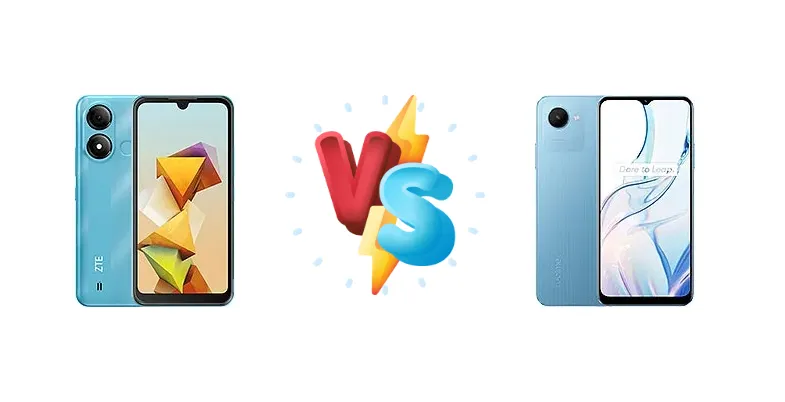
The ZTE Blade A33s and Realme C30s represent the ultra-budget end of the smartphone spectrum. Both aim to deliver essential smartphone functionality at the lowest possible price point, but they take slightly different approaches to achieving this. This comparison dissects their core specifications to determine which device offers the best value for users prioritizing affordability.
🏆 Quick Verdict
For the average user seeking a slightly more capable processor for basic multitasking and app usage, the ZTE Blade A33s emerges as the better choice. Its Unisoc SC9863A chipset, while still entry-level, offers a more complex octa-core configuration than the Realme C30s' simpler CPU, potentially leading to smoother performance in demanding scenarios.
| Network |
|---|
| 2G bands | GSM 850 / 900 / 1800 / 1900 | GSM 850 / 900 / 1800 / 1900 |
| 3G bands | HSDPA 850 / 900 / 1900 / 2100 | HSDPA 850 / 900 / 2100 |
| 4G bands | LTE | 1, 3, 5, 8, 38, 40, 41 |
| Speed | HSPA, LTE | HSPA, LTE |
| Technology | GSM / HSPA / LTE | GSM / HSPA / LTE |
| Launch |
|---|
| Announced | 2023, November | 2022, September 14 |
| Status | Available. Released 2023, November | Available. Released 2022, September 23 |
| Body |
|---|
| Build | - | Glass front, plastic frame, plastic back |
| Dimensions | 160 x 78 x 10.3 mm (6.30 x 3.07 x 0.41 in) | 164.2 x 75.7 x 8.5 mm (6.46 x 2.98 x 0.33 in) |
| SIM | Nano-SIM + Nano-SIM | Nano-SIM + Nano-SIM |
| Weight | - | 186 g (6.56 oz) |
| Display |
|---|
| Resolution | 480 x 1014 pixels, 19:9 ratio (~178 ppi density) | 720 x 1600 pixels, 20:9 ratio (~270 ppi density) |
| Size | 6.3 inches, 99.0 cm2 (~79.3% screen-to-body ratio) | 6.5 inches, 102.0 cm2 (~82.1% screen-to-body ratio) |
| Type | IPS LCD | IPS LCD |
| Platform |
|---|
| CPU | Octa-core (4x1.6 GHz Cortex-A55 & 4x1.2 GHz Cortex-A55) | Octa-core 1.6 GHz Cortex-A55 |
| Chipset | Unisoc SC9863A (28 nm) | - |
| GPU | IMG8322 | IMG8322 |
| OS | Android 12 (Go edition) | Android 12, Realme UI Go |
| Memory |
|---|
| Card slot | microSDXC (dedicated slot) | microSDXC (dedicated slot) |
| Internal | 32GB 2GB RAM | 32GB 2GB RAM, 32GB 3GB RAM, 64GB 3GB RAM, 64GB 4GB RAM |
| Main Camera |
|---|
| Features | LED flash | LED flash, HDR, panorama |
| Single | 5 MP (interpolated to 8 MP), AF | 8 MP, (wide), 1/4.0", 1.12µm |
| Video | 1080p@30fps | 1080p@30fps |
| Selfie camera |
|---|
| Features | - | HDR |
| Single | 2 MP (interpolated to 5 MP) | 5 MP, (wide), 1/5.0", 1.12µm |
| Video | Yes | 720p@30fps |
| Sound |
|---|
| 3.5mm jack | - | Yes |
| 35mm jack | Yes | Yes |
| Loudspeaker | Yes | Yes |
| Comms |
|---|
| Bluetooth | 5.2, A2DP, LE | 4.2, A2DP |
| NFC | No | No |
| Positioning | GPS | GPS, GLONASS |
| Radio | Unspecified | Unspecified |
| USB | microUSB | microUSB 2.0, OTG |
| WLAN | Wi-Fi 802.11 b/g/n | Wi-Fi 802.11 b/g/n |
| Features |
|---|
| Sensors | Fingerprint (rear-mounted, optional), accelerometer | Fingerprint (side-mounted), accelerometer, proximity |
| Battery |
|---|
| Charging | - | 10W wired |
| Type | 4000 mAh | 5000 mAh |
| Misc |
|---|
| Colors | Silver, Blue, Green | Stripe Blue, Stripe Black |
| Models | - | RMX3690 |
| Price | - | About 100 EUR |
ZTE Blade A33s
- Potentially smoother multitasking due to octa-core split-cluster CPU.
- More complex processor architecture may offer better performance.
- Likely a more competitive price-to-performance ratio.
- Older 28nm process node may lead to slightly higher power consumption.
- Lack of detailed specifications makes a full assessment difficult.
Realme C30s
- Simplicity and ease of use.
- Brand recognition and potentially better software support from Realme.
- 10W charging provides a basic charging solution.
- Simpler CPU architecture may struggle with multitasking.
- Potentially lower performance compared to the ZTE Blade A33s.
- Slow 10W charging.
Display Comparison
Neither ZTE nor Realme provide display specifications beyond size. Given the price point, both likely utilize LCD panels with 720p+ resolution. The absence of detailed display specs suggests a focus on cost reduction, meaning users should expect basic viewing experiences. Color accuracy and brightness are likely to be average at best. Bezels are expected to be substantial on both devices.
Camera Comparison
Both devices are expected to feature basic camera setups. Without specific sensor details, it's safe to assume both rely on low-resolution primary sensors paired with auxiliary lenses of limited utility. Image quality will likely be acceptable for casual snapshots in good lighting conditions, but struggles in low light are anticipated. The absence of Optical Image Stabilization (OIS) on either device further limits low-light performance. Focusing on megapixel counts alone would be misleading; sensor size and image processing algorithms are far more critical at this price point.
Performance
The core difference lies in the chipset. The ZTE Blade A33s features the Unisoc SC9863A, an octa-core processor split into two clusters: four Cortex-A55 cores clocked at 1.6 GHz and four at 1.2 GHz. This dual-cluster approach allows for more efficient power management, dedicating cores to background tasks while reserving the faster cores for active applications. The Realme C30s, conversely, utilizes an octa-core CPU with all cores clocked at 1.6 GHz Cortex-A55. While the clock speed is identical, the lack of a split-cluster design may result in less efficient multitasking. The 28nm process node of the Unisoc chip is older, potentially impacting thermal efficiency compared to newer nodes, but the Realme C30s lacks any information on its manufacturing process.
Battery Life
Battery capacity is not specified for either device. However, given the budget nature of both phones, capacities are likely in the 4000-5000 mAh range. The Realme C30s supports 10W wired charging, which is relatively slow by modern standards. The ZTE Blade A33s charging speed is unknown, but is likely similar. Real-world battery life will depend heavily on usage patterns, but both phones should be capable of lasting a full day with moderate use. The slower charging speed on the Realme C30s means longer periods tethered to a power outlet.
Buying Guide
Buy the ZTE Blade A33s if you need a phone capable of handling more than just the most basic tasks, such as light web browsing and social media. The octa-core processor provides a slight edge in multitasking. Buy the Realme C30s if your primary needs are simple communication – calls, texts, and minimal app usage – and you prioritize simplicity and potentially longer software support from a larger brand.
Frequently Asked Questions
❓ Will the Unisoc SC9863A in the ZTE Blade A33s struggle with popular apps like WhatsApp and Facebook?
While the Unisoc SC9863A is an entry-level processor, its octa-core configuration should be sufficient to run apps like WhatsApp and Facebook without significant issues. However, expect some slowdowns when multitasking or running more demanding applications alongside these social media platforms.
❓ Is the 10W charging on the Realme C30s noticeably slow compared to other smartphones?
Yes, 10W charging is considerably slower than the charging speeds offered by many modern smartphones. Expect it to take several hours to fully charge the Realme C30s from 0% to 100%. This is a trade-off for the lower price point.
❓ Can either of these phones handle basic mobile gaming?
Both phones can handle very basic mobile games, but don't expect a smooth experience with graphically intensive titles. Frame rates will likely be low, and you may encounter stuttering or lag. These phones are best suited for casual gaming.