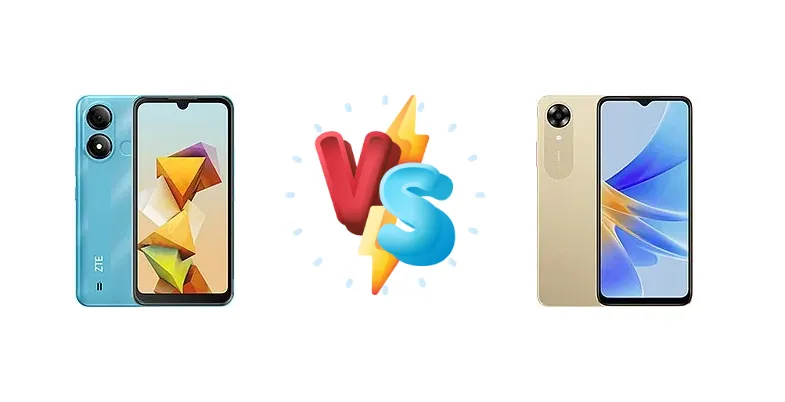
The ZTE Blade A33s and Oppo A17k represent the fiercely competitive sub-$150 smartphone market. Both aim to deliver essential functionality at an accessible price point, but they achieve this with significantly different chipsets. This comparison dissects the key differences between the Unisoc SC9863A-powered ZTE and the MediaTek Helio G35-equipped Oppo, helping you determine which device offers the best value for your needs.
🏆 Quick Verdict
For the average user prioritizing responsiveness and slightly better gaming capability, the Oppo A17k emerges as the stronger choice. Its Helio G35 chipset, fabricated on a smaller 12nm process, delivers a noticeable performance edge over the ZTE Blade A33s’ Unisoc SC9863A, despite the ZTE having a more complex core configuration on paper.
| Network |
|---|
| 2G bands | GSM 850 / 900 / 1800 / 1900 | GSM 850 / 900 / 1800 / 1900 |
| 3G bands | HSDPA 850 / 900 / 1900 / 2100 | HSDPA 850 / 900 / 2100 |
| 4G bands | LTE | 1, 3, 5, 8, 38, 40, 41 |
| Speed | HSPA, LTE | HSPA, LTE |
| Technology | GSM / HSPA / LTE | GSM / HSPA / LTE |
| Launch |
|---|
| Announced | 2023, November | 2022, October 13 |
| Status | Available. Released 2023, November | Available. Released 2022, October 18 |
| Body |
|---|
| Dimensions | 160 x 78 x 10.3 mm (6.30 x 3.07 x 0.41 in) | 164.2 x 75.6 x 8.3 mm (6.46 x 2.98 x 0.33 in) |
| SIM | Nano-SIM + Nano-SIM | Nano-SIM + Nano-SIM |
| Weight | - | 189 g (6.67 oz) |
| | - | IPX4 water resistance |
| Display |
|---|
| Protection | - | Panda Glass |
| Resolution | 480 x 1014 pixels, 19:9 ratio (~178 ppi density) | 720 x 1612 pixels, 20:9 ratio (~269 ppi density) |
| Size | 6.3 inches, 99.0 cm2 (~79.3% screen-to-body ratio) | 6.56 inches, 103.4 cm2 (~83.3% screen-to-body ratio) |
| Type | IPS LCD | IPS LCD, 480 nits (typ), 600 nits (HBM) |
| Platform |
|---|
| CPU | Octa-core (4x1.6 GHz Cortex-A55 & 4x1.2 GHz Cortex-A55) | Octa-core (4x2.3 GHz Cortex-A53 & 4x1.8 GHz Cortex-A53) |
| Chipset | Unisoc SC9863A (28 nm) | Mediatek MT6765 Helio G35 (12 nm) |
| GPU | IMG8322 | PowerVR GE8320 |
| OS | Android 12 (Go edition) | Android 12, ColorOS 12.1 |
| Memory |
|---|
| Card slot | microSDXC (dedicated slot) | microSDXC |
| Internal | 32GB 2GB RAM | 64GB 3GB RAM |
| | - | eMMC 5.1 |
| Main Camera |
|---|
| Features | LED flash | LED flash, panorama |
| Single | 5 MP (interpolated to 8 MP), AF | 8 MP, f/2.0, (wide), AF |
| Video | 1080p@30fps | 1080p@30fps |
| Selfie camera |
|---|
| Single | 2 MP (interpolated to 5 MP) | 5 MP, f/2.2, (wide) |
| Video | Yes | 1080p@30fps |
| Sound |
|---|
| 3.5mm jack | - | Yes |
| 35mm jack | Yes | Yes |
| Loudspeaker | Yes | Yes |
| Comms |
|---|
| Bluetooth | 5.2, A2DP, LE | 5.3, A2DP, LE, aptX HD |
| NFC | No | No |
| Positioning | GPS | GPS, GLONASS, BDS, GALILEO |
| Radio | Unspecified | Unspecified |
| USB | microUSB | microUSB 2.0, OTG |
| WLAN | Wi-Fi 802.11 b/g/n | Wi-Fi 802.11 a/b/g/n/ac, dual-band |
| Features |
|---|
| Sensors | Fingerprint (rear-mounted, optional), accelerometer | Fingerprint (side-mounted), accelerometer, proximity, compass |
| Battery |
|---|
| Type | 4000 mAh | Li-Po 5000 mAh |
| Misc |
|---|
| Colors | Silver, Blue, Green | Navy Blue, Gold |
| Models | - | CPH2471 |
| Price | - | About 130 EUR |
ZTE Blade A33s
- Potentially longer software support from ZTE.
- Octa-core CPU configuration (though less efficient).
- May be more readily available in certain regions.
- Older 28nm chipset fabrication process.
- Less powerful CPU and GPU compared to the Oppo.
- Likely lower sustained performance due to thermal limitations.
Oppo A17k
- More modern 12nm chipset fabrication process.
- Faster CPU and GPU for smoother performance.
- Better power efficiency for potentially longer battery life.
- Potentially shorter software support lifecycle.
- Cortex-A53 cores are older architecture.
- May be slightly more expensive than the ZTE.
Display Comparison
Neither device boasts a standout display. Both likely feature LCD panels, typical for this price bracket. However, the lack of detailed display specifications necessitates a focus on the chipset's ability to drive the UI smoothly. The Oppo A17k’s more powerful GPU will likely translate to slightly smoother scrolling and animations, even if the resolution and refresh rate are identical. Bezels are expected to be substantial on both devices, minimizing the immersive experience.
Camera Comparison
Camera performance is likely to be similar, with both devices likely featuring a primary sensor paired with basic auxiliary lenses. Given the context data, detailed analysis is limited. However, the Helio G35’s image signal processor (ISP) is likely more advanced than the one found in the SC9863A, potentially resulting in slightly better image processing, particularly in low-light conditions. Expect both to struggle with dynamic range and detail in challenging lighting scenarios. The presence of a 2MP macro camera on either device is largely a marketing gimmick and should not be a deciding factor.
Performance
The core difference lies in the chipsets. The Oppo A17k’s MediaTek Helio G35 (12nm) utilizes four Cortex-A53 cores clocked at 2.3 GHz and four at 1.8 GHz. While the ZTE Blade A33s’ Unisoc SC9863A (28nm) has an octa-core configuration with a split of 1.6 GHz and 1.2 GHz Cortex-A55 cores, the older 28nm process and less efficient Cortex-A55 architecture result in lower overall performance. The Helio G35’s architecture, despite using older A53 cores, benefits from the smaller fabrication node, leading to better power efficiency and sustained performance. This translates to faster app loading times and a more fluid multitasking experience on the Oppo.
Battery Life
Battery life will depend heavily on usage patterns. While the exact battery capacities aren't provided, the Helio G35’s improved power efficiency could offset a potentially smaller battery in the Oppo A17k. The 12nm process allows for more efficient operation, reducing power draw during everyday tasks. Charging wattage is also unknown, but both devices likely support standard 5W or 10W charging, resulting in relatively slow 0-100% charge times.
Buying Guide
Buy the ZTE Blade A33s if you prioritize a potentially longer software support lifecycle from ZTE and are primarily focused on basic tasks like calling, texting, and light social media use. Buy the Oppo A17k if you prefer a more responsive user experience, enjoy occasional mobile gaming, and value the benefits of a more modern chipset architecture, even if it means potentially shorter software updates.
Frequently Asked Questions
❓ Will the Helio G35 in the Oppo A17k struggle with demanding games like PUBG Mobile?
While the Helio G35 isn't a gaming powerhouse, it's capable of running PUBG Mobile at lower settings (balanced graphics, medium frame rate). Expect occasional frame drops during intense firefights. The ZTE Blade A33s will likely offer a less smooth experience even at the lowest settings.
❓ How does the Unisoc SC9863A handle multitasking compared to the Helio G35?
The Helio G35’s more efficient architecture and GPU will result in smoother multitasking. Switching between apps will be noticeably faster on the Oppo A17k, while the ZTE Blade A33s may exhibit more lag and slowdown when running multiple applications simultaneously.
❓ Is the software experience significantly different between the ZTE Blade A33s and Oppo A17k?
Both devices likely run a customized version of Android. Oppo's ColorOS is generally more feature-rich and polished, but also more resource-intensive. ZTE's software is typically lighter, which could benefit the less powerful SC9863A chipset, but may lack some of the advanced features found in ColorOS.
❓ Which phone is likely to receive more software updates?
ZTE historically has provided longer software support for its devices, even in the budget segment. Oppo's update schedule can be less predictable. However, given the age of both chipsets, don't expect major Android version updates on either device.