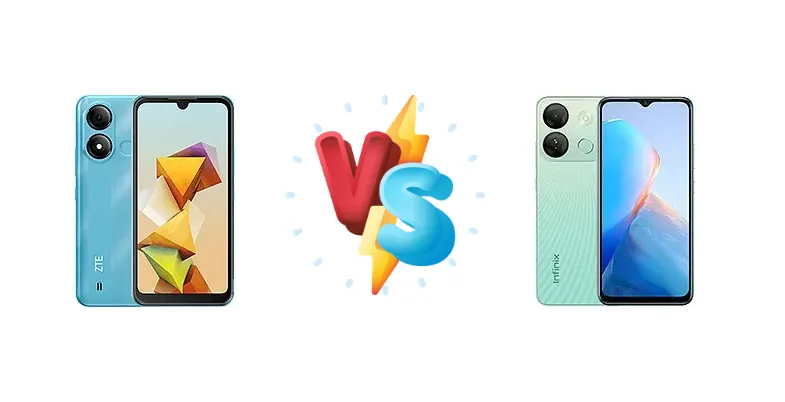
The ZTE Blade A33s and Infinix Smart 7 HD represent the extreme end of the smartphone price spectrum. Both aim to deliver essential smartphone functionality at a price point accessible to almost anyone. This comparison dissects their core components to determine which device offers the best balance of features and performance for the budget-conscious consumer.
🏆 Quick Verdict
For most users, the ZTE Blade A33s emerges as the slightly better choice. Its Unisoc SC9863A chipset, while not a powerhouse, offers a more detailed CPU core configuration than the Infinix Smart 7 HD, potentially leading to smoother multitasking. However, the Infinix Smart 7 HD's 10W charging is a welcome addition absent in the ZTE.
| Network |
|---|
| 2G bands | GSM 850 / 900 / 1800 / 1900 | GSM 850 / 900 / 1800 / 1900 |
| 3G bands | HSDPA 850 / 900 / 1900 / 2100 | HSDPA 850 / 900 / 2100 |
| 4G bands | LTE | 1, 3, 5, 8, 38, 40, 41 |
| Speed | HSPA, LTE | HSPA, LTE |
| Technology | GSM / HSPA / LTE | GSM / HSPA / LTE |
| | - | 1, 2, 3, 4, 5, 7, 8, 20, 28, 38, 40, 41 |
| Launch |
|---|
| Announced | 2023, November | 2023, April 14 |
| Status | Available. Released 2023, November | Available. Released 2023, April 14 |
| Body |
|---|
| Build | - | Glass front, plastic back, plastic frame |
| Dimensions | 160 x 78 x 10.3 mm (6.30 x 3.07 x 0.41 in) | 163.9 x 75.5 x 8.7 mm (6.45 x 2.97 x 0.34 in) |
| SIM | Nano-SIM + Nano-SIM | Nano-SIM + Nano-SIM |
| Weight | - | 196.5 g (6.95 oz) |
| Display |
|---|
| Resolution | 480 x 1014 pixels, 19:9 ratio (~178 ppi density) | 720 x 1612 pixels, 20:9 ratio (~267 ppi density) |
| Size | 6.3 inches, 99.0 cm2 (~79.3% screen-to-body ratio) | 6.6 inches, 104.6 cm2 (~84.6% screen-to-body ratio) |
| Type | IPS LCD | IPS LCD, 500 nits |
| Platform |
|---|
| CPU | Octa-core (4x1.6 GHz Cortex-A55 & 4x1.2 GHz Cortex-A55) | Octa-core 1.6 GHz |
| Chipset | Unisoc SC9863A (28 nm) | - |
| GPU | IMG8322 | - |
| OS | Android 12 (Go edition) | Android 12 (Go edition) |
| Memory |
|---|
| Card slot | microSDXC (dedicated slot) | microSDXC (dedicated slot) |
| Internal | 32GB 2GB RAM | 64GB 2GB RAM |
| | - | UFS 2.1 |
| Main Camera |
|---|
| Dual | - | 8 MP, f/2.0
0.08 MP, (depth) |
| Features | LED flash | Dual-LED flash, HDR, panorama |
| Single | 5 MP (interpolated to 8 MP), AF | 8 MP, f/2.0
Auxiliary lens |
| Video | 1080p@30fps | 1080p@30fps |
| Selfie camera |
|---|
| Features | - | LED flash |
| Single | 2 MP (interpolated to 5 MP) | 5 MP, f/2.0 |
| Video | Yes | 720p@30fps |
| Sound |
|---|
| 3.5mm jack | - | Yes |
| 35mm jack | Yes | Yes |
| Loudspeaker | Yes | Yes |
| Comms |
|---|
| Bluetooth | 5.2, A2DP, LE | 5.0, A2DP, LE |
| NFC | No | No |
| Positioning | GPS | GPS |
| Radio | Unspecified | FM radio |
| USB | microUSB | microUSB 2.0, OTG |
| WLAN | Wi-Fi 802.11 b/g/n | Wi-Fi 802.11 b/g/n |
| Features |
|---|
| Sensors | Fingerprint (rear-mounted, optional), accelerometer | Fingerprint (rear-mounted), accelerometer, proximity |
| Battery |
|---|
| Charging | - | 10W wired |
| Type | 4000 mAh | 5000 mAh |
| Misc |
|---|
| Colors | Silver, Blue, Green | Ink Black, Silk Blue, Jade White, Green Apple |
| Models | - | X6516 |
| Price | - | About 110 EUR |
ZTE Blade A33s
- Potentially smoother multitasking due to the split-core CPU design.
- Unisoc chipset offers a known architecture for software optimization.
- Likely a more robust software experience due to wider chipset adoption.
- Charging specifications are unknown, potentially leading to slow charging times.
- 28nm process may result in higher power consumption.
Infinix Smart 7 HD
- 10W wired charging provides a faster charging experience.
- Simpler CPU configuration may lead to better power efficiency in some scenarios.
- Potentially lower price point compared to the ZTE Blade A33s.
- Lack of CPU architecture details raises concerns about performance optimization.
- Potentially less responsive multitasking due to a less refined core configuration.
Display Comparison
Neither ZTE nor Infinix provide display specifications beyond size. Given the price point, both likely utilize LCD panels with 720p+ resolution. The absence of details like peak brightness or color gamut suggests neither phone will excel in outdoor visibility or color accuracy. Bezels are expected to be substantial on both devices, maximizing screen real estate within a compact form factor. PWM dimming rates are unknown, making it difficult to assess potential eye strain.
Camera Comparison
Camera specifications are sparse for both devices. It's safe to assume both feature a primary rear camera and potentially a secondary depth or macro sensor. Without knowing sensor sizes or lens apertures, it's impossible to assess image quality. The focus should be on basic functionality rather than photographic excellence. The absence of Optical Image Stabilization (OIS) on either device means low-light performance will be limited. Any 2MP macro sensors included should be considered marketing features rather than genuinely useful cameras.
Performance
The ZTE Blade A33s features the Unisoc SC9863A, an octa-core processor built on a 28nm process. Its CPU configuration is split into 4x1.6 GHz Cortex-A55 cores and 4x1.2 GHz Cortex-A55 cores, offering a tiered approach to performance and efficiency. The Infinix Smart 7 HD lists an octa-core 1.6 GHz CPU, but lacks specific core architecture details. This suggests a potentially less refined core configuration, possibly consisting of eight slower Cortex-A55 cores. The 28nm process of the Unisoc chip will likely result in higher power consumption compared to more modern nodes, but the core split in the ZTE may offer better responsiveness in certain tasks. RAM details are missing for both, but are likely limited to 2-3GB, impacting multitasking capabilities.
Battery Life
Battery capacity is not specified for the ZTE Blade A33s, but given its market segment, it's likely around 4000-5000 mAh. The Infinix Smart 7 HD includes 10W wired charging, a significant advantage over the ZTE, which lacks any charging information. While 10W is slow by modern standards, it's still preferable to relying solely on slower, potentially less efficient charging methods. Real-world battery life will depend heavily on usage patterns, but both phones should comfortably last a full day with moderate use.
Buying Guide
Buy the ZTE Blade A33s if you prioritize a potentially smoother user experience with its octa-core processor and are comfortable with slower charging. This phone is ideal for users who primarily use their phone for calls, messaging, and light social media. Buy the Infinix Smart 7 HD if you value a slightly faster charging solution and are willing to accept potentially less responsive performance in multi-tasking scenarios. This is a good option for users who need a phone primarily for basic communication and have limited access to charging opportunities.
Frequently Asked Questions
❓ Is the Unisoc SC9863A chipset capable of running popular apps like WhatsApp and Facebook smoothly?
Yes, the Unisoc SC9863A is generally sufficient for running basic applications like WhatsApp and Facebook. However, expect some lag when multitasking or running more demanding apps. The split-core architecture may help with responsiveness compared to a simpler octa-core design.
❓ How long will the battery last on the Infinix Smart 7 HD with typical usage (calls, messaging, social media)?
With typical usage, the Infinix Smart 7 HD should last a full day on a single charge. The battery capacity is likely in the 4000-5000 mAh range, and the 10W charging will allow you to top it up relatively quickly when needed. However, heavy usage (gaming, video streaming) will significantly reduce battery life.
❓ Can either of these phones handle basic mobile games like Candy Crush or Subway Surfers?
Both phones should be able to handle less demanding mobile games like Candy Crush or Subway Surfers, but don't expect high frame rates or detailed graphics. The Unisoc SC9863A in the ZTE Blade A33s might offer a slightly better gaming experience due to its more complex CPU configuration.