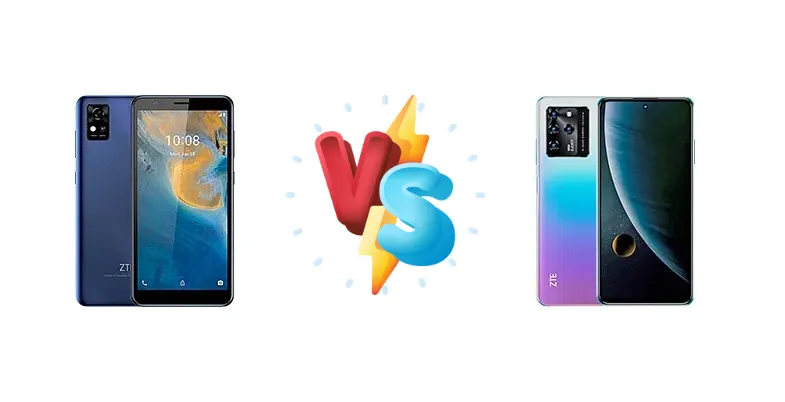
The ZTE Blade A31 and V30 represent ZTE's continued push into the affordable smartphone market. While both aim to deliver essential functionality at a low price point, they differ significantly in their underlying hardware. This comparison dissects those differences, focusing on the impact of the newer Unisoc Tiger T618 in the V30 versus the SC9863A found in the A31, and determines which device offers the best value for your money.
🏆 Quick Verdict
For most users, the ZTE Blade V30 is the superior choice. The 12nm Unisoc Tiger T618 chipset provides a noticeable performance uplift over the 28nm SC9863A in the A31, and the inclusion of 18W charging is a significant convenience. While the A31 remains a viable option for extremely budget-conscious buyers, the V30’s improved efficiency and speed justify the price difference.
| Network |
|---|
| 2G bands | GSM 850 / 900 / 1800 / 1900 | GSM 850 / 900 / 1800 / 1900 |
| 3G bands | HSDPA 850 / 900 / 2100 | HSDPA 850 / 1700(AWS) / 1900 - Mexico |
| 4G bands | 1, 2, 3, 5, 7, 8, 20, 28, 38 | 1, 2, 3, 4, 5, 7, 12, 13, 26, 28, 66 - Mexico |
| Speed | HSPA, LTE | HSPA, LTE |
| Technology | GSM / HSPA / LTE | GSM / HSPA / LTE |
| Launch |
|---|
| Announced | 2021, July 13 | 2021, July 16 |
| Status | Available. Released 2021, July 13 | Available. Released 2021, September 01 |
| Body |
|---|
| Dimensions | 140 x 71 x 8.9 mm (5.51 x 2.80 x 0.35 in) | 165.8 x 77.8 x 8.9 mm (6.53 x 3.06 x 0.35 in) |
| SIM | Nano-SIM + Nano-SIM | Nano-SIM + Nano-SIM |
| Weight | 166 g (5.86 oz) | 193 g (6.81 oz) |
| Display |
|---|
| Resolution | 720 x 1440 pixels, 18:9 ratio (~295 ppi density) | 1080 x 2400 pixels, 20:9 ratio (~395 ppi density) |
| Size | 5.45 inches, 76.7 cm2 (~77.1% screen-to-body ratio) | 6.67 inches, 107.4 cm2 (~83.3% screen-to-body ratio) |
| Type | IPS LCD | IPS LCD |
| Platform |
|---|
| CPU | Octa-core (4x1.6 GHz Cortex-A55 & 4x1.2 GHz Cortex-A55) | Octa-core (2x2.0 GHz Cortex-A75 & 6x2.0 GHz Cortex-A55) |
| Chipset | Unisoc SC9863A (28 nm) | Unisoc Tiger T618 (12 nm) |
| GPU | IMG8322 | Mali G52 MP2 |
| OS | Android 11 (Go edition) | Android 11 |
| Memory |
|---|
| Card slot | microSDXC | microSDXC |
| Internal | 32GB 2GB RAM | 128GB 4GB RAM |
| Main Camera |
|---|
| Features | LED flash, HDR | LED flash, HDR, panorama |
| Single | 8 MP | 16 MP, f/2.0, (wide) |
| Triple | - | 64 MP, f/1.8, 26mm (wide), PDAF
8 MP, f/2.4, 120˚, 16mm (ultrawide)
5 MP (macro)
Auxiliary lens |
| Video | 720p@30fps | 1080p@30fps |
| Selfie camera |
|---|
| Single | 2 MP (up-scaled to 5 MP) | 16 MP, f/2.0, (wide) |
| Sound |
|---|
| 3.5mm jack | Yes | Yes |
| 35mm jack | Yes | Yes |
| Loudspeaker | Yes | Yes |
| Comms |
|---|
| Bluetooth | 4.2, A2DP, LE | 5.0, A2DP, LE |
| NFC | Yes (market/region dependent) | No |
| Positioning | GPS, GLONASS | GPS |
| Radio | FM radio | Unspecified |
| USB | microUSB 2.0 | USB Type-C 2.0 |
| WLAN | Wi-Fi 802.11 b/g/n | Wi-Fi 802.11 b/g/n/ac |
| Features |
|---|
| Sensors | Accelerometer | Fingerprint (side-mounted), accelerometer, gyro, proximity |
| Battery |
|---|
| Charging | - | 18W wired |
| Type | Li-Ion 3000 mAh, removable | Li-Po 5000 mAh |
| Misc |
|---|
| Colors | Blue, Gray | Black, Blue |
| Models | - | 9030 |
| Price | - | About 200 EUR |
ZTE Blade A31
- Lowest possible price point
- Functional for basic tasks
- Simple and easy to use
- Slow performance
- Inefficient chipset
- Slow charging
ZTE Blade V30
- Faster and more responsive performance
- More efficient chipset
- 18W fast charging
- Slightly higher price
- May still struggle with graphically intensive games
- Likely similar camera performance to A31
Display Comparison
Neither ZTE provides detailed display specifications beyond resolution. However, the focus here isn't display quality, but the chipset's ability to drive the UI smoothly. The A31's older chipset may exhibit more noticeable lag when scrolling or transitioning between apps, impacting the perceived display experience. We can assume both utilize IPS LCD panels common in this price bracket, with similar color accuracy limitations.
Camera Comparison
Without detailed camera specs, a direct comparison is difficult. However, it’s safe to assume both phones feature basic camera setups geared towards casual photography. The image signal processor (ISP) within the Unisoc Tiger T618 in the V30 is likely more advanced, potentially resulting in better image processing, noise reduction, and dynamic range compared to the A31. Any differences in sensor size or lens aperture would further accentuate this advantage, but without that data, we can only infer a benefit to the V30 based on its superior chipset.
Performance
The core difference lies in the chipsets. The ZTE Blade V30’s Unisoc Tiger T618, built on a 12nm process, represents a significant architectural leap over the A31’s 28nm Unisoc SC9863A. The T618’s CPU configuration – 2x2.0 GHz Cortex-A75 and 6x2.0 GHz Cortex-A55 – is far more capable than the A31’s 4x1.6 GHz Cortex-A55 & 4x1.2 GHz Cortex-A55. The A75 cores in the V30 provide a substantial boost in single-core performance, crucial for responsive app launches and general UI fluidity. The 12nm process also translates to improved power efficiency, meaning less heat generation and potentially longer sustained performance. The A31 will struggle with demanding applications and multitasking.
Battery Life
While battery capacity isn't specified, the V30’s 18W wired charging is a clear advantage. The A31 likely supports standard 5W or 10W charging, resulting in significantly longer charge times. The more efficient 12nm Unisoc Tiger T618 in the V30 will also contribute to better battery life, even if the battery capacity is similar. The faster charging allows for quick top-ups, addressing a common pain point for budget smartphone users.
Buying Guide
Buy the ZTE Blade A31 if you prioritize absolute lowest cost and basic smartphone functionality for tasks like calls, texts, and light social media. It’s a suitable option for first-time smartphone users or as a backup device. Buy the ZTE Blade V30 if you value smoother multitasking, faster app loading times, and quicker charging. This phone is better suited for users who engage in more demanding tasks like video streaming or casual gaming.
Frequently Asked Questions
❓ Will the ZTE Blade V30 handle popular games like PUBG Mobile or Call of Duty?
While the Unisoc Tiger T618 is a step up, don't expect flagship-level gaming performance. You'll likely be able to play PUBG Mobile at medium settings with reasonable frame rates, but demanding titles may require significant graphical compromises. The A31 will struggle even with minimal settings.
❓ How much faster is the charging on the ZTE Blade V30 compared to the A31?
The V30’s 18W charging will significantly reduce charging times. Expect a full charge in approximately 2-3 hours, whereas the A31, with its likely 5W-10W charging, could take 5-6 hours or even longer. This is a major convenience factor for users who need to quickly top up their battery.
❓ Is the difference in chipsets noticeable in everyday use?
Yes, the difference is quite noticeable. The V30’s Unisoc Tiger T618 provides a smoother and more responsive experience when multitasking, opening apps, and browsing the web. The A31’s older chipset will exhibit more lag and slowdowns, especially with multiple apps open.