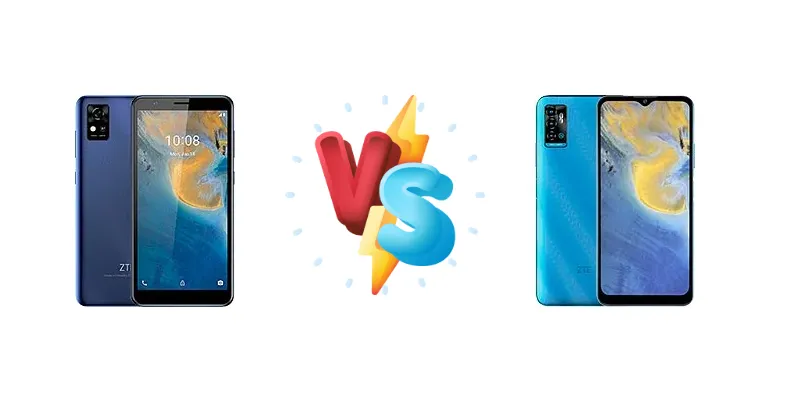
The ZTE Blade A31 and A71 present a curious case. Both devices are positioned as ultra-budget smartphones, and remarkably, they share *identical* core hardware. This comparison isn't about raw power, but rather about how ZTE differentiates these phones through software, market positioning, and potentially, subtle component sourcing. We'll dissect the similarities and attempt to uncover any meaningful distinctions for the budget-conscious consumer.
🏆 Quick Verdict
For the average user, the ZTE Blade A71 is the slightly better buy. While both phones utilize the same Unisoc SC9863A chipset, the A71's likely more recent release suggests potential for more optimized software and longer software support, making it a marginally more future-proof option within this extremely limited price bracket.
| Network |
|---|
| 2G bands | GSM 850 / 900 / 1800 / 1900 | GSM 850 / 900 / 1800 / 1900 |
| 3G bands | HSDPA 850 / 900 / 2100 | HSDPA 850 / 900 / 2100 |
| 4G bands | 1, 2, 3, 5, 7, 8, 20, 28, 38 | 1, 3, 5, 7, 8, 20, 28, 38, 40, 41 |
| Speed | HSPA, LTE | HSPA, LTE |
| Technology | GSM / HSPA / LTE | GSM / HSPA / LTE |
| Launch |
|---|
| Announced | 2021, July 13 | 2021, October 07 |
| Status | Available. Released 2021, July 13 | Available. Released 2021, October 07 |
| Body |
|---|
| Dimensions | 140 x 71 x 8.9 mm (5.51 x 2.80 x 0.35 in) | 165.2 x 75.2 x 8.2 mm (6.50 x 2.96 x 0.32 in) |
| SIM | Nano-SIM + Nano-SIM | Nano-SIM + Nano-SIM |
| Weight | 166 g (5.86 oz) | 180 g (6.35 oz) |
| Display |
|---|
| Resolution | 720 x 1440 pixels, 18:9 ratio (~295 ppi density) | 720 x 1600 pixels, 20:9 ratio (~269 ppi density) |
| Size | 5.45 inches, 76.7 cm2 (~77.1% screen-to-body ratio) | 6.52 inches, 102.6 cm2 (~82.6% screen-to-body ratio) |
| Type | IPS LCD | IPS LCD |
| Platform |
|---|
| CPU | Octa-core (4x1.6 GHz Cortex-A55 & 4x1.2 GHz Cortex-A55) | Octa-core (4x1.6 GHz Cortex-A55 & 4x1.2 GHz Cortex-A55) |
| Chipset | Unisoc SC9863A (28 nm) | Unisoc SC9863A (28 nm) |
| GPU | IMG8322 | IMG8322 |
| OS | Android 11 (Go edition) | Android 11 |
| Memory |
|---|
| Card slot | microSDXC | microSDXC |
| Internal | 32GB 2GB RAM | 64GB 3GB RAM |
| Main Camera |
|---|
| Features | LED flash, HDR | LED flash, HDR |
| Single | 8 MP | - |
| Triple | - | 16 MP, f/1.8, (wide), AF
8 MP, f/2.2, 120˚, (ultrawide)
Auxiliary lens |
| Video | 720p@30fps | 1080p@30fps |
| Selfie camera |
|---|
| Single | 2 MP (up-scaled to 5 MP) | 8 MP |
| Video | - | 1080p@30fps |
| Sound |
|---|
| 3.5mm jack | Yes | Yes |
| 35mm jack | Yes | Yes |
| Loudspeaker | Yes | Yes |
| Comms |
|---|
| Bluetooth | 4.2, A2DP, LE | 4.2, A2DP, LE |
| NFC | Yes (market/region dependent) | Yes |
| Positioning | GPS, GLONASS | GPS, GLONASS |
| Radio | FM radio | FM radio |
| USB | microUSB 2.0 | USB Type-C 2.0 |
| WLAN | Wi-Fi 802.11 b/g/n | Wi-Fi 802.11 b/g/n |
| Features |
|---|
| Sensors | Accelerometer | Fingerprint (side-mounted), accelerometer, proximity |
| Battery |
|---|
| Type | Li-Ion 3000 mAh, removable | Li-Ion 4000 mAh |
| Misc |
|---|
| Colors | Blue, Gray | Blue, Gray, Green |
| Models | - | A7030 |
| Price | - | About 90 EUR |
ZTE Blade A31
- Potentially lower price point due to being an older model.
- Functional for basic smartphone tasks.
- Decent battery life given the chipset.
- Likely older software version.
- Potentially shorter software support lifecycle.
- May be harder to find in retail.
ZTE Blade A71
- Likely more recent software version.
- Potentially longer software support.
- May be easier to find in retail.
- May be slightly more expensive than the A31.
- Performance is identical to the A31.
- Still limited by the Unisoc SC9863A chipset.
Display Comparison
Both the ZTE Blade A31 and A71 are expected to feature similar LCD panels, given their price point. Without specific display specs (resolution, brightness, color gamut), it's safe to assume both offer a basic viewing experience. The 28nm Unisoc SC9863A isn't a power-hungry chipset, so neither phone is likely to push the display to its limits. Expect standard 60Hz refresh rates on both, and color accuracy will likely be adequate for casual use but not ideal for content creation.
Camera Comparison
Camera performance is likely to be similar on both devices. Given the target market, expect a primary camera sensor paired with potentially a depth or macro sensor (often 2MP, and of limited utility). Image quality will be acceptable in good lighting conditions, but low-light performance will be poor. The Unisoc SC9863A's image signal processor (ISP) is basic, so don't expect advanced features like HDR or sophisticated image processing. The aperture of the main lens will be a critical factor, but without that information, it's difficult to assess the potential for low-light photography.
Performance
The heart of both devices is the Unisoc SC9863A chipset, featuring an octa-core CPU configuration with 4 cores clocked at 1.6 GHz (Cortex-A55) and 4 cores at 1.2 GHz (Cortex-A55). This is a very entry-level processor designed for basic tasks. Performance will be sufficient for apps like WhatsApp, Facebook, and light web browsing, but expect noticeable slowdowns with more demanding applications or multitasking. The 28nm manufacturing process isn't particularly efficient, but the low clock speeds mitigate thermal concerns; neither phone is likely to overheat under normal usage. RAM capacity, which is not specified, will be a key determinant of multitasking performance.
Battery Life
Battery capacity is not specified for either device. However, given the power efficiency of the Unisoc SC9863A and the basic displays, both phones should be able to achieve all-day battery life with moderate usage. Charging wattage is also unknown, but it's likely to be relatively slow (5W-10W) given the budget nature of these devices. Expect a 0-100% charge to take several hours.
Buying Guide
Buy the ZTE Blade A31 if you find it significantly discounted and need a functional, basic smartphone for essential tasks like calls, texts, and light web browsing. Buy the ZTE Blade A71 if you prioritize potentially longer software support and a slightly more modern user experience, even if the core performance remains the same. Both are suitable for first-time smartphone users or as a reliable backup device.
Frequently Asked Questions
❓ Will the Unisoc SC9863A chipset struggle with popular apps like TikTok or Instagram?
The Unisoc SC9863A is an entry-level chipset. While it can run apps like TikTok and Instagram, you may experience occasional lag, especially when scrolling through feeds or recording videos. It's best to avoid running multiple apps simultaneously to minimize performance issues.
❓ How long will software updates be available for the ZTE Blade A71?
ZTE's software update policy for the Blade series is typically limited. While the A71 is a newer release than the A31, expect only one major Android version update, if any, and limited security patches. Don't expect the same level of long-term support as flagship devices.
❓ Is the camera on either of these phones good enough for casual social media photos?
For casual social media photos in good lighting conditions, the cameras on both phones will be adequate. However, don't expect high-quality images with a lot of detail. Low-light performance will be poor, and the image processing is basic.