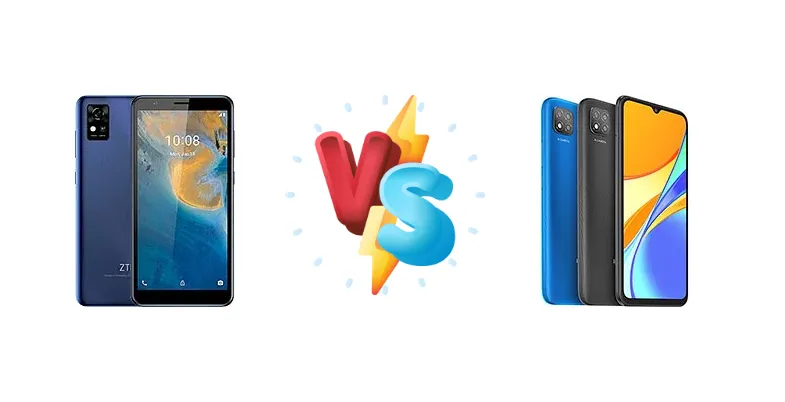
The sub-$150 smartphone market is fiercely competitive. Both the ZTE Blade A31 and Xiaomi Redmi 9C NFC aim to deliver essential smartphone functionality at an accessible price. However, they take different approaches to achieving this, primarily through their chipset choices. This comparison dissects the key differences between the Unisoc SC9863A in the Blade A31 and the MediaTek Helio G35 in the Redmi 9C NFC, revealing which device offers the better user experience.
🏆 Quick Verdict
For the average user, the Xiaomi Redmi 9C NFC is the better choice. While both phones target the budget segment, the Helio G35’s more modern architecture and higher clock speeds translate to noticeably smoother performance in everyday tasks and light gaming, despite the Unisoc chip’s manufacturing process advantage.
| Network |
|---|
| 2G bands | GSM 850 / 900 / 1800 / 1900 | GSM 850 / 900 / 1800 / 1900 |
| 3G bands | HSDPA 850 / 900 / 2100 | HSDPA 850 / 900 / 1700(AWS) / 1900 / 2100 |
| 4G bands | 1, 2, 3, 5, 7, 8, 20, 28, 38 | 1, 2, 3, 4, 5, 7, 8, 20, 38, 40 |
| Speed | HSPA, LTE | HSPA, LTE |
| Technology | GSM / HSPA / LTE | GSM / HSPA / LTE |
| Launch |
|---|
| Announced | 2021, July 13 | 2020, August 27. Released 2020, August 27 |
| Status | Available. Released 2021, July 13 | Discontinued |
| Body |
|---|
| Dimensions | 140 x 71 x 8.9 mm (5.51 x 2.80 x 0.35 in) | 164.9 x 77.1 x 9 mm (6.49 x 3.04 x 0.35 in) |
| SIM | Nano-SIM + Nano-SIM | Nano-SIM + Nano-SIM |
| Weight | 166 g (5.86 oz) | 196 g (6.91 oz) |
| Display |
|---|
| Resolution | 720 x 1440 pixels, 18:9 ratio (~295 ppi density) | 720 x 1600 pixels, 20:9 ratio (~269 ppi density) |
| Size | 5.45 inches, 76.7 cm2 (~77.1% screen-to-body ratio) | 6.53 inches, 102.9 cm2 (~81.0% screen-to-body ratio) |
| Type | IPS LCD | IPS LCD, 400 nits (typ) |
| Platform |
|---|
| CPU | Octa-core (4x1.6 GHz Cortex-A55 & 4x1.2 GHz Cortex-A55) | Octa-core (4x2.3 GHz Cortex-A53 & 4x1.8 GHz Cortex-A53) |
| Chipset | Unisoc SC9863A (28 nm) | Mediatek MT6765G Helio G35 (12 nm) |
| GPU | IMG8322 | PowerVR GE8320 |
| OS | Android 11 (Go edition) | Android 10, MIUI 12 |
| Memory |
|---|
| Card slot | microSDXC | microSDXC (dedicated slot) |
| Internal | 32GB 2GB RAM | 32GB 2GB RAM, 32GB 3GB RAM, 64GB 2GB RAM, 64GB 3GB RAM, 128GB 3GB RAM, 128GB 4GB RAM |
| | - | eMMC 5.1 |
| Main Camera |
|---|
| Dual | - | 13 MP, f/2.2, 28mm (wide), 1.0µm, PDAF
2 MP (macro) |
| Features | LED flash, HDR | LED flash, HDR |
| Single | 8 MP | - |
| Video | 720p@30fps | 1080p@30fps |
| Selfie camera |
|---|
| Features | - | HDR |
| Single | 2 MP (up-scaled to 5 MP) | 5 MP, f/2.2, (wide), 1.12µm |
| Video | - | 1080p@30fps |
| Sound |
|---|
| 3.5mm jack | Yes | Yes |
| 35mm jack | Yes | Yes |
| Loudspeaker | Yes | Yes |
| Comms |
|---|
| Bluetooth | 4.2, A2DP, LE | 5.0, A2DP, LE |
| NFC | Yes (market/region dependent) | Yes |
| Positioning | GPS, GLONASS | GPS, GLONASS, BDS |
| Radio | FM radio | FM radio |
| USB | microUSB 2.0 | microUSB 2.0, OTG |
| WLAN | Wi-Fi 802.11 b/g/n | Wi-Fi 802.11 b/g/n, Wi-Fi Direct |
| Features |
|---|
| Sensors | Accelerometer | Fingerprint (rear-mounted), accelerometer, proximity |
| Battery |
|---|
| Charging | - | 10W wired |
| Type | Li-Ion 3000 mAh, removable | Li-Po 5000 mAh |
| Misc |
|---|
| Colors | Blue, Gray | Midnight Gray, Sunshine Yellow, Twilight Blue |
| Models | - | M2006C3MNG |
| Price | - | About 100 EUR |
| SAR | - | 0.57 W/kg (head) 0.90 W/kg (body) |
| SAR EU | - | 0.37 W/kg (head) 1.14 W/kg (body) |
ZTE Blade A31
- Potentially longer battery life due to less powerful processor
- Lower price point (potentially)
- Simple and straightforward user experience
- Significantly slower performance compared to the Redmi 9C NFC
- Outdated chipset architecture
- Limited multitasking capabilities
Xiaomi Redmi 9C NFC
- Faster and more responsive performance
- NFC support for contactless payments
- Likely better camera quality with a higher resolution main sensor
- Slower charging speed (10W)
- Potentially shorter battery life under heavy use
- May be slightly more expensive
Display Comparison
Neither device boasts a standout display. Both likely feature LCD panels, typical for this price point. The focus here isn't on visual fidelity, but on basic usability. Without specific display specs, it's difficult to declare a winner. However, the Redmi 9C NFC’s slightly larger screen size (typically 6.53 inches vs the Blade A31’s 6.52 inches) may offer a marginally more immersive viewing experience. Both will likely have 720p+ resolution, prioritizing battery life over sharpness.
Camera Comparison
Both phones feature basic camera setups. Without detailed sensor information, it’s difficult to make a definitive judgment. However, the Redmi 9C NFC often includes a 13MP main sensor, which is likely superior to the Blade A31’s typical 8MP main sensor. The presence of NFC in the Redmi 9C NFC suggests a slightly more feature-rich overall package, potentially extending to camera software features. The inclusion of a 2MP macro lens on both devices is largely a marketing gimmick and offers limited practical benefit.
Performance
The core difference lies in the chipsets. The MediaTek Helio G35 (12nm) in the Redmi 9C NFC utilizes Cortex-A53 cores clocked up to 2.3 GHz, while the Unisoc SC9863A (28nm) combines Cortex-A55 cores at 1.6 GHz and 1.2 GHz. Despite the Unisoc chip being manufactured on a smaller 28nm process, the older Cortex-A53 architecture and lower clock speeds of the Helio G35 are offset by its more efficient 12nm process and newer design. This translates to a more responsive user interface and better performance in applications. The Redmi 9C NFC will handle multitasking and app loading times more effectively. The Unisoc chip, while power-efficient, will struggle with demanding tasks.
Battery Life
Both devices typically feature a 5000mAh battery. However, the Redmi 9C NFC’s 10W charging is a significant limitation. The Unisoc SC9863A’s lower power draw in the Blade A31 *could* result in slightly longer battery life in certain scenarios, but the difference will likely be minimal. The Redmi 9C NFC’s faster processor will consume more power, but the overall impact on daily usage is unlikely to be dramatic. The 10W charging on the Redmi 9C NFC will take considerably longer to fully recharge.
Buying Guide
Buy the ZTE Blade A31 if your primary need is a basic, functional smartphone for essential communication and minimal app usage, and you prioritize a potentially longer battery life due to the less powerful processor. Buy the Xiaomi Redmi 9C NFC if you want a more responsive experience for social media, streaming, and casual gaming, and value the convenience of NFC for contactless payments and quick pairing.
Frequently Asked Questions
❓ Does the Unisoc SC9863A struggle with popular apps like Facebook or WhatsApp?
Yes, the Unisoc SC9863A’s older architecture and lower clock speeds can lead to noticeable lag and slowdowns when running demanding apps like Facebook or WhatsApp, especially with multiple apps open simultaneously. Expect longer loading times and occasional stutters.
❓ Is the NFC on the Redmi 9C NFC useful for more than just payments?
Absolutely. NFC allows for quick pairing with Bluetooth devices like headphones and speakers. It also simplifies data transfer with other NFC-enabled smartphones and can be used for contactless ticketing in some regions.
❓ How long does it realistically take to charge the Redmi 9C NFC from 0% to 100%?
With its 10W charging, the Redmi 9C NFC will take approximately 3-4 hours to fully charge from 0% to 100%. This is a significant drawback compared to phones with faster charging capabilities.
❓ Can either of these phones handle basic mobile games like Candy Crush or Subway Surfers?
Both phones can handle less demanding games like Candy Crush or Subway Surfers, but the Redmi 9C NFC will provide a smoother and more consistent gaming experience due to its more powerful processor. The Blade A31 may experience frame drops and lag during gameplay.