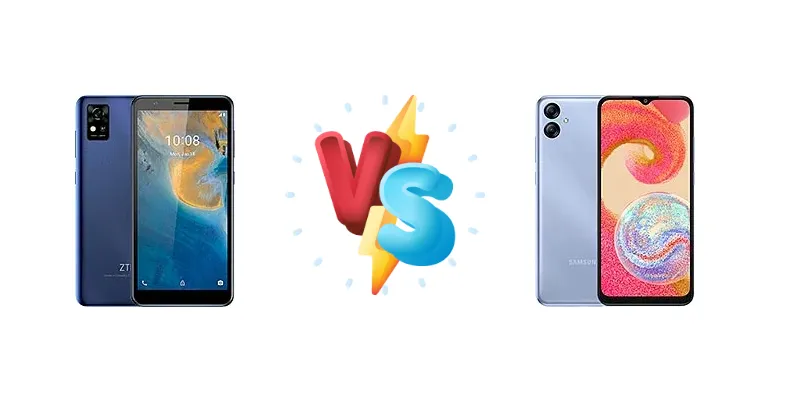
The ZTE Blade A31 and Samsung Galaxy A04e represent the extreme end of the smartphone price spectrum. Both aim to deliver essential smartphone functionality at a minimal cost, but they achieve this through very different approaches to chipset design. This comparison dissects those differences, focusing on real-world performance implications for the average user.
🏆 Quick Verdict
For most users, the Samsung Galaxy A04e is the better choice. While the ZTE Blade A31 benefits from a more modern manufacturing process, the A04e’s faster CPU cores provide a noticeable performance advantage in everyday tasks and light gaming, outweighing the A31’s efficiency gains.
| Network |
|---|
| 2G bands | GSM 850 / 900 / 1800 / 1900 | GSM 850 / 900 / 1800 / 1900 |
| 3G bands | HSDPA 850 / 900 / 2100 | HSDPA 850 / 900 / 2100 |
| 4G bands | 1, 2, 3, 5, 7, 8, 20, 28, 38 | 1, 3, 5, 7, 8, 20, 28, 38, 40, 41 |
| Speed | HSPA, LTE | HSPA, LTE |
| Technology | GSM / HSPA / LTE | GSM / HSPA / LTE |
| Launch |
|---|
| Announced | 2021, July 13 | 2022, October 21 |
| Status | Available. Released 2021, July 13 | Available. Released 2022, November 07 |
| Body |
|---|
| Build | - | Glass front, plastic back, plastic frame |
| Dimensions | 140 x 71 x 8.9 mm (5.51 x 2.80 x 0.35 in) | 164.2 x 75.9 x 9.1 mm (6.46 x 2.99 x 0.36 in) |
| SIM | Nano-SIM + Nano-SIM | · Nano-SIM· Nano-SIM + Nano-SIM |
| Weight | 166 g (5.86 oz) | 188 g (6.63 oz) |
| Display |
|---|
| Resolution | 720 x 1440 pixels, 18:9 ratio (~295 ppi density) | 720 x 1600 pixels, 20:9 ratio (~270 ppi density) |
| Size | 5.45 inches, 76.7 cm2 (~77.1% screen-to-body ratio) | 6.5 inches, 102.0 cm2 (~81.8% screen-to-body ratio) |
| Type | IPS LCD | PLS LCD |
| Platform |
|---|
| CPU | Octa-core (4x1.6 GHz Cortex-A55 & 4x1.2 GHz Cortex-A55) | Octa-core (4x2.3 GHz Cortex-A53 & 4x1.8 GHz Cortex-A53) |
| Chipset | Unisoc SC9863A (28 nm) | Mediatek MT6765 Helio P35 (12 nm) |
| GPU | IMG8322 | PowerVR GE8320 |
| OS | Android 11 (Go edition) | Android 12, One UI Core 4.1 |
| Memory |
|---|
| Card slot | microSDXC | microSDXC (dedicated slot) |
| Internal | 32GB 2GB RAM | 32GB 2GB RAM, 32GB 3GB RAM, 32GB 4GB RAM, 64GB 2GB RAM, 64GB 3GB RAM, 64GB 4GB RAM, 128GB 4GB RAM |
| Main Camera |
|---|
| Dual | - | 13 MP, f/2.2, (wide), AF
Auxiliary lens |
| Features | LED flash, HDR | LED flash |
| Single | 8 MP | 5 MP, f/2.2 |
| Video | 720p@30fps | 1080p@30fps |
| Selfie camera |
|---|
| Single | 2 MP (up-scaled to 5 MP) | 5 MP, f/2.2 |
| Video | - | Yes |
| Sound |
|---|
| 3.5mm jack | Yes | Yes |
| 35mm jack | Yes | Yes |
| Loudspeaker | Yes | Yes |
| Comms |
|---|
| Bluetooth | 4.2, A2DP, LE | 5.0, A2DP, LE |
| NFC | Yes (market/region dependent) | No |
| Positioning | GPS, GLONASS | GPS, GLONASS, GALILEO, BDS |
| Radio | FM radio | Unspecified |
| USB | microUSB 2.0 | USB Type-C 2.0, OTG |
| WLAN | Wi-Fi 802.11 b/g/n | Wi-Fi 802.11 b/g/n, Wi-Fi Direct |
| Features |
|---|
| Sensors | Accelerometer | Accelerometer, proximity |
| Battery |
|---|
| Type | Li-Ion 3000 mAh, removable | Li-Po 5000 mAh |
| Misc |
|---|
| Colors | Blue, Gray | Black, Copper, Light Blue |
| Models | - | SM-A042F, SM-A042F/DS, SM-A042M, SM-A042M/DS |
| Price | - | ₹ 7,999 |
| SAR EU | - | 0.29 W/kg (head) 1.11 W/kg (body) |
ZTE Blade A31
- Potentially longer battery life due to efficient chipset.
- Lower manufacturing cost, potentially translating to a lower price.
- Unisoc’s architecture is newer, offering future optimization potential.
- Slower CPU performance compared to the A04e.
- Older 28nm manufacturing process.
- Likely less refined image processing.
Samsung Galaxy A04e
- Faster CPU cores for smoother performance.
- 12nm manufacturing process offers better performance per watt.
- MediaTek ISP may provide slightly better image quality.
- Potentially shorter battery life under heavy use.
- Cortex-A53 cores are an older architecture.
- May run warmer under sustained load.
Display Comparison
Neither device is expected to boast a high-end display. Details are limited, but both likely feature 720p+ LCD panels. The focus here isn't on visual fidelity, but on power consumption. The A31's more efficient chipset *could* translate to slightly longer screen-on time, but this is highly dependent on software optimization. Bezels are likely to be substantial on both devices, reflecting their budget positioning.
Camera Comparison
Both phones are expected to feature basic camera setups. Given the price point, image quality will be heavily reliant on software processing. Details are scarce, but it's safe to assume both will include a primary camera and potentially a depth sensor. The A04e may have a slight edge due to MediaTek’s image signal processor (ISP) being generally more refined than Unisoc’s, but the difference will be minimal. Don't expect exceptional low-light performance from either device.
Performance
The core difference lies in the chipsets. The Samsung Galaxy A04e’s MediaTek Helio P35 (12nm) features four Cortex-A53 cores clocked at 2.3 GHz, paired with four slower cores at 1.8 GHz. This contrasts with the ZTE Blade A31’s Unisoc SC9863A (28nm) which uses four Cortex-A55 cores at 1.6 GHz and four at 1.2 GHz. While the A31’s A55 cores are architecturally more efficient than the A53, the A04e’s higher clock speeds provide a significant performance boost. The 12nm process of the Helio P35 also contributes to better performance per watt compared to the older 28nm process of the Unisoc chip. This means the A04e will likely handle multitasking and app launches more smoothly, though it may run slightly warmer under sustained load.
Battery Life
Battery capacity is not specified, but both phones likely house batteries in the 3000-4000 mAh range. The ZTE Blade A31’s more efficient Unisoc SC9863A chipset *should* result in longer battery life, especially during standby and light usage. However, the Samsung Galaxy A04e’s faster processor will consume more power during active use. Charging wattage is also likely to be low on both devices, meaning full charges will take several hours.
Buying Guide
Buy the ZTE Blade A31 if you prioritize long battery life and are primarily using the phone for very basic tasks like calls, texts, and light social media. Its Unisoc chipset is designed for efficiency. Buy the Samsung Galaxy A04e if you need a phone that feels more responsive for app switching, web browsing, and occasional gaming, even if it means slightly shorter battery life. The A04e’s faster CPU provides a smoother user experience.
Frequently Asked Questions
❓ Will the Helio P35 in the Galaxy A04e overheat during gaming?
The Helio P35 is not a gaming powerhouse, and prolonged gaming sessions will likely cause some thermal throttling. However, it's unlikely to overheat to the point of causing instability. Expect playable frame rates in less demanding titles, but don't expect a smooth experience in graphically intensive games.
❓ Is the Unisoc SC9863A a reliable chipset for long-term use?
Unisoc chipsets have improved in recent years, but they generally don't have the same level of software support and optimization as MediaTek or Qualcomm. While the SC9863A should be adequate for basic tasks, you may experience slower updates and potentially more bugs over time.
❓ How much storage and RAM do these phones typically offer?
Both phones are likely to come in configurations with 2GB or 3GB of RAM and 32GB or 64GB of storage. Given the limited processing power, 3GB of RAM is recommended for a smoother experience, and a microSD card slot is essential for expanding storage.
❓ Which phone is better for running apps like WhatsApp and Facebook?
The Samsung Galaxy A04e will handle apps like WhatsApp and Facebook more smoothly due to its faster CPU. The A31 may experience slight lag when switching between these apps or loading content.