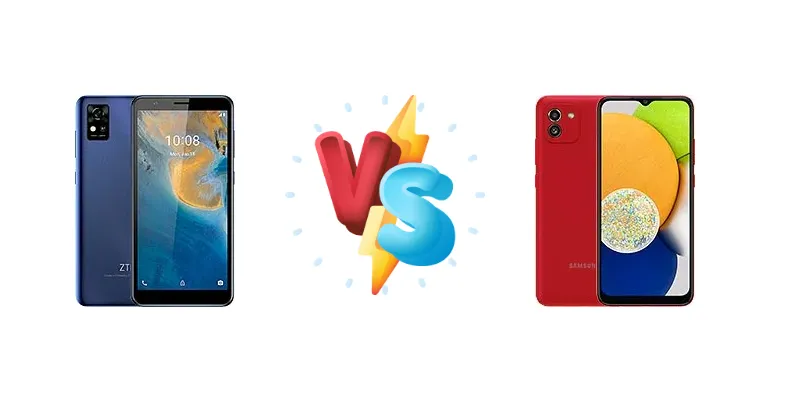
The ZTE Blade A31 and Samsung Galaxy A03 represent the extreme end of the smartphone price spectrum. Both aim to deliver essential smartphone functionality at an incredibly affordable price point, but they achieve this with different approaches to hardware. This comparison dissects their core components to determine which device offers the best experience for the budget-conscious consumer.
🏆 Quick Verdict
For most users, the Samsung Galaxy A03 emerges as the better choice. Its newer Unisoc T606 chipset, built on a more efficient 12nm process, provides a noticeable performance advantage over the ZTE Blade A31’s older 28nm SC9863A, translating to smoother multitasking and app loading. While both phones are limited, the A03 offers a slightly more future-proof experience.
| Network |
|---|
| 2G bands | GSM 850 / 900 / 1800 / 1900 | GSM 850 / 900 / 1800 / 1900 |
| 3G bands | HSDPA 850 / 900 / 2100 | HSDPA 850 / 900 / 2100 |
| 4G bands | 1, 2, 3, 5, 7, 8, 20, 28, 38 | 1, 3, 5, 7, 8, 20, 28, 38, 40, 41 |
| Speed | HSPA, LTE | HSPA 42.2/5.76 Mbps, LTE Cat4 150/50 Mbps |
| Technology | GSM / HSPA / LTE | GSM / HSPA / LTE |
| Launch |
|---|
| Announced | 2021, July 13 | 2021, November 26 |
| Status | Available. Released 2021, July 13 | Available. Released 2022, January 21 |
| Body |
|---|
| Build | - | Glass front, plastic back, plastic frame |
| Dimensions | 140 x 71 x 8.9 mm (5.51 x 2.80 x 0.35 in) | 164.2 x 75.9 x 9.1 mm (6.46 x 2.99 x 0.36 in) |
| SIM | Nano-SIM + Nano-SIM | · Nano-SIM· Nano-SIM + Nano-SIM |
| Weight | 166 g (5.86 oz) | 196 g (6.91 oz) |
| Display |
|---|
| Resolution | 720 x 1440 pixels, 18:9 ratio (~295 ppi density) | 720 x 1600 pixels, 20:9 ratio (~270 ppi density) |
| Size | 5.45 inches, 76.7 cm2 (~77.1% screen-to-body ratio) | 6.5 inches, 102.0 cm2 (~81.8% screen-to-body ratio) |
| Type | IPS LCD | PLS LCD |
| Platform |
|---|
| CPU | Octa-core (4x1.6 GHz Cortex-A55 & 4x1.2 GHz Cortex-A55) | Octa-core (2x1.6 GHz Cortex-A75 & 6x1.6 GHz Cortex-A55) |
| Chipset | Unisoc SC9863A (28 nm) | Unisoc T606 (12 nm) |
| GPU | IMG8322 | Mali-G57 MP1 |
| OS | Android 11 (Go edition) | Android 11, upgradable to Android 13, One UI core 5 |
| Memory |
|---|
| Card slot | microSDXC | microSDXC (dedicated slot) |
| Internal | 32GB 2GB RAM | 32GB 2GB RAM, 32GB 3GB RAM, 32GB 4GB RAM, 64GB 4GB RAM, 64GB 3GB RAM, 128GB 4GB RAM |
| | - | eMMC 5.1 |
| Main Camera |
|---|
| Dual | - | 48 MP, f/1.8, (wide), AF
Auxiliary lens |
| Features | LED flash, HDR | LED flash |
| Single | 8 MP | 5 MP, f/2.2 |
| Video | 720p@30fps | 1080p@30fps |
| Selfie camera |
|---|
| Single | 2 MP (up-scaled to 5 MP) | 5 MP, f/2.2 |
| Video | - | Yes |
| Sound |
|---|
| 3.5mm jack | Yes | Yes |
| 35mm jack | Yes | Yes |
| Loudspeaker | Yes | Yes |
| Comms |
|---|
| Bluetooth | 4.2, A2DP, LE | 5.0, A2DP, LE |
| NFC | Yes (market/region dependent) | No |
| Positioning | GPS, GLONASS | GPS |
| Radio | FM radio | Unspecified |
| USB | microUSB 2.0 | microUSB 2.0 |
| WLAN | Wi-Fi 802.11 b/g/n | Wi-Fi 802.11 a/b/g/n/ac, dual-band, Wi-Fi Direct |
| Features |
|---|
| Sensors | Accelerometer | Accelerometer, proximity |
| Battery |
|---|
| Type | Li-Ion 3000 mAh, removable | Li-Po 5000 mAh |
| Misc |
|---|
| Colors | Blue, Gray | Black, Blue, Red |
| Models | - | SM-A035F, SM-A035F/DS, SM-A035M, SM-A035G |
| Price | - | € 119.90 / £ 88.00 / ₹ 11,990 |
| SAR EU | - | 0.20 W/kg (head) 1.35 W/kg (body) |
ZTE Blade A31
- Lowest possible price point
- Functional for basic tasks
- Acceptable battery life for light use
- Outdated and slow chipset
- Poor multitasking performance
- Limited camera capabilities
Samsung Galaxy A03
- More powerful and efficient chipset
- Smoother user experience
- Slightly better multitasking capabilities
- Still limited by budget constraints
- Camera performance remains basic
- Slow charging speeds
Display Comparison
Neither device boasts a standout display. Both likely feature LCD panels, typical for this price bracket. However, the lack of detailed display specifications necessitates focusing on the chipset’s ability to drive the UI smoothly. The A03’s more powerful GPU, stemming from the T606, will likely result in slightly smoother scrolling and animations, even if the resolution and panel quality are similar. Bezels are expected to be substantial on both devices, maximizing screen real estate within their budget constraints.
Camera Comparison
Camera performance on both devices will be limited. Both are likely to feature a primary camera alongside basic depth or macro sensors. Given the lack of detailed sensor information, it’s safe to assume both utilize low-resolution sensors. The A03’s slightly more capable chipset may offer marginally better image processing, but don’t expect flagship-level results. The 2MP macro sensors found on both devices are largely marketing gimmicks and offer limited practical value. Focusing on the primary sensor’s megapixel count (if available) and aperture would be more indicative of real-world image quality.
Performance
The core difference lies in the chipsets. The Samsung Galaxy A03’s Unisoc T606 (12nm) is a clear upgrade over the ZTE Blade A31’s Unisoc SC9863A (28nm). The 12nm process node allows for greater transistor density and improved power efficiency. Crucially, the T606 features two Cortex-A75 cores clocked at 1.6GHz alongside six A55 cores, while the A31 relies solely on four A55 cores at 1.6GHz and four at 1.2GHz. This architectural difference means the A03 will exhibit significantly better performance in single-threaded tasks and a more responsive overall experience. The A31’s older chipset will struggle with multitasking and demanding applications.
Battery Life
Battery life will depend heavily on usage patterns. While specific mAh capacities aren’t provided, both phones likely feature batteries in the 4000-5000mAh range. The A03’s more efficient 12nm chipset will contribute to longer battery life under similar usage conditions. Charging speeds are also likely to be slow on both devices, with neither supporting fast charging technologies. Expect several hours for a full charge from 0-100%.
Buying Guide
Buy the ZTE Blade A31 if you prioritize absolute lowest cost and are primarily focused on basic communication tasks like calls, texts, and light web browsing. It’s a functional device for those with minimal smartphone needs. Buy the Samsung Galaxy A03 if you value a slightly more responsive user experience, occasional social media use, and a chipset that’s less likely to struggle with even moderately demanding apps. The A03 offers a small but meaningful upgrade in performance for a minimal price increase.
Frequently Asked Questions
❓ Will the Samsung Galaxy A03 handle popular apps like WhatsApp and Facebook smoothly?
Yes, the Unisoc T606 chipset in the A03 is sufficiently capable of running apps like WhatsApp and Facebook without significant lag. While it won’t offer a high-end experience, it will provide a usable and responsive experience for these common social media applications. The ZTE Blade A31 may struggle with these apps, especially with multiple apps open simultaneously.
❓ Is the ZTE Blade A31 a good choice for a first smartphone for a senior citizen?
The ZTE Blade A31 could be suitable for a senior citizen with very basic needs – primarily making calls and sending texts. Its simplicity and low cost are appealing. However, the slow performance might be frustrating if they attempt to use more demanding apps. The larger screen of the A03 might be preferable for readability.
❓ Can either of these phones play PUBG Mobile?
While technically possible to *launch* PUBG Mobile on both devices, the experience will be severely limited. The ZTE Blade A31 will likely be unplayable due to its weak chipset. The Samsung Galaxy A03 might allow for gameplay at the lowest settings and frame rates, but expect significant lag and stuttering. Neither phone is designed for gaming.