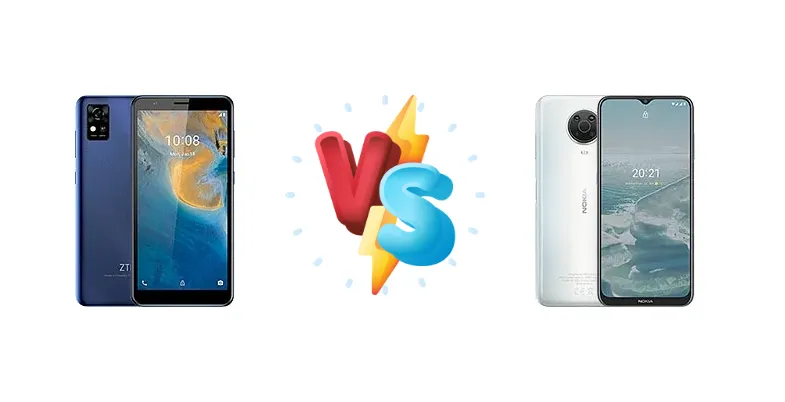
The ZTE Blade A31 and Nokia G20 represent the extreme end of the smartphone price spectrum, typically found under $150. Both aim to provide essential smartphone functionality without breaking the bank, but they take different approaches to achieving this. The A31 relies on a Unisoc chipset, while the G20 opts for MediaTek's Helio G35. This comparison will dissect their strengths and weaknesses to determine which offers the best value for budget-conscious consumers.
🏆 Quick Verdict
For most users, the Nokia G20 emerges as the slightly better choice. While the ZTE Blade A31 is a functional device, the Nokia G20’s more modern 12nm Helio G35 chipset provides a noticeable performance uplift, making it more responsive for everyday tasks. The inclusion of 10W charging, though slow, is a benefit the A31 lacks.
| Network |
|---|
| 2G bands | GSM 850 / 900 / 1800 / 1900 | GSM 850 / 900 / 1800 / 1900 |
| 3G bands | HSDPA 850 / 900 / 2100 | HSDPA 850 / 900 / 1900 / 2100 - International |
| 4G bands | 1, 2, 3, 5, 7, 8, 20, 28, 38 | 1, 3, 5, 7, 8, 20, 28, 38, 40, 41 - International |
| Speed | HSPA, LTE | HSPA 42.2/5.76 Mbps, LTE Cat4 150/50 Mbps |
| Technology | GSM / HSPA / LTE | GSM / HSPA / LTE |
| | - | 1, 2, 3, 4, 5, 7, 8, 12, 17, 28, 66 - LATAM |
| Launch |
|---|
| Announced | 2021, July 13 | 2021, April 08 |
| Status | Available. Released 2021, July 13 | Available. Released 2021, May 17 |
| Body |
|---|
| Dimensions | 140 x 71 x 8.9 mm (5.51 x 2.80 x 0.35 in) | 164.9 x 76 x 9.2 mm (6.49 x 2.99 x 0.36 in) |
| SIM | Nano-SIM + Nano-SIM | · Nano-SIM· Nano-SIM + Nano-SIM |
| Weight | 166 g (5.86 oz) | 197 g (6.95 oz) |
| | - | Splash protection |
| Display |
|---|
| Resolution | 720 x 1440 pixels, 18:9 ratio (~295 ppi density) | 720 x 1600 pixels, 20:9 ratio (~269 ppi density) |
| Size | 5.45 inches, 76.7 cm2 (~77.1% screen-to-body ratio) | 6.52 inches, 102.6 cm2 (~81.9% screen-to-body ratio) |
| Type | IPS LCD | IPS LCD |
| Platform |
|---|
| CPU | Octa-core (4x1.6 GHz Cortex-A55 & 4x1.2 GHz Cortex-A55) | Octa-core (4x2.3 GHz Cortex-A53 & 4x1.8 GHz Cortex-A53) |
| Chipset | Unisoc SC9863A (28 nm) | Mediatek MT6765G Helio G35 (12 nm) |
| GPU | IMG8322 | PowerVR GE8320 |
| OS | Android 11 (Go edition) | Android 11, upgradable to Android 13 |
| Memory |
|---|
| Card slot | microSDXC | microSDXC (dedicated slot) |
| Internal | 32GB 2GB RAM | 64GB 4GB RAM, 128GB 4GB RAM |
| Main Camera |
|---|
| Features | LED flash, HDR | LED flash, HDR, panorama |
| Quad | - | 48 MP, f/1.8, (wide), PDAF
5 MP, (ultrawide)
2 MP (macro)
Auxiliary lens |
| Single | 8 MP | 8 MP, (wide) |
| Video | 720p@30fps | 1080p@30fps |
| Selfie camera |
|---|
| Single | 2 MP (up-scaled to 5 MP) | 8 MP, (wide) |
| Video | - | 1080p@30fps |
| Sound |
|---|
| 3.5mm jack | Yes | Yes |
| 35mm jack | Yes | Yes |
| Loudspeaker | Yes | Yes |
| Comms |
|---|
| Bluetooth | 4.2, A2DP, LE | 5.0, A2DP, LE |
| NFC | Yes (market/region dependent) | Yes (market/region dependent) |
| Positioning | GPS, GLONASS | GPS, GLONASS, BDS |
| Radio | FM radio | FM radio |
| USB | microUSB 2.0 | USB Type-C 2.0, OTG |
| WLAN | Wi-Fi 802.11 b/g/n | Wi-Fi 802.11 b/g/n |
| Features |
|---|
| Sensors | Accelerometer | Fingerprint (side-mounted), accelerometer, gyro, proximity |
| Battery |
|---|
| Charging | - | 10W wired |
| Type | Li-Ion 3000 mAh, removable | Li-Po 5050 mAh |
| Misc |
|---|
| Colors | Blue, Gray | Glacier, Night |
| Models | - | TA-1336, TA-1343, TA-1347, TA-1372, TA-1365 |
| Price | - | About 90 EUR |
| SAR | - | 1.01 W/kg (head) 1.02 W/kg (body) |
| SAR EU | - | 0.49 W/kg (head) 1.13 W/kg (body) |
ZTE Blade A31
- Extremely affordable price point
- Functional for basic tasks
- Potentially smaller form factor (speculation based on market positioning)
- Outdated Unisoc SC9863A chipset
- Likely poor performance
- No mention of charging support
- Low-resolution display (assumed)
Nokia G20
- More powerful MediaTek Helio G35 chipset
- 10W wired charging
- Larger display size
- Better overall performance for everyday tasks
- Low-resolution display
- Basic camera system
- Still limited performance compared to mid-range phones
Display Comparison
Neither device boasts a standout display. Specifications are unavailable for the ZTE Blade A31’s panel, but given its price point, it’s likely a basic IPS LCD. The Nokia G20 features a large 6.5-inch IPS LCD, but its resolution is only 720 x 1600. Both will likely suffer from limited viewing angles and color accuracy. The lack of any mention of features like high PWM dimming rates on either device suggests they may not be ideal for users sensitive to screen flicker. The larger screen size of the G20 may be preferable for media consumption, despite the lower pixel density.
Camera Comparison
Camera performance on both devices is expected to be basic. Details are scarce, but both likely feature a primary camera alongside depth or macro sensors. The Nokia G20’s camera setup is likely to be slightly more capable due to the more powerful ISP within the Helio G35 chipset, allowing for better image processing. The ZTE Blade A31’s Unisoc chipset will likely struggle with dynamic range and noise reduction. The presence of a 10W charger on the Nokia G20 suggests a slightly more complete user experience, as the A31 lacks any mention of charging capabilities.
Performance
This is where the Nokia G20 gains a significant advantage. The MediaTek Helio G35, built on a 12nm process, is demonstrably more efficient and powerful than the Unisoc SC9863A (28nm) found in the ZTE Blade A31. The G35’s Cortex-A53 cores, clocked up to 2.3 GHz, outperform the A31’s Cortex-A55 cores (1.6 GHz and 1.2 GHz). While both are octa-core CPUs, the architectural improvements and higher clock speeds of the G35 translate to snappier app launches and smoother multitasking. The A31’s older 28nm process will also likely result in higher power consumption for similar tasks. RAM configurations are not specified, but the G35’s superior processing power will be more effectively utilized with adequate memory.
Battery Life
Both devices likely feature batteries in the 4000-5000 mAh range, typical for this price segment. However, the Nokia G20’s more efficient Helio G35 chipset will translate to longer battery life in real-world usage. The inclusion of 10W wired charging on the G20 is a significant advantage over the ZTE Blade A31, which appears to lack any charging support beyond potentially micro-USB. While 10W is slow, it’s better than relying on infrequent charging or external power banks.
Buying Guide
Buy the ZTE Blade A31 if your primary need is a basic, extremely affordable smartphone for minimal usage – think calls, texts, and light browsing. It’s a good option for a first phone for a child or as a temporary backup device. Buy the Nokia G20 if you prioritize a smoother user experience, even with basic apps, and appreciate the convenience of even slow wired charging. It’s better suited for users who rely on their phone for more than just essential communication.
Frequently Asked Questions
❓ Is the MediaTek Helio G35 in the Nokia G20 capable of playing modern mobile games?
While the Helio G35 can handle some mobile games, it's best suited for less demanding titles. Expect to play games like PUBG Mobile or Call of Duty Mobile on low settings with reduced frame rates. It's not a gaming-focused chipset, but it's significantly better than the Unisoc SC9863A in the ZTE Blade A31 for gaming.
❓ Does the Nokia G20 support fast charging, and how long does it take to fully charge?
The Nokia G20 supports 10W wired charging, which is relatively slow. A full charge from 0% to 100% will likely take around 3-4 hours. While not fast, it's a functional charging solution that the ZTE Blade A31 appears to lack entirely.
❓ What kind of storage options are available on the ZTE Blade A31 and Nokia G20, and can it be expanded?
Storage configurations are not explicitly stated in the provided data. However, given the price point, both devices likely start with 32GB of internal storage. Both devices *likely* support microSD card expansion, allowing users to increase storage capacity, but this needs to be verified with official specifications.
❓ Which phone is better for running Android Go Edition?
Both phones could technically run Android Go Edition, but the Nokia G20’s more powerful Helio G35 would provide a smoother experience. Android Go is designed for low-end hardware, and the G35 has more headroom to handle the operating system and apps efficiently.